USAID DEC
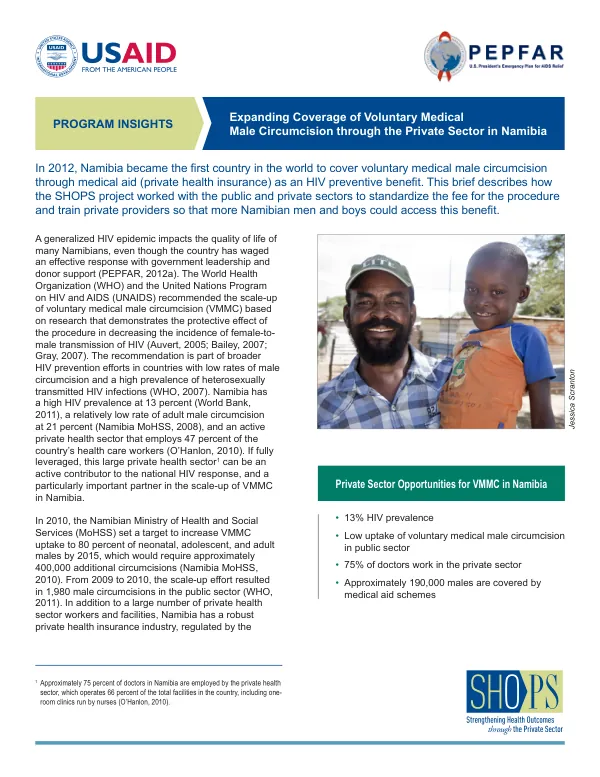
Expanding Coverage of Voluntary Medical Male Circumcision through the Private Sector in Namibia
Sign inDELOITTE INC.
Expanding Coverage of Voluntary Medical Male Circumcision through the Private Sector in Namibia
The Namibian government has set a target to increase voluntary medical male circumcision (VMMC) uptake to 80 percent of neonatal, adolescent, and adult males by 2015, requiring approximately 400,000 additional circumcisions.
2012 · 4 pages
Sign in to readA free account is required to download.
Abstract
The country has a high HIV prevalence at 13 percent and a relatively low rate of adult male circumcision at 21 percent. The private health sector in Namibia employs 47 percent of the country's healthcare workers and operates 66 percent of the total facilities, including one-room clinics run by nurses. The World Health Organization (WHO) and the United Nations Program on HIV and AIDS (UNAIDS) recommended the scale-up of VMMC based on research demonstrating its protective effect in decreasing the incidence of female-to-male transmission of HIV. The Namibian Ministry of Health and Social Services (MoHSS) set a target to increase VMMC uptake to 80 percent by 2015, which would require approximately 400,000 additional circumcisions. From 2009 to 2010, the scale-up effort resulted in 1,980 male circumcisions in the public sector. Namibia has a robust private health insurance industry, regulated by the Namibia Association of Medical Aid Funds (NAMAF). In 2012, Namibia became the first country in the world to cover VMMC through medical aid as an HIV preventive benefit. The SHOPS project worked with the public and private sectors to standardize the fee for the procedure and train private providers. The project estimated that if 50 percent of men employed in the formal sector were covered by medical aid for preventive VMMC and there was 80 percent uptake of the procedure by covered men, then 93,600 men could be circumcised in the private health sector. The SHOPS project used the activity-based costing method to determine an appropriate tariff for VMMC. The actuaries divided the circumcision procedure into three stages: activities that should take place before the procedure, activities associated with the actual procedure and post-operative care, and activities associated with potential follow-up for any complications. The costing included a margin for error to account for unpredicted costs or wasted medical materials. The MoHSS provided input into the development of the tariff and reviewed the work done by the actuaries. The tariff for VMMC was accepted by NAMAF in October 2011 and went into effect in January 2012. By January 2013, nine out of ten medical aid schemes in the country chose to include the tariff for male circumcision as an HIV preventive benefit. The primary health outcome associated with the tariff is measured in the number of insured men who choose to undergo the procedure through their medical aid scheme. SHOPS received preliminary data from NAMAF that 1,074 male circumcisions were done by private providers prior to the acceptance of the standard fee structure. To ensure quality and standardize provision of the procedure across the country, the MoHSS, in partnership with SHOPS, invested in ensuring private providers have access to VMMC training that follows WHO and MoHSS guidelines and meets the needs of private providers. SHOPS partner Jhpiego worked with the MoHSS Male Circumcision Technical Working Group to conduct an assessment of private provider training needs. Jhpiego then adapted the public sector male circumcision training curriculum developed by WHO for private sector providers. Since the private health sector is not organized under a central authority in Namibia, uniformity of quality standards and adherence to reporting essential service statistics is often a concern. SHOPS created linkages between NAMAF and the MoHSS to help create a system for annually reporting the number of male circumcisions performed in the private sector. These statistics will assist the Namibian government in better understanding the availability and use of HIV services throughout the health system, and can help establish the profitability of male circumcision for private providers and medical aid schemes. The success of standardizing the male circumcision tariff in Namibia illustrates the potential of the private sector to contribute to high-impact HIV prevention services and the relative speed in which private sector domestic resources can be leveraged to help sustain donor-funded efforts. However, further efforts to create demand may be required to complement the supply-side financing effort. A demand creation campaign should be sector-neutral and allow potential clients to understand that both public and private service delivery points exist for the procedure.
Related documents