USAID DEC
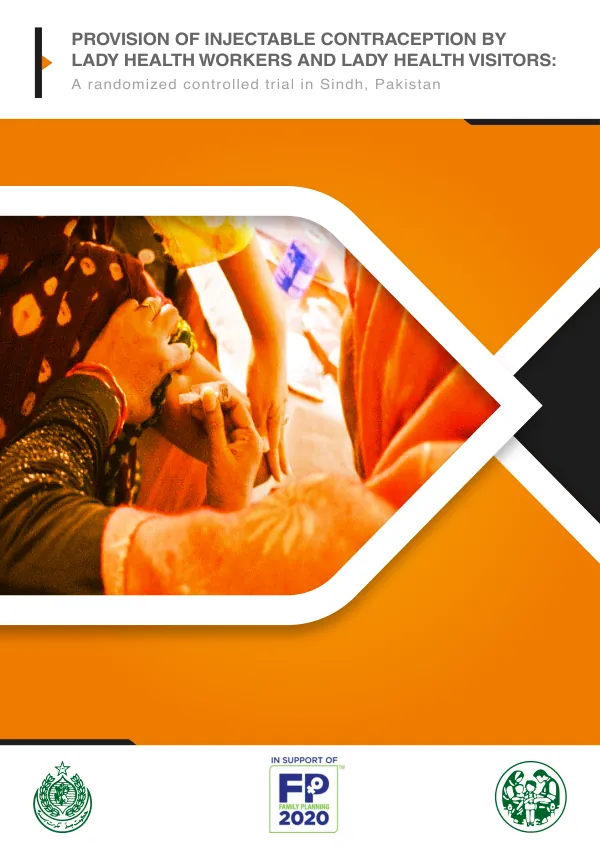
Expanding Family Planning Service: Results from a randomized, controlled trial of DMPA administration in Sindh Province, Pakistan
Sign inFHI360
Expanding Family Planning Service: Results from a randomized, controlled trial of DMPA administration in Sindh Province, Pakistan
Pakistan's current policy restricts Lady Health Workers (LHWs) from providing initial injectable contraception, whereas Lady Health Visitors (LHVs), who are clinically trained, are allowed to perform this service.
2019 · 4 pages
Sign in to readA free account is required to download.
Abstract
Amending policy and programs to allow LHWs to screen and initiate injectable contraception could significantly improve access to family planning services for hundreds of thousands, if not millions, of women. Official endorsement and implementation of this change may increase the modern contraceptive prevalence rate (mCPR) in Sindh and other provinces while advancing Pakistan's FP2020 goals. A randomized controlled trial (RCT) was conducted to assess whether lay health workers perform as well as clinically trained providers at initiating injectable contraception. The trial focused on the comparison of safety and effectiveness of screening, counselling, and first-time administration of intramuscular and subcutaneous DMPA by LHWs and LHVs. The primary objective of the study was to assess whether LHWs can screen and initiate women on intramuscular (IM) and subcutaneous (SC) Depo Provera injections as safely and effectively as LHVs. The study was conducted in five urban sites in Karachi and five rural sites in Thatta district. Data collectors conducted independent observations of screening and counselling performed by LHWs or LHVs to DMPA clients. Confirmation of client eligibility was performed by nurses before method provision. Data collectors also conducted independent observations of injection technique for DMPA IM or DMPA SC (Sayana Press) by LHWs or LHVs as well as interviews with clients immediately after initiating DMPA and with LHVs and LHWs four months after trial initiation. The majority of DMPA clients, served either by LHWs, LHVs, or in rural or urban areas, were highly satisfied with their providers and with their method of DMPA. However, findings from the urban sample show that LHWs did not screen first-time users of DMPA as well as clinically trained LHVs. Both LHWs and LHVs in the rural sample performed screening at a higher level than providers in the urban sample. The findings suggest that differences may be due to client load and operations of facilities based on that load more so than the ability of providers. Appropriate counselling was observed to be inadequate by all providers. LHVs performed as poorly as LHWs in urban areas. However, the measure was low across all groups, with room for improvement even among the higher performing LHWs. Job aids were not used uniformly by LHWs and LHVs, and less so by urban providers who were not observed to screen nor counsel as well as their rural counterparts. The Government of Sindh is working with partners to prepare a roll-out plan for the province. Initially, the Government is interested in rolling out Sayana Press in RCT intervention districts. Preliminary findings were shared at the Public Health Conference in Islamabad and the International Conference on Family Planning in Kigali, Rwanda. The findings on the safety and effectiveness of LHW-initiation of DMPA IM and SC provide an opportunity to expedite policy direction under FP2020 that DMPA SC would be introduced. It also provides evidence that LHWs can provide the first dose of injectable with proper training and under supervision.