POPULATION COUNCIL
USAID's Support for Birth Spacing in Pakistan
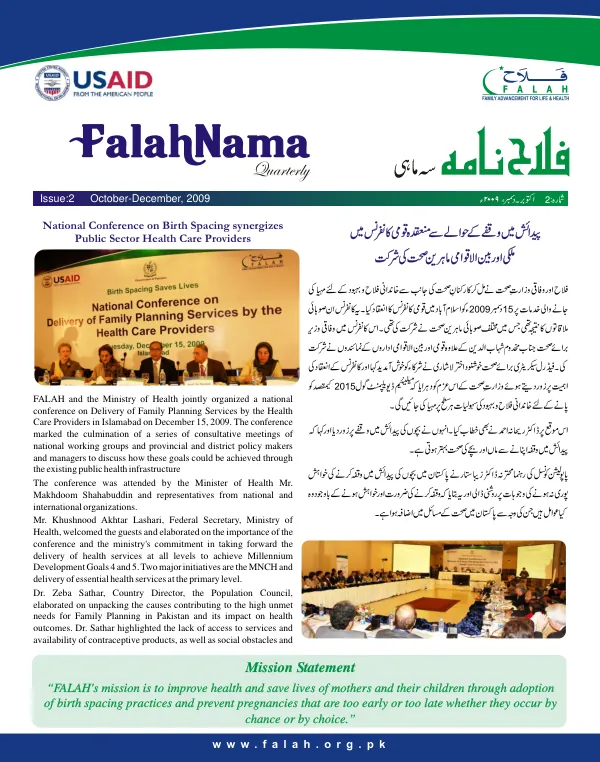
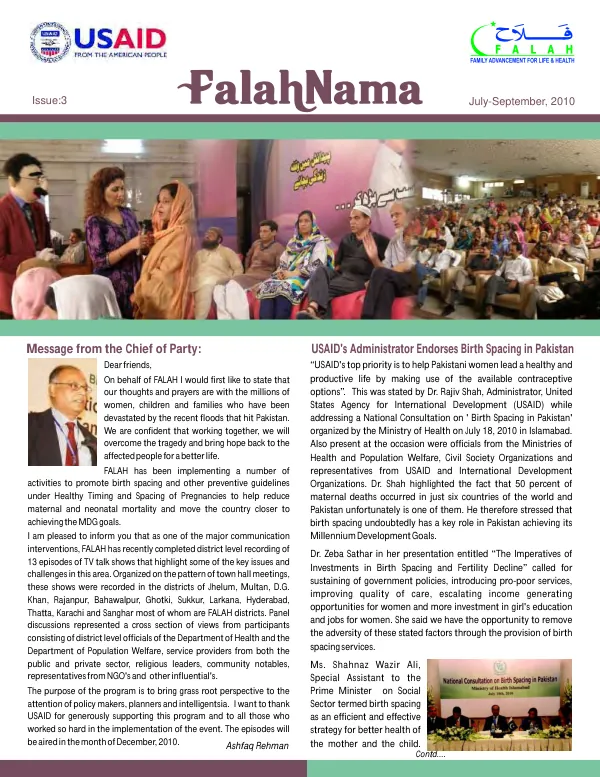
The FALAH project in Pakistan has been implementing activities to promote birth spacing and other preventive guidelines under the Healthy Timing and Spacing of Pregnancies initiative.
2010 · 8 pages
Sign in to readA free account is required to download.
Abstract
This effort aims to reduce maternal and neonatal mortality and move the country closer to achieving the Millennium Development Goals. As part of this initiative, FALAH has completed district-level recording of 13 episodes of TV talk shows that highlight key issues and challenges in birth spacing. The talk shows were organized on the pattern of town hall meetings and were recorded in 13 districts, including Jhelum, Multan, D.G. Khan, Rajanpur, Bahawalpur, Ghotki, Sukkur, Larkana, Hyderabad, Thatta, Karachi, and Sanghar. Panel discussions represented a cross-section of views from participants consisting of district-level officials, service providers, religious leaders, community notables, representatives from NGOs, and other influential individuals. The purpose of the program is to bring grassroots perspectives to the attention of policymakers, planners, and intellectuals. The airing of the program was initially scheduled to take place after Ramadan on PTV Home and regional channels but has been postponed due to the devastation caused by the floods. FALAH is rehabilitating Lady Health Workers (LHWS) by distributing 1,500 kits to affected LHWS in its flood-hit districts. Each aid package contains a tent, an adult weighing scale, a stethoscope, a plastic chair, a folding steel bed, an iron sign board, a torch, and a blanket. The high-intensity floodwaters have left health facilities either damaged or destroyed, and health providers are without support. The Population Council has also carried out relief activities for flood victims in FALAH districts, namely Sukkur and Shikarpur. A doctor from Population Council staff provided healthcare to around 1,350 patients, mainly children and women in the affected areas. FALAH's training program on Client Centered Family Planning Services (CCFPS) focuses on behavior change and enables LHWS to apply communication and counseling skills more effectively, provide updates on contraceptive technology, use FALAH IEC material effectively, and organize group meetings explaining birth spacing and HTSP messages. As of June 2010, FALAH had trained 114 master trainers in CCFPS and group methodology, who have in turn imparted the same training to 9,463 LHWS through 479 step-down trainings in the project districts. The LHWs of the National Program for Family Planning and Primary Health Care in Pakistan are community-based workers who have been trained to provide family planning and primary healthcare services to rural communities. FALAH project partner Rural Support Programs Network (RSPN) is extending birth spacing services in rural areas in partnership with the Punjab Water and Drainage Authority (PWD) and the Government of Sindh's Ministry of Health (GSM). This partnership aims to provide community-based volunteers with the necessary training and resources to promote birth spacing and family planning services in rural areas. The FALAH project is working to change the mindsets of LHWS through client-centered training and community-based volunteers model. This effort aims to empower LHWS to provide effective family planning and primary healthcare services to rural communities. By extending birth spacing services in rural areas, FALAH is working to reduce maternal and neonatal mortality and move the country closer to achieving the Millennium Development Goals.