USAID DEC
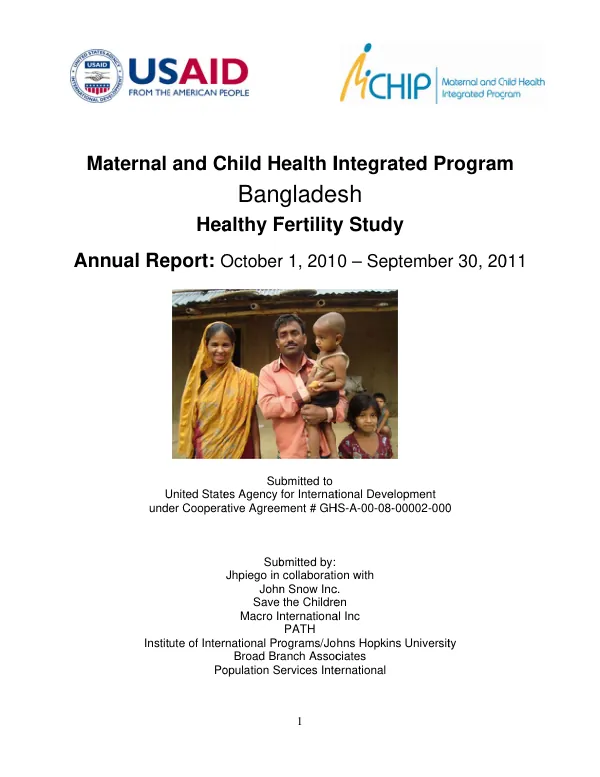
Healthy Fertility Study: Operations Research to Address Unmet Need for Contraception in the Postpartum Period in Sylhet District, Bangladesh Final Report
Sign inJHPIEGO
Healthy Fertility Study: Operations Research to Address Unmet Need for Contraception in the Postpartum Period in Sylhet District, Bangladesh Final Report
The Healthy Fertility Study was conducted in Sylhet District, Bangladesh, with the primary objective of addressing unmet need for contraception in the postpartum period.
2014 · 37 pages
Sign in to readA free account is required to download.
Abstract
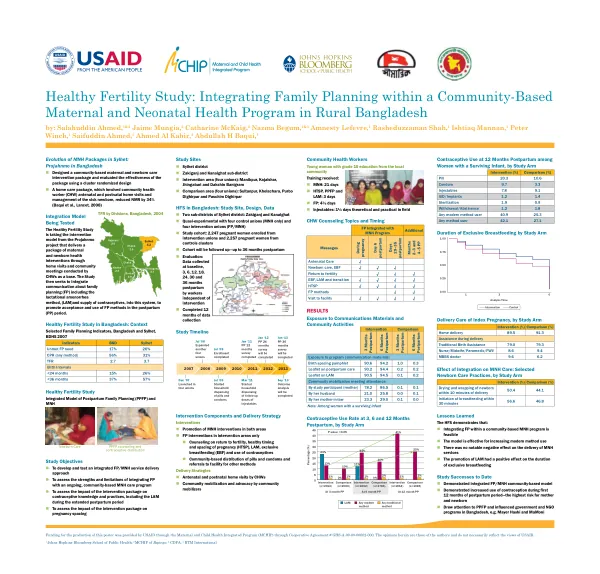
Funded by the U.S. Agency for International Development (USAID), the project began in 2007 as a partnership between the Bangladesh Ministry of Health and Family Welfare (MoHFW), the nongovernmental organization (NGO) Shimantik, the Center for Data Processing and Analysis (CDPA), ACCESS-FP, and the Johns Hopkins Bloomberg School of Public Health (JHSPH). The study transitioned from ACCESS-FP to the USAID-funded Maternal and Child Health Integrated Program (MCHIP) in December 2010. The specific objectives of the study were to develop and test an integrated Family Planning (FP)/Maternal Neonatal Health (MNH) service delivery approach in rural settings of Bangladesh, building on the MNH service delivery system developed by the Projahnmo Study Group. The intervention activities included behavior change communications (BCC) on optimum pregnancy spacing and expansion of contraceptive options for postpartum women, including provision of oral contraceptive pills, condoms, and injectables through household visits by community health workers (CHWs). The study also aimed to assess the strengths and limitations of integrating FP into an ongoing community-based MNH care program and to evaluate the impact of the intervention package on exposure to key messages, knowledge of contraceptive methods, and the benefits of healthy fertility practices. The study design involved a quasi-experimental approach, with two unions receiving the integrated MNH/FP package and two comparison unions receiving MNH care promotion. All pregnant women identified by CHWs in these four unions were offered enrollment in the study. A baseline survey of the women who consented to participate was conducted, and follow-up surveys were conducted at 36 months postpartum to assess the impact of the intervention package. The study population consisted of postpartum women in Sylhet District, Bangladesh, who were identified by CHWs and offered enrollment in the study. The baseline survey revealed that the majority of the women were between 20 and 35 years old, had a secondary level of education, and were married. The women also reported a high level of knowledge about contraceptive methods, but a low level of use of modern contraceptive methods. The intervention package included behavior change communications (BCC) on optimum pregnancy spacing and expansion of contraceptive options for postpartum women. The BCC activities were conducted through household visits by CHWs, and the women were provided with oral contraceptive pills, condoms, and injectables. The study also assessed the feasibility and acceptability of integrating FP into an ongoing community-based MNH care program. The results of the study showed that the integrated FP/MNH service delivery approach was feasible and acceptable in rural settings of Bangladesh. The women who received the intervention package reported a higher level of knowledge about contraceptive methods and a higher level of use of modern contraceptive methods compared to the women in the comparison unions. The study also found that the intervention package had a positive impact on birth spacing, with a higher proportion of women in the intervention unions reporting a longer interval between births. The study implications suggest that the integrated FP/MNH service delivery approach can be an effective way to address unmet need for contraception in the postpartum period in rural settings of Bangladesh. The study also highlights the importance of behavior change communications (BCC) in promoting the use of modern contraceptive methods among postpartum women. Further analyses are needed to assess the long-term impact of the intervention package and to identify the factors that contribute to the success of the integrated FP/MNH service delivery approach.