USAID DEC
Provision of Injectable Contraception by Lady Health Workers and Lady Health Visitors: A Randomized Controlled Trial in Sindh, Pakistan
Sign inDEPARTMENT OF HEALTH
Provision of Injectable Contraception by Lady Health Workers and Lady Health Visitors: A Randomized Controlled Trial in Sindh, Pakistan
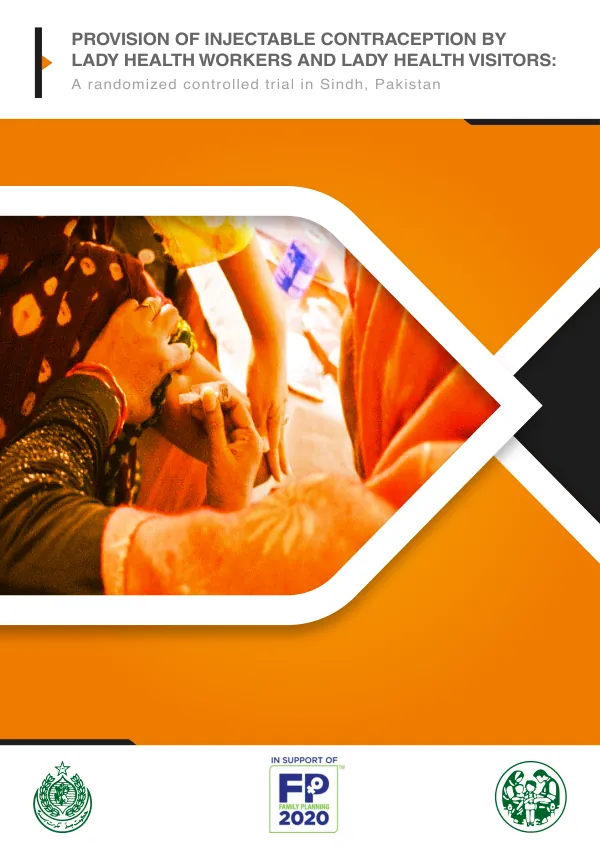
The randomized controlled trial in Sindh, Pakistan, aimed to assess whether Lady Health Workers (LHWs) can safely and effectively screen and initiate women on injectable contraceptives as their clinically-trained counterparts, Lady Health Visitors (LHVs).
2019 · 70 pages
Sign in to readA free account is required to download.
Abstract
The trial was conducted in collaboration with the Aga Khan University, the Population Welfare Department, the Department of Health in the Government of Sindh, Jhpiego/Pakistan, and USAID/Pakistan. The trial focused on the comparison of safety and effectiveness of screening, counseling, and first-time administration of intramuscular and subcutaneous DMPA by LHWs and LHVs. Statistical analyses were geared towards determining whether LHWs performed as well as the more experienced LHVs in an urban sample of these providers. The trial was powered specifically to detect non-inferiority, meaning whether LHWs were no worse than LHVs. Data collectors posted in five health facilities in Karachi (urban) and five in Thatta (rural) districts were trained to perform onsite observations of screening and counseling of first-time DMPA clients performed by LHWs and LHVs. An onsite nurse, blinded to the type of provider (LHW or LHV) who provided the initial screening and counseling, observed and recorded the interactions between the providers and clients. The trial included a subcutaneous form of DMPA, Sayana Press, which was facilitated by relevant training of LHWs and LHVs by Jhpiego. The necessary stock of Sayana Press for the trial was provided by special USAID procurement, as the product was not available in Pakistan during the trial. The trial was designed to provide evidence of LHW ability to provide injectable contraceptive services for both intramuscular and subcutaneous forms of DMPA. The trial was conducted in Sindh Province, Pakistan, from March to July 2018. The Government of Sindh has been proactive and progressive in moving forward with community-based access to injection (CBA2I). In October 2017, the GoS approved initiation of injectable contraception by LHWs and are collaborating with the Sindh FP2020 Working Group to scale up provision of injectable contraception. The overall goal of the trial was to provide high-level evidence that community health workers can safely and effectively screen and initiate women who chose injectable contraceptives as their contraceptive method. The primary objective was to assess whether the community health worker cadre, Lady Health Workers (LHWs) in Pakistan, can screen and initiate women on intramuscular and subcutaneous Depo Provera injections as safely and effectively as their clinically-trained counterparts, Lady Health Visitors (LHVs). The trial's findings have the potential to increase the country's modern contraceptive prevalence rate (mCPR) by granting access to family planning services for thousands of women. The trial's results will be used to inform decision-making at the provincial level and to advocate for the expansion of community-based access to injectable contraceptives in Sindh Province and beyond.
Related documents
Documents in this collection
 2019
2019USAID DEC
Expanding Family Planning Service: Results from a randomized, controlled trial of DMPA administration in Sindh Province, Pakistan
Open record 2014
2014USAID DEC