USAID DEC
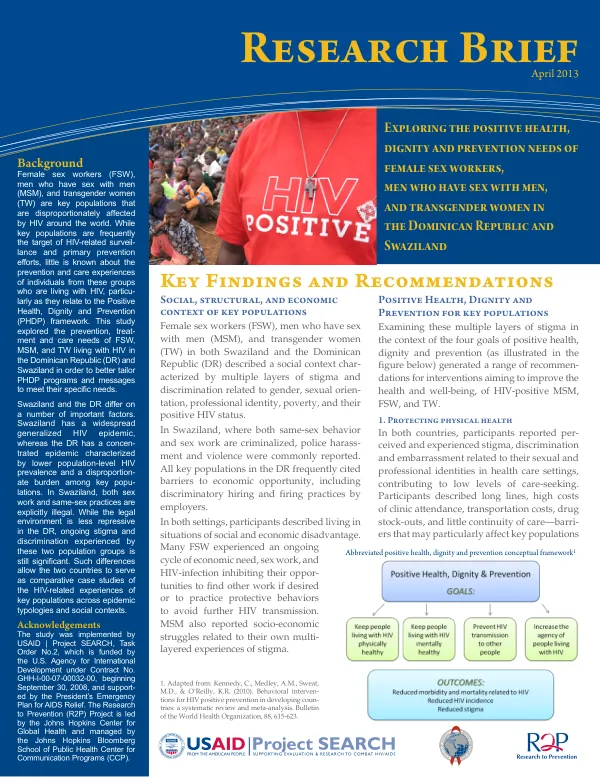
Exploring the positive health, dignity and prevention needs of female sex workers, men who have sex with men, and transgender women in the Dominican Republic and Swaziland
Sign inTHE INFO PROJECT AT THE JOHNS HOPKINS BLOOMBERG SCHOOL OF PUBLIC HEALTH, CENTER FOR COMMUNICATION PROGRAMS
Exploring the positive health, dignity and prevention needs of female sex workers, men who have sex with men, and transgender women in the Dominican Republic and Swaziland
The social, structural, and economic context of key populations in Swaziland and the Dominican Republic is characterized by multiple layers of stigma and discrimination related to gender, sexual orientation, professional identity, poverty, and their positive HIV status.
2013 · 2 pages
Sign in to readA free account is required to download.
Abstract
In Swaziland, where both same-sex behavior and sex work are criminalized, police harassment and violence were commonly reported. In the Dominican Republic, key populations frequently cited barriers to economic opportunity, including discriminatory hiring and firing practices by employers. Participants in both countries described living in situations of social and economic disadvantage. Many female sex workers experienced an ongoing cycle of economic need, sex work, and HIV-infection inhibiting their opportunities to find other work if desired or to practice protective behaviors to avoid further HIV transmission. Men who have sex with men also reported socio-economic struggles related to their own multi-layered experiences of stigma. The study aimed to explore the prevention, treatment, and care needs of female sex workers, men who have sex with men, and transgender women living with HIV in the Dominican Republic and Swaziland. The research used a qualitative approach, including key informant interviews, longitudinal in-depth interviews, and focus groups with participants from the FSW, MSM, and TW communities. The study found that participants in both countries reported perceived and experienced stigma, discrimination, and embarrassment related to their sexual and professional identities in healthcare settings, contributing to low levels of care-seeking. Participants described long lines, high costs of clinic attendance, transportation costs, drug stock-outs, and little continuity of care - barriers that may particularly affect key populations. The study generated a range of recommendations for interventions aiming to improve the health and well-being of HIV-positive MSM, FSW, and TW. These recommendations include training a cadre of peer navigators or "expert clients" to accompany individuals to appointments, identify social service programs, and provide social support. At the policy level, there is a need for greater advocacy to address the sustainability of access to treatment for key populations, to provide nutritional and economic support to facilitate optimal engagement with health services, and to train healthcare providers to be sensitive to the needs of key populations. In terms of protecting mental well-being, the study found that participants in both countries described very similar psychosocial support needs, but the availability of services varied substantially. Key populations in the Dominican Republic described greater use of formal mental health services than those in Swaziland. They did, however, note financial barriers to attending these services, as well as the fear of facing the additional burden of mental health stigma. The study also found that participants expressed a strong desire to prevent transmission of HIV to their partners, though participants in Swaziland emphasized an unmet need for HIV prevention services and limited distribution of condoms and lubricants. They also described assumptions of heterosexuality and monogamy by clinical providers, limiting opportunities for relevant conversations about safer sex in the context of sex work or same-sex practices. In terms of ensuring agency and involvement in programs, advocacy, and policy-making, the study found that many participants in the Dominican Republic were actively involved in education and support activities to prevent the further spread of HIV in their communities. They indicated that participation in these activities made them feel better, gave them a sense of purpose, and improved their own mental health. Participants in Swaziland, however, reported more challenges in becoming involved due to extremely heightened stigma and their hidden identities. The study highlights the need to develop integrated HIV prevention, treatment, and care programs, supporting biomedical, behavioral, social, and structural intervention elements for key populations. There are additional needs for community mobilization strengthening, safe work spaces, and health sector interventions/trainings to combat stigma and discrimination to more effectively meet the PHDP needs of FSW, MSM, and TW.
Related documents
Documents in this collection
 2011
2011USAID DEC
Understanding the Dynamics of Concurrent Sexual Partnerships in Malawi and Tanzania: A Qualitative Study
Open record 2015
2015USAID DEC