USAID DEC
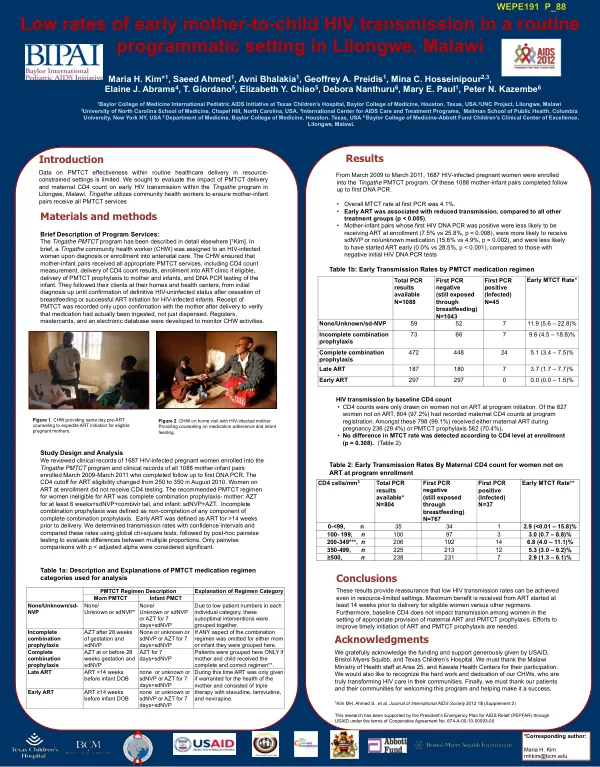
Supporting Option B+ scale up and strengthening the prevention of mother-to-child transmission cascade in central Malawi: results from a serial cross-sectional study
Sign inMINISTRY OF HEALTH
Supporting Option B+ scale up and strengthening the prevention of mother-to-child transmission cascade in central Malawi: results from a serial cross-sectional study
The Safeguard the Family (STF) project was established in 2011 to support the Malawi Ministry of Health (MoH) in scaling up universal antiretroviral therapy (ART) for HIV-infected pregnant and breastfeeding women, known as Option B+.
2015 · 13 pages
Sign in to readA free account is required to download.
Abstract
The project aimed to strengthen the prevention of mother-to-child transmission (PMTCT) cascade by implementing various interventions in five districts in central Malawi. These interventions included health worker training and mentorship, couples' HIV testing and counseling (HTC), women's psychosocial support groups, and health and laboratory system strengthening for early infant HIV diagnosis (EID). The STF project implemented a serial cross-sectional study to evaluate its performance on PMTCT indicators from 2011 to 2013. The study used facility-level quarterly program data and individual-level infant HIV-1 DNA PCR data to assess the impact of STF interventions. The results showed significant increases in facility-level uptake of HTC, ART, infant nevirapine prophylaxis, and infant DNA PCR testing from quarterly baselines to project end. Specifically, HTC uptake increased from 66% to 87%, ART uptake increased from 23% to 96%, infant nevirapine prophylaxis uptake increased from 1% to 100%, and infant DNA PCR testing uptake increased from 52% to 62%. The study also found that quarterly HTC, ART, and infant nevirapine prophylaxis uptake outperformed national averages over years 2-3. Additionally, the STF project provided first-time HIV-1 DNA PCR testing for 2,226 of 11,261 HIV-exposed infants, with 78 (3.5%) testing HIV-positive. Among infants with complete documentation, the median age at first testing decreased from 112 days to 76 days over the study period. The STF project's interventions achieved favorable HTC, maternal ART, infant prophylaxis, and EID services uptake, and a low proportion of infants found HIV-infected at first DNA PCR testing. However, continued investments are needed to strengthen the PMTCT cascade, particularly around EID. The study highlights the importance of optimizing PMTCT interventions for HIV-infected mothers and their HIV-exposed infants at each step of the PMTCT cascade to reduce mother-to-child transmission. The STF project's implementation model and strategies to mitigate barriers to service delivery along the early PMTCT cascade in sub-Saharan Africa (SSA) are promising. The project's focus on health worker training and mentorship, couples' HTC, women's psychosocial support groups, and health and laboratory system strengthening for EID has contributed to its success. The study's findings have implications for the scale-up of Option B+ and the strengthening of the PMTCT cascade in SSA. The Malawi National PMTCT Program has offered free PMTCT services, including HTC and anti-retroviral medications, to HIV-infected pregnant women since 2002. However, the program has faced challenges, including client refusal of ART and dropout from the PMTCT cascade. The introduction of Option B+ in 2011 led to a significant increase in the number of HIV-infected pregnant and breastfeeding women accessing ART, but client refusal and dropout remain concerns. The STF project's evaluation has provided valuable insights into the impact of its interventions on PMTCT indicators and the effectiveness of Option B+ in reducing mother-to-child transmission. The study's findings have implications for the scale-up of Option B+ and the strengthening of the PMTCT cascade in SSA, and highlight the importance of continued investments in PMTCT interventions to reduce HIV transmission among infants and children.
Related documents