USAID DEC
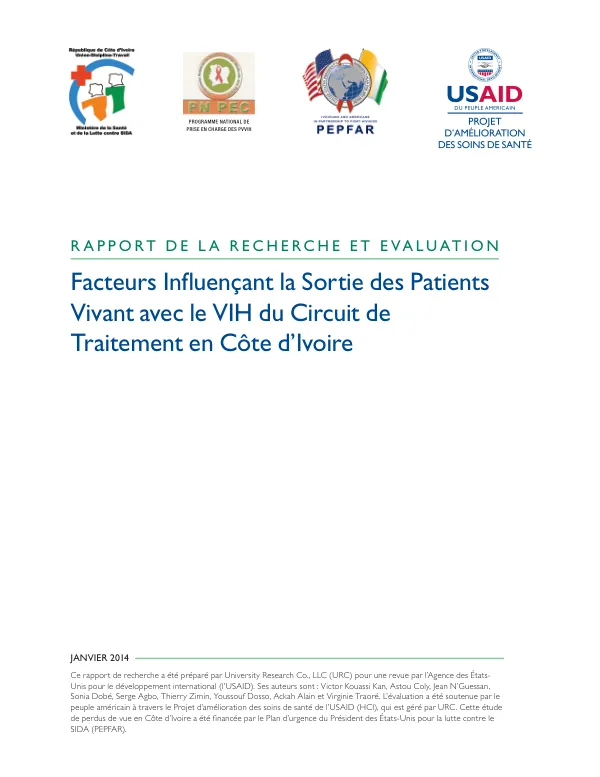
Facteurs influençant la sortie des patients vivant avant avec le VIH du circuit de traitement en Côte d’Ivoire
Sign inENCOMPASS, LLC
Facteurs influençant la sortie des patients vivant avant avec le VIH du circuit de traitement en Côte d’Ivoire
In Côte d'Ivoire, the Programme National de Prise en Charge des Personnes Vivant avec le VIH (PNPVH) was established to provide medical care to individuals living with HIV.
2014 · 42 pages
Sign in to readA free account is required to download.
Abstract
The PNPVH is supported by the US President's Emergency Plan for AIDS Relief (PEPFAR) and the US Agency for International Development (USAID). A research study was conducted to identify factors influencing the loss to follow-up of patients living with HIV on antiretroviral therapy (ART) in Côte d'Ivoire. The study used a cross-sectional design and enrolled 1,264 patients from 15 health facilities in Côte d'Ivoire. The patients were interviewed using a standardized questionnaire to collect data on their sociodemographic characteristics, clinical status, and adherence to ART. The study found that patients who were older, had lower levels of education, and were living in rural areas were more likely to be lost to follow-up. The study also found that patients who experienced adverse events during treatment, such as side effects or stigma, were more likely to be lost to follow-up. Additionally, patients who had lower levels of knowledge about HIV/AIDS and were less likely to disclose their HIV status to their partners were also more likely to be lost to follow-up. The study's findings suggest that interventions aimed at improving patient retention in care should focus on addressing the social and economic challenges faced by patients, as well as providing support to patients who experience adverse events during treatment. The study's results also highlight the need for healthcare providers to be aware of the factors that contribute to loss to follow-up and to develop strategies to address these factors. The study's methodology involved a cross-sectional design, with data collection conducted at 15 health facilities in Côte d'Ivoire. The study population consisted of 1,264 patients living with HIV who were on ART. The data collection tools used in the study included a standardized questionnaire, which was administered to patients by trained interviewers. The study's results are presented in a series of tables, which provide an overview of the sociodemographic characteristics of the study population, as well as the factors associated with loss to follow-up. The study's findings suggest that loss to follow-up is a significant problem in Côte d'Ivoire, with approximately 20% of patients lost to follow-up over a 12-month period. The study's recommendations include the need for healthcare providers to develop strategies to improve patient retention in care, such as providing support to patients who experience adverse events during treatment and addressing the social and economic challenges faced by patients. The study's results also highlight the need for further research on the factors that contribute to loss to follow-up and the development of effective interventions to address this problem. The study's conclusions are based on the analysis of data collected from 1,264 patients living with HIV in Côte d'Ivoire. The study's findings suggest that loss to follow-up is a significant problem in Côte d'Ivoire, with approximately 20% of patients lost to follow-up over a 12-month period. The study's results also highlight the need for healthcare providers to be aware of the factors that contribute to loss to follow-up and to develop strategies to address these factors.