USAID DEC
FANTA Zambia Legacy Report 2017
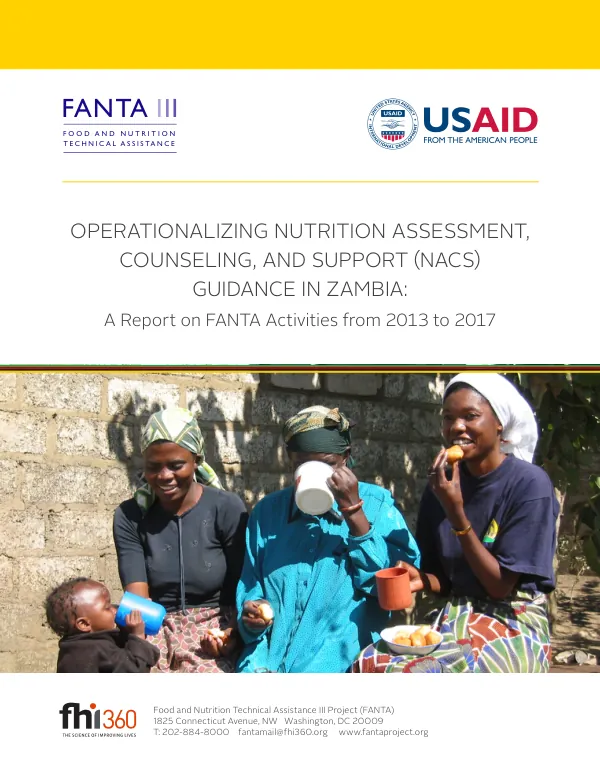
Nutrition Assessment, Counseling, and Support (NACS) Guidance in Zambia: A Report on FANTA Activities from 2013 to 2017 highlights the country's struggle with malnutrition, which affects approximately 40% of children under 5 and 10% of women aged 15-49.
2017 · 20 pages
Sign in to readA free account is required to download.
Abstract
The report emphasizes the need for integrated nutrition assessment, counseling, and support to address the double burden of undernutrition and overnutrition in Zambia. Zambia's high HIV prevalence, which has declined from 19.0% in 2003 to 12.9% in 2015, contributes to malnutrition. The country's economic growth is uneven, with HIV and AIDS reducing national economic output and increasing medical expenses. The Government of the Republic of Zambia (GRZ) has established plans and resources to address undernutrition and HIV, including the National Food and Nutrition Commission (NFNC) and the National AIDS Strategic Framework 2017-2021. The Food and Nutrition Technical Assistance III Project (FANTA) has provided technical assistance to the Zambian Ministry of Health (MOH) and NFNC to integrate NACS into health policy, planning, and service delivery for people with HIV. FANTA's contributions to Zambia's efforts to address nutrition problems include strengthening the enabling environment for NACS integration, supporting and accelerating NACS integration at the district level, and providing essential NACS supplies and equipment. FANTA has supported national workshops to develop NACS guidelines and training and counseling materials, as well as nutrition advocacy at national, provincial, and district levels. The project has also built capacity for integrated management of acute malnutrition (IMAM) and NACS through training and support for exchange visits. FANTA has collaborated with the MOH and PEPFAR implementing partners (IPs) to improve NACS oversight and coalition building. At the district level, FANTA has trained NACS trainers, facility-based health care providers, and community NACS volunteers. The project has operationalized NACS guidance and generated lessons for scale-up, provided essential NACS supplies and equipment, and strengthened systems for nutrition data collection and reporting. FANTA has also strengthened linkages between health facilities and communities to improve nutrition outcomes. The report highlights the achievements of FANTA's NACS activities in Zambia, including the integration of NACS into 43 health facilities in 2 districts, training of 18 district trainers, 273 facility-based health care providers, 16 community NACS trainers, 470 community NACS volunteers, and 16 staff of second- and third-level hospitals and private nursing schools. The project has also provided IMAM training to 32 national trainers and 273 facility-based health care providers. FANTA's contributions to Zambia's efforts to address nutrition problems have been significant, and the project's achievements demonstrate the potential for integrated nutrition assessment, counseling, and support to improve nutrition outcomes in Zambia. The report highlights the need for continued support and investment in NACS integration to address the country's nutrition challenges.
Related documents