PARTNERS OF THE AMERICAS
Farmer-to-Farmer (FTF) Program Impacts and Accomplishments
The Farmer-to-Farmer (FTF) Program has a long history of providing professional assistance to host organizations in developing countries.
2012 · 1 pages
Sign in to readA free account is required to download.
Abstract
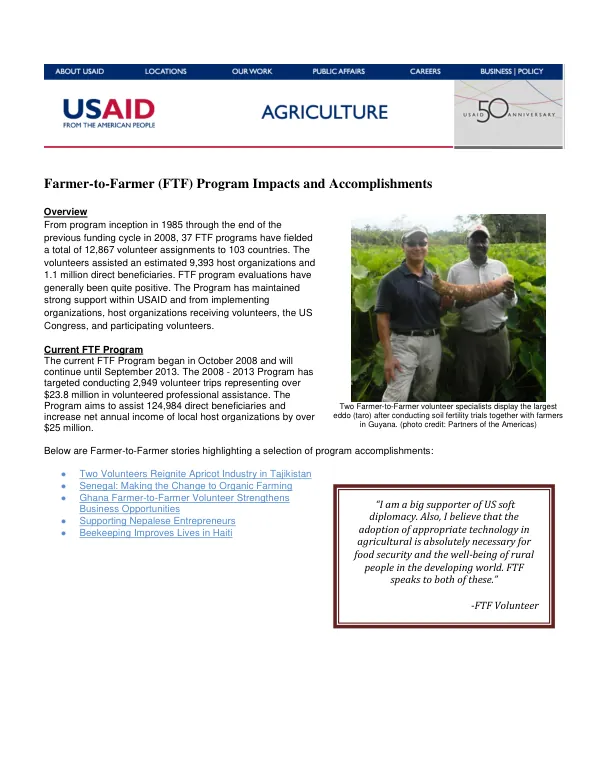
Since its inception in 1985, the program has fielded a total of 37 programs, resulting in 12,867 volunteer assignments to 103 countries. These assignments have assisted an estimated 9,393 host organizations and 1.1 million direct beneficiaries. The program has received positive evaluations and maintained strong support from various stakeholders, including USAID, implementing organizations, host organizations, the US Congress, and participating volunteers. The current FTF Program, which began in October 2008 and will continue until September 2013, aims to conduct 2,949 volunteer trips, representing over $23.8 million in volunteered professional assistance. The program targets assisting 124,984 direct beneficiaries and increasing the net annual income of local host organizations by over $25 million. This ambitious goal is a testament to the program's commitment to improving agricultural productivity and food security in developing countries. One of the program's notable achievements is its ability to revitalize local industries through the transfer of knowledge and skills. For instance, two FTF volunteers helped reignite the apricot industry in Tajikistan by introducing new farming techniques and technologies. Similarly, in Senegal, FTF volunteers assisted farmers in transitioning to organic farming practices, which has improved crop yields and reduced the use of chemical fertilizers. In Ghana, a FTF volunteer helped strengthen business opportunities for local farmers by providing training on market access and entrepreneurship. The program's impact extends beyond individual farmers and communities, as it also contributes to the development of local economies. By increasing the net annual income of host organizations, the program helps to stimulate economic growth and reduce poverty. Furthermore, the program's focus on agricultural development and food security aligns with the broader goals of USAID and other development agencies. The FTF Program's success can be attributed to its collaborative approach, which brings together volunteers, host organizations, and implementing partners to achieve common goals. The program's emphasis on knowledge transfer, capacity building, and community engagement has enabled it to make a lasting impact on the lives of millions of people in developing countries. As the program continues to evolve and expand, it is likely to remain a vital component of USAID's efforts to promote agricultural development and food security worldwide.
Related documents