USAID DEC
Feasibility and acceptability of oral cholera vaccine mass vaccination campaign in response to an outbreak and floods in Malawi
Sign inMINISTRY OF HEALTH
Feasibility and acceptability of oral cholera vaccine mass vaccination campaign in response to an outbreak and floods in Malawi
The oral cholera vaccine (OCV) mass vaccination campaign in response to an outbreak and floods in Malawi was conducted in March and April 2015.
2016 · 6 pages
Sign in to readA free account is required to download.
Abstract
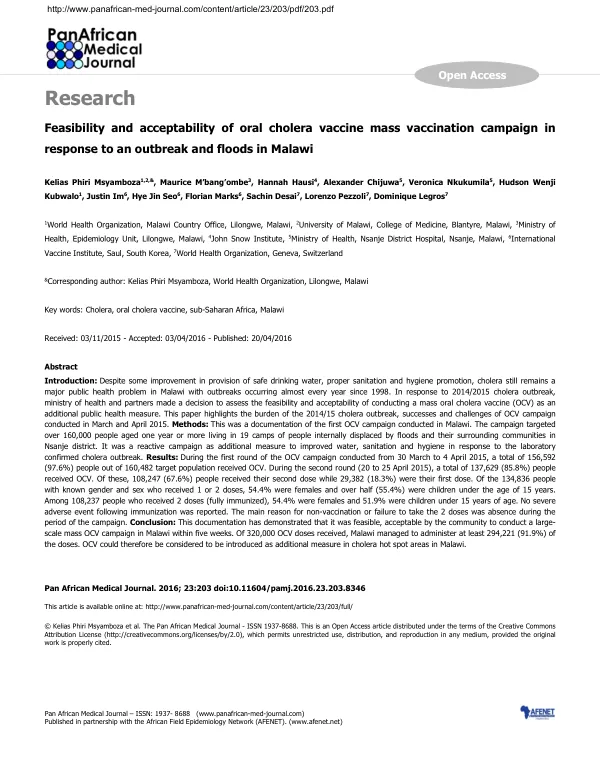
The campaign targeted over 160,000 people aged one year or more living in 19 camps of internally displaced people and the surrounding communities in Nsanje district. The main aim of the campaign was to provide an additional public health measure to improved water, sanitation, and promotion of personal and environmental hygiene to prevent the spread of cholera to camps. The campaign was conducted in two rounds, with the first round taking place from 30 March to 4 April 2015 and the second round from 20 to 25 April 2015. Each round was followed by a one-day mop up in areas with low coverage. The campaign was a reactive measure in response to the laboratory-confirmed cholera outbreak in Nsanje district, which was the first district to be affected by the outbreak during the 2014/2015 rainy season. The cholera outbreak in Nsanje district was cross-border spread from Jambawe gold mine in Mutarara district in Mozambique. By the end of March 2015, a total of 176 cholera cases and 3 deaths were reported in the district, with the number of new cases per week increasing. The threat of a cholera outbreak within the camps of internally displaced people was imminent, with 19 camps hosting over 70,000 people who were displaced by floods in January 2015. A total of 320,000 OCV doses were sourced from the International Coordinating Group (ICG) and the International Vaccine Institute (IVI) to respond to the emergency. The campaign was organized by the Ministry of Health and partners, with the main aim of providing an additional public health measure to improved water, sanitation, and promotion of personal and environmental hygiene to prevent the spread of cholera to camps. The campaign was successful in administering at least 294,221 (91.9%) of the 320,000 OCV doses received. The main reason for non-vaccination or failure to take the second dose was absence during the period of the campaign. No severe adverse event following immunization was reported. The campaign demonstrated that it was feasible and acceptable to conduct a large-scale mass OCV campaign in Malawi within five weeks. The results of the campaign showed that 156,592 (97.6%) people out of 160,482 target population received OCV during the first round, and 137,629 (85.8%) people received OCV during the second round. Of these, 108,247 (67.6%) people received their second dose, while 29,382 (18.3%) were their first dose. The majority of the people who received OCV were females (54.4%) and children under the age of 15 years (55.4%). The campaign was successful in preventing the spread of cholera to camps of internally displaced people, and it demonstrated the feasibility and acceptability of conducting a large-scale mass OCV campaign in Malawi.
Related documents