MINISTRY OF HEALTH
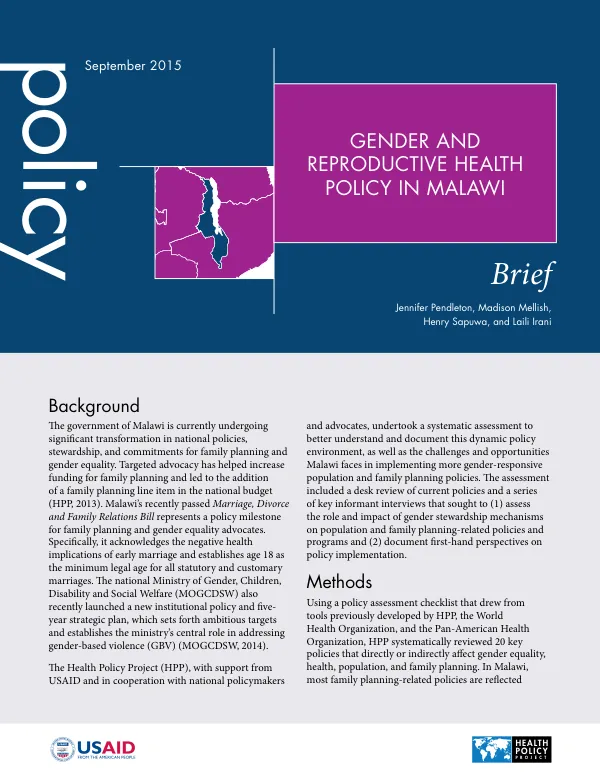
Gender and Reproductive Health Policy in Malawi
The government of Malawi is undergoing significant transformation in national policies, stewardship, and commitments for family planning and gender equality.
2015 · 10 pages
Sign in to readA free account is required to download.
Abstract
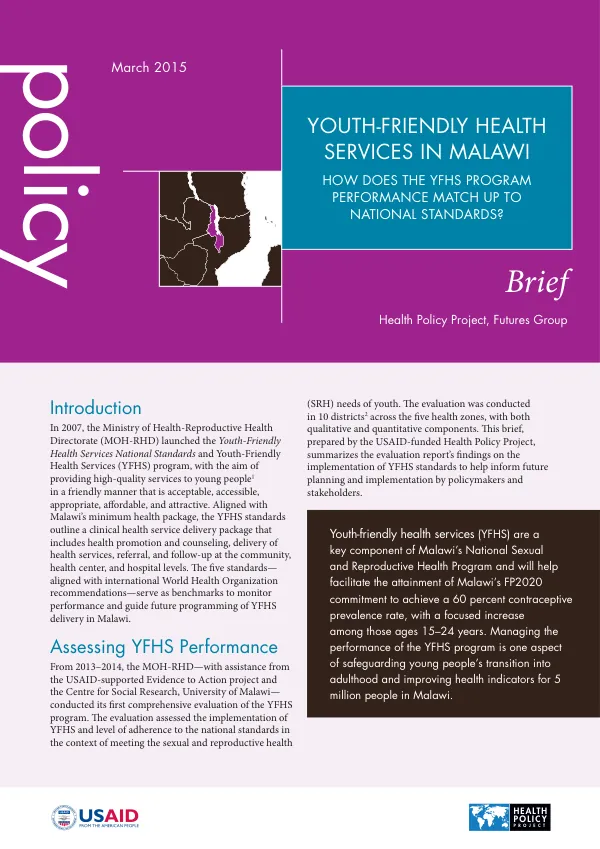
Targeted advocacy has increased funding for family planning, and the recently passed Marriage, Divorce and Family Relations Bill acknowledges the negative health implications of early marriage and establishes age 18 as the minimum legal age for all statutory and customary marriages. The national Ministry of Gender, Children, Disability and Social Welfare (MOGCDSW) has launched a new institutional policy and five-year strategic plan, which sets forth ambitious targets and establishes the ministry's central role in addressing gender-based violence (GBV). A systematic assessment was conducted by the Health Policy Project (HPP) to better understand and document the dynamic policy environment in Malawi. The assessment included a desk review of current policies and a series of key informant interviews. The policy assessment checklist used by HPP drew from tools previously developed by HPP, the World Health Organization, and the Pan-American Health Organization. The checklist was used to review 20 key policies that directly or indirectly affect gender equality, health, population, and family planning. Among the health and population-focused policies reviewed, two meet the most criteria for gender-responsiveness: the National Plan of Action for Scaling up SRH and HIV Prevention Initiatives for Young People (2008) and the National Population Policy (2012). The least gender-responsive policies were Clinical Management of HIV in Children and Adults (2014 guidelines) and Guidelines for Community Initiatives for Reproductive Health (2007). More recently drafted national health policies suggest an aspiration to align with national and international gender equality and human rights standards, but direct alignment is not evident across documents. The National Gender Policy (draft, June 2014) gives more attention to HIV and AIDS than to family planning and reproductive health. The 2013 Gender Equality Act makes stronger references to linkages between gender and SRH, but according to stakeholders, the stipulations of this law are not yet well-known or operationalized. Policies that focus on GBV and harmful cultural practices, such as early marriage, reflect the clearest opportunities and mandates for multisectoral engagement. The National Guidelines for Provision of Services for Physical and Sexual Violence documents a specific, signed commitment by the MOGCDSW, MOH, police, and judiciary to support its implementation within their respective sectors. In most instances, outside of gender-focused policies, there is no clear indication that gender experts were consulted as part of the policy development process. Only two of the health-focused policies reviewed explicitly acknowledge the role of the gender ministry or other gender advocates. The National Plan of Action for Scaling up SRH and HIV Prevention Initiatives for Young People (2008-2012) explicitly notes the participation of the then Ministry of Gender and Community Services. The National Guidelines for Provision of Services for Physical and Sexual Violence acknowledges the then Ministry of Gender, Women and Child Development for its technical inputs and lists the current MOGCDSW among four ministerial signatories to the guideline. The most commonly referenced gender and health priorities and interventions among all policies reviewed were in the areas of GBV and reduction of harmful cultural practices and male involvement in SRH or women and girls' empowerment. Seventeen of the 20 policies reviewed addressed GBV or other harmful practices, such as early marriage, and 12 addressed the need for male involvement. These areas were more strongly evident in high-level policies rather than implementation guidelines, and were generally not well-defined.