USAID DEC
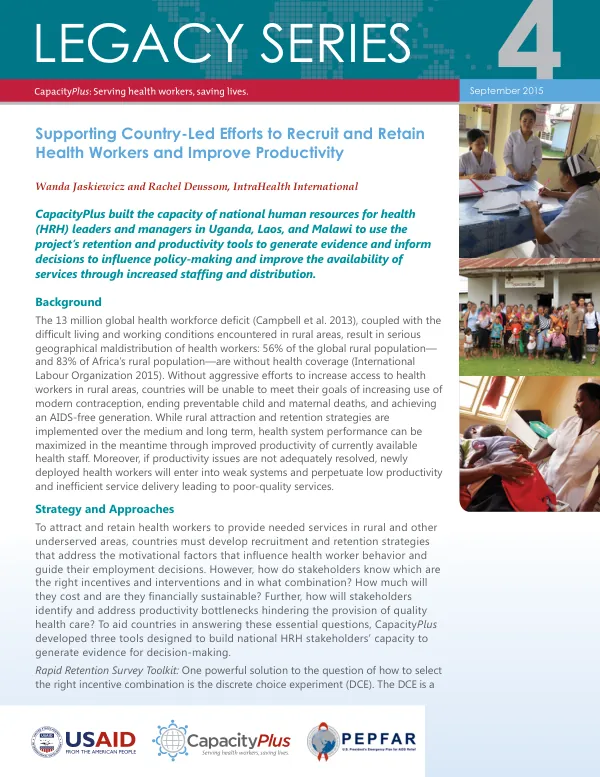
Supporting Country-Led Efforts to Recruit and Retain Health Workers and Improve Productivity
Sign inINTRAHEALTH
Supporting Country-Led Efforts to Recruit and Retain Health Workers and Improve Productivity
The global health workforce deficit is estimated at 13 million, with 56% of the global rural population and 83% of Africa's rural population lacking health coverage.
2015 · 6 pages
Sign in to readA free account is required to download.
Abstract
To address this issue, CapacityPlus developed three tools to build national human resources for health leaders and managers' capacity to generate evidence for decision-making. The Rapid Retention Survey Toolkit uses a discrete choice experiment to assess health workers' motivational preferences and design appropriate financial and non-financial incentive packages. The iHRIS Retain tool guides users through the costing process to capture all relevant financial, operational, and workforce data and calculate individual and aggregate costs of each incentive or intervention strategy. The Health Workforce Productivity Analysis and Improvement Toolkit provides a stepwise process to empower managers and supervisors to measure the productivity of facility-based health workers, understand the underlying causes of problems, and identify potential interventions to address them. In Uganda, CapacityPlus collaborated with the USAID/Uganda-funded Uganda Capacity Program to build the capacity of the Ministry of Health, Ministry of Public Service, and faith-based organizations in use of the Rapid Retention Survey Toolkit. National stakeholders conducted a rapid DCE with 158 health workers in the Western and Northern regions and 544 health professional students from three universities among priority cadres. The resulting preferred financial and non-financial incentive packages were costed using iHRIS Retain to identify which combinations would be the most cost-effective and feasible. The MOH, with technical assistance from the Uganda Capacity Program, used the results from application of the Rapid Retention Survey Toolkit and iHRIS Retain, along with data from the Uganda HRH Information System, to advocate with the Ministry of Finance to address workforce shortage and distribution issues. This resulted in allocation of an additional $20 million, or a 16% increase, for the health wage bill, allowing the MOH to recruit 7,211 new health workers in 2012-2013. The Ministry's recruitment previously averaged about 500 health workers annually. The percentage of filled health worker positions by region increased from a mean of 55% in 2009 (range 39%-100%) to 66% in 2013 (range 57%-78%). The newly recruited health workers were deployed to 1,030 health center IIIs and HC IVs across all 111 districts. An ecological analysis of service statistics from the District Health Information System between 2012 and 2014 at 962 matched facilities found that the mean number of persons tested for HIV and the number of persons living with HIV started on cotrimoxazole prophylaxis increased significantly.
Related documents