INTERNATIONAL ORGANIZATION FOR MIGRATION
Federated States of Micronesia and the Republic of the Marshall Islands FS#1
The Federated States of Micronesia (FSM) and the Republic of the Marshall Islands (RMI) experienced a dengue fever outbreak in 2011.
2012 · 3 pages
Sign in to readA free account is required to download.
Abstract
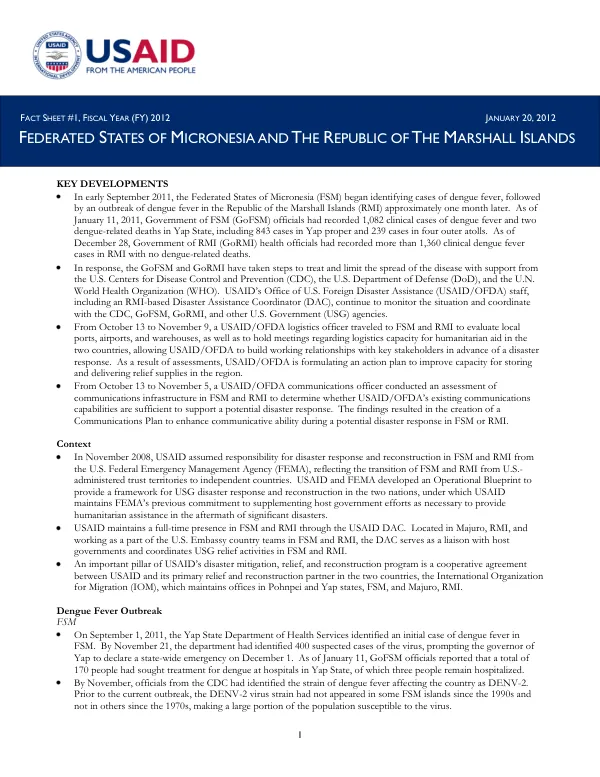
The outbreak began in early September in FSM, with the first reported case in Yap State. By November, officials had identified 400 suspected cases of the virus, prompting the governor of Yap to declare a state-wide emergency on December 1. As of January 11, 170 people had sought treatment for dengue at hospitals in Yap State, with three people remaining hospitalized. The strain of dengue fever affecting the country was identified as DENV-2, a virus strain that had not appeared in some FSM islands since the 1990s and not in others since the 1970s, making a large portion of the population susceptible to the virus. In response to the outbreak, the Centers for Disease Control and Prevention (CDC) and the World Health Organization (WHO) worked with the FSM Ministry of Health to conduct dengue fever surveillance, train local health staff, and administer household surveys of suspected dengue cases in Yap State. In RMI, the first reported outbreak of dengue fever occurred on October 20, 2011, with three confirmed cases. The RMI declared a state of emergency on October 28 due to the outbreak on Majuro Atoll, the capital of RMI and the most heavily populated of RMI's 34 atolls and islands. By early December, cases of dengue fever had appeared on Ebeye, Enewetak, and Utirik atolls. The RMI Environmental Protection Authority completed larvicide and adulticide application in approximately 95 percent of houses in Ajeltake town on Majuro Atoll as of November 30. The US Government (USG) provided support to the FSM and RMI in response to the outbreak. The USG Operational Blueprint, developed by USAID and the Federal Emergency Management Agency (FEMA), provided a framework for USG disaster response and reconstruction in the two nations. USAID maintained a full-time presence in FSM and RMI through the USAID Disaster Assistance Coordinator (DAC), who served as a liaison with host governments and coordinated USG relief activities in FSM and RMI. USAID worked with the International Organization for Migration (IOM) to preposition emergency relief supplies in three strategic locations in FSM and RMI. Commodities included communications equipment, water purification technologies, water storage solutions, tarpaulins, health kits, medical supplies for field hospitals, and generators. USAID also prepared to meet the logistical challenges associated with responding to a potential disaster in FSM or RMI by prepositioning basic emergency camp resources in Chuuk and Yap states, FSM, for up to 25 disaster response personnel from the USG and implementing partners. USAID supported disaster preparedness in FSM and RMI through capacity building activities for local and national government officials. The Asia Foundation's Pacific Islands Disaster Risk Management Program 2 received $750,000 from USAID/OFDA for national and regional disaster management trainings in FSM and RMI, as well as 12 other South Pacific nations. USAID/OFDA also procured five portable reverse osmosis machines for donation to the RMI National Disaster Committee, which were capable of producing up to 200 gallons of drinking water per day.
Related documents