USAID DEC
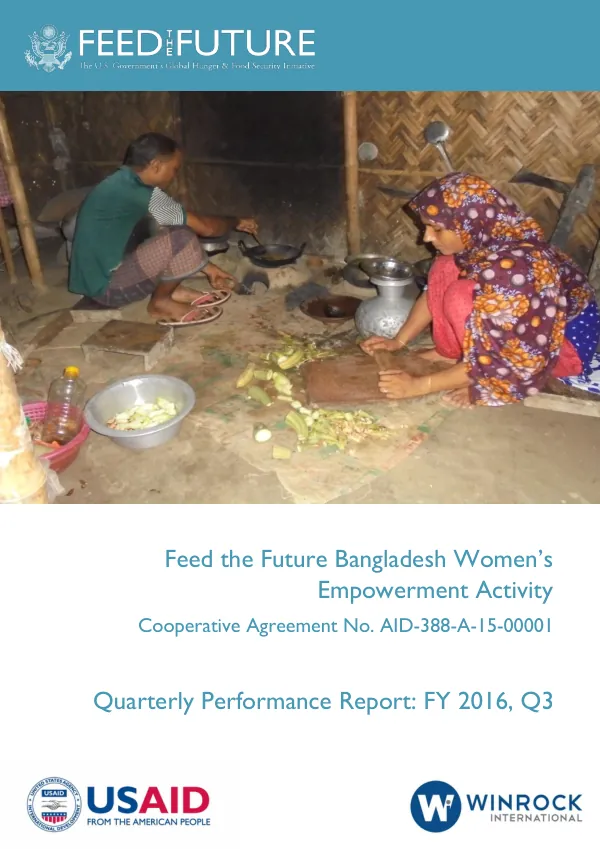
Feed the Future Bangladesh Women’s Empowerment Activity | Quarterly Performance Report: FY 2018, Q1
Sign inWINROCK INTERNATIONAL FOUNDATION
Feed the Future Bangladesh Women’s Empowerment Activity | Quarterly Performance Report: FY 2018, Q1
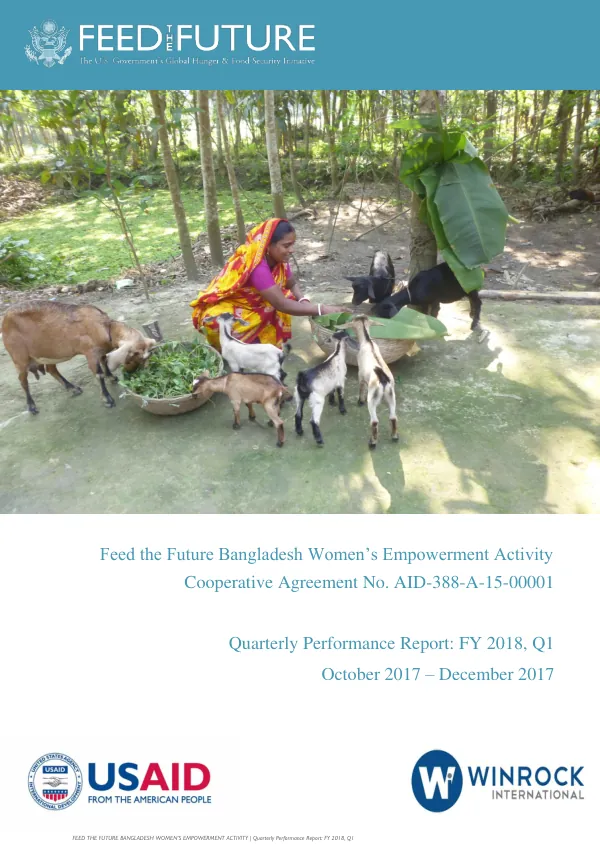
The Feed the Future Bangladesh Women’s Empowerment Activity (WEA) is a three-and-a-half-year initiative aimed at increasing the empowerment of women and gender parity in targeted areas of the Feed the Future Zone of Influence in Bangladesh.
2018 · 11 pages
Sign in to readA free account is required to download.
Abstract
The project, led by Winrock International, focuses on generating intermediate results, including increased leadership in community, economic, or social groups by women, improved decision-making by women over productive resources, and improved women’s control over income. During the October-December 2017 reporting period, WEA continued interventions in five districts, including Khulna, Jessore, Barisal, Patuakhali, and Barguna. The project made significant progress in meeting targets for key indicators, including women’s increased use of applied improved technology and increased sale of products in the agricultural sector. WEA transferred improved agricultural technology, knowledge, information, and skills on empowerment, gender parity, and business planning through Entrepreneurship Development Training (EDT). The Local Advisory Committee (LAC) played a crucial role in the project, with 162 quarterly meetings held during the reporting period. A total of 849 female members and 582 male members participated in these meetings, reviewing their experiences and achievements, the effectiveness of the Village Savings and Loan (VSL) program, and progress on other activities. LACs carried out various activities, including monitoring VSL activities, supporting beneficiary-led enterprises, networking with Union and Upazila level government officials, and providing economic and legal support to ELTE group members. Entrepreneurship Development Training (EDT) was another key activity during the quarter, with 114 women completing EDT on crop farming and cattle rearing programs in Jessore, Khulna, Barisal, Patuakhali, and Barguna districts. The women had completed Agricultural Technical Training (ATT) during ELTE and demonstrated capacity and expressed interest in enterprise development before being selected for EDT. ACI organized the EDT to support women beneficiaries to start enterprises, and the training was facilitated by a group of trainers that includes ACI Agro-Business Representatives and Upazila Agriculture and Livestock Officers. Post-test scores showed that 97 percent of female participants increased their technical knowledge on agricultural production through an advanced level three-day EDT course on selected agricultural product field crops and cattle farming. The average post-test score was 8.9 out of 10, whereas the average pre-test score was 3.7 out of 10. Workshops with input market actors were also conducted in Khulna, Jessore, and Barisal districts, with the goal of increasing women’s access to inputs. The project has also introduced the VSL program to additional women groups to meet their financial needs and enable them to start new Income Generating Activities (IGAs) or add on to their existing IGAs. The VSL program has been successful in promoting self-help savings and loan activities within ELTE groups. Overall, WEA has made significant progress in meeting its targets and achieving its intermediate results during the October-December 2017 reporting period.