USAID DEC
Feed the Future Bangladesh Women’s Empowerment Activity | Quarterly Performance Report: FY 2016, Q3
Sign inWINROCK INTERNATIONAL FOUNDATION
Feed the Future Bangladesh Women’s Empowerment Activity | Quarterly Performance Report: FY 2016, Q3
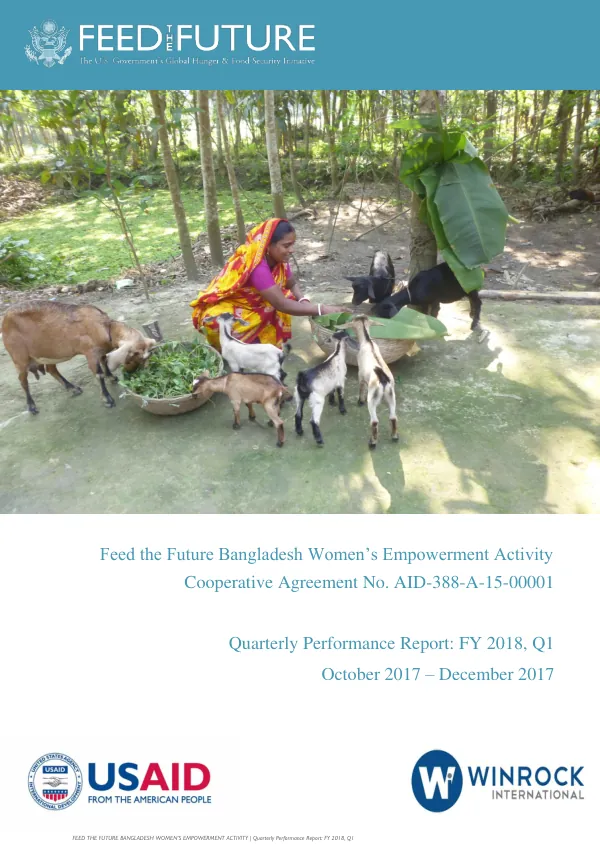
The Feed the Future Bangladesh Women's Empowerment Activity is a three-year initiative aimed at increasing the empowerment of women and gender parity in targeted areas of the Feed the Future Zone of Influence.
2016 · 21 pages
Sign in to readA free account is required to download.
Abstract
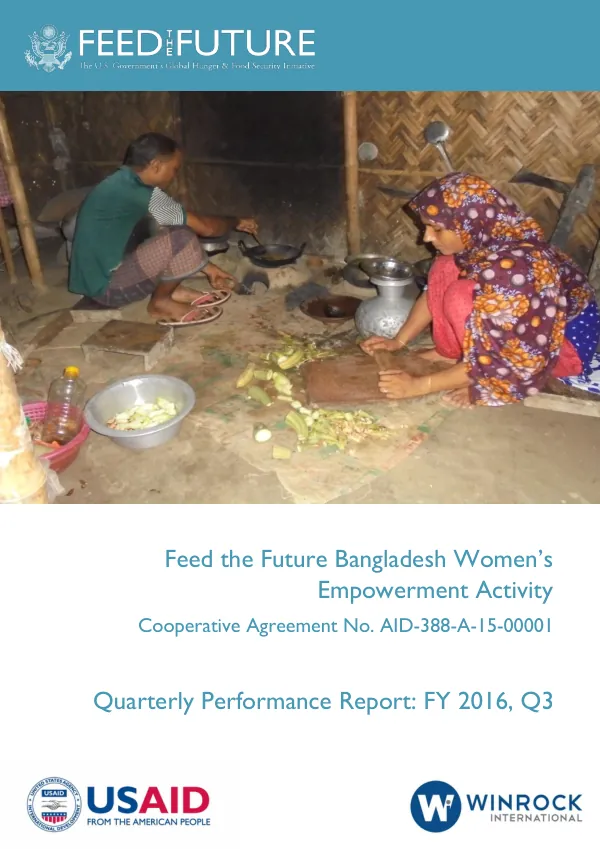
The activity is led by Winrock International and its partners, including Dhaka Ahsania Mission, Sheba Manab Kallyan Kendra, SAINT Bangladesh, Nabolok Parishad, and Advanced Chemical Industries, Ltd. The goal of the activity is to achieve six intermediate results, including increased leadership in community economic or social groups by women, improved decision-making by women over productive resources, and improved women's control over income. During the third quarter of Fiscal Year 2016, the activity team focused on implementing planned activities, capacity development of partner organizations, and strategic initiatives for continuation of the group affiliation established through the 7-month Entrepreneurial Literacy Training for Empowerment (ELTE). The activities included continuation of Community Asset Appraisal (CAA), selection of additional beneficiaries, Peer Leaders, and ELTE facilitators, and ELTE group formation in new communities. The team also provided Agricultural Technical Training (ATT) for women beneficiaries, conducted mobile-based data collection training for selected Peer Leaders, and implemented Leadership for Change (LfC) Training for Local Advisory Committees (LAC). The activity also focused on strengthening decision-making by women in agricultural production, improved time use by women, and increased social acceptance of women's empowerment. The team established linkages with relevant Ministries of the Bangladesh Government and implemented behavioral change communication events in Jessore and Patuakhali District. Additionally, the activity adopted a Village Savings and Loan (VSL) program in ELTE groups to start self-help income-earning activities. The activity faced some challenges during the quarter, including the month of Ramadan, which affected ELTE sessions for male groups, and local government elections, which hampered regular field-level activities. However, the team was able to make up for the missed sessions and complete the planned activities by the end of the quarter. The activity has made significant progress in achieving its intermediate results, including increased leadership in community economic or social groups by women. Local Advisory Committees (LAC) members received LfC training, and at present, they are fully engaged in project activities and leading the community empowerment process. The CAA methodology has encouraged community ownership of the project and helped women to understand the assets and opportunities available to them. The activity has also made progress in improving decision-making by women over productive resources, improved women's control over income, and strengthened decision-making by women in agricultural production. The team has established linkages with relevant Ministries of the Bangladesh Government and implemented behavioral change communication events in Jessore and Patuakhali District. The activity has also made progress in improving time use by women and increased social acceptance of women's empowerment. The team has implemented a Village Savings and Loan (VSL) program in ELTE groups to start self-help income-earning activities, which will help to sustain the effects of entrepreneurial literacy and behavioral change communication initiatives. The activity has also made progress in monitoring and evaluation, with the team conducting data quality assessments and implementing a web-based M&E system. The team has also conducted training of trainers on ELTE modules and Village Savings and Loan (VSL) programs for Winrock and partners' staff. Overall, the Feed the Future Bangladesh Women's Empowerment Activity has made significant progress in achieving its intermediate results and has established a strong foundation for continued progress in the coming quarters.