USAID
Feed the Future Ethiopia Fact Sheet 2015
The U.S.
2015 · 4 pages
Sign in to readA free account is required to download.
Abstract
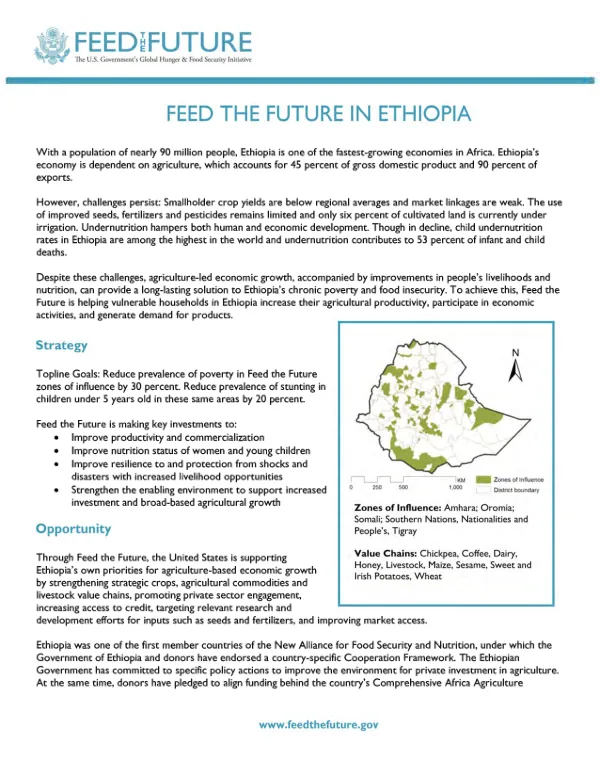
Government's Global Hunger & Food Security Initiative, FEED THE FUTURE, is working in Ethiopia to address the country's chronic poverty and food insecurity. With a population of nearly 90 million people, Ethiopia is one of the fastest-growing economies in Africa, and its economy is heavily dependent on agriculture, which accounts for 45 percent of gross domestic product and 90 percent of exports. However, smallholder crop yields are below regional averages, and market linkages are weak. The use of improved seeds, fertilizers, and pesticides remains limited, and only six percent of cultivated land is currently under irrigation. Undernutrition hampers both human and economic development in Ethiopia, with child undernutrition rates among the highest in the world. Despite these challenges, agriculture-led economic growth, accompanied by improvements in people's livelihoods and nutrition, can provide a long-lasting solution to Ethiopia's chronic poverty and food insecurity. To achieve this, Feed the Future is helping vulnerable households in Ethiopia increase their agricultural productivity, participate in economic activities, and generate demand for products. The initiative is making key investments to improve productivity and commercialization, improve nutrition status of women and young children, improve resilience to and protection from shocks and disasters, and strengthen the enabling environment to support increased investment and broad-based agricultural growth. Feed the Future is working in four zones of influence in Ethiopia: Amhara, Oromia, Somali, and Southern Nations, Nationalities, and People's. The initiative is focusing on strategic crops, agricultural commodities, and livestock value chains, promoting private sector engagement, increasing access to credit, and targeting relevant research and development efforts for inputs such as seeds and fertilizers. Ethiopia was one of the first member countries of the New Alliance for Food Security and Nutrition, and the Government of Ethiopia has committed to specific policy actions to improve the environment for private investment in agriculture. The results of Feed the Future's work in Ethiopia in FY2014 include: more than 217,600 farmers and other producers applied new technologies and practices for the first time with Feed the Future's help; producers applied improved technologies and management practices on more than 90,800 hectares of land with Feed the Future's help; Feed the Future-supported farmers and producers increased the value of their agricultural product sales by more than $45.6 million; and Feed the Future leveraged more than $27.49 million in new private investment in food and agriculture in Ethiopia. Additionally, U.S. Government programs reached more than 1.3 million children under 5 across Ethiopia to improve their nutrition. Feed the Future is also working to empower rural women as food producers and managers of household nutrition, promoting equitable decision-making in managing household resources, providing training in reading and math, and engaging women's advocacy groups in policy reform. The initiative has formed valuable public and private partnerships across sectors to promote agricultural development in Ethiopia, including partnerships with the United Nations World Food Program, local partners, and smallholder farmers. Feed the Future is also working to increase the resilience of people, places, and livelihood activities in Ethiopia through climate smart natural resource management, the building and restoring of community assets, and a combination of activities that provide families with sustainable and reliable sources of income and assets.