FEED THE FUTURE
Feed the Future Learning Agenda Presentation
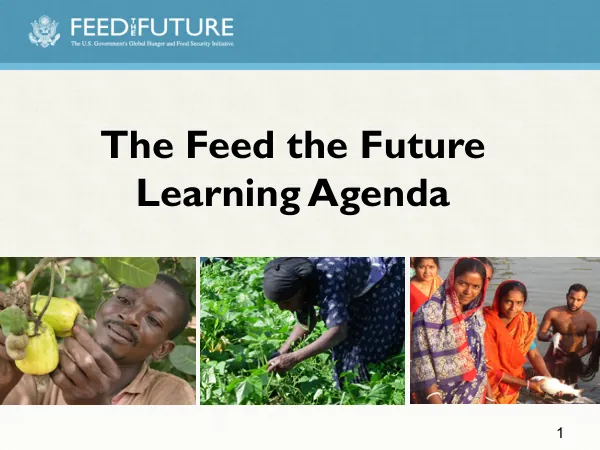
The Feed the Future Learning Agenda is a set of questions for which the initiative seeks to generate evidence, findings, and answers.
10 pages
Sign in to readA free account is required to download.
Abstract
The purpose of the Learning Agenda is to inform programming and decision-making through rigorous research and evaluation. The agenda is comprised of eight themes: Agricultural Productivity, Research and Development, Markets and Trade, Nutrition and Dietary Diversity, Gender and Women's Empowerment, Resilience of Vulnerable Populations, Improved Nutrition and Dietary Diversity, and Food Safety. The history of the Learning Agenda's development involved a multi-step process. Examination of causal linkages in the Feed the Future Results Framework and Missions' Monitoring and Evaluation Systems generated a list of questions in January and February 2011. Analysis of this list by experts from the Bureau for Food Security/Monitoring and Evaluation and the International Food Policy Research Institute (IFPRI) developed themes and refined questions in March 2011. Technical working groups of experts revised and prioritized questions in each theme to create a draft in April and May 2011. Concept notes on the Learning Agenda themes were drafted by experts in May and June 2011, and a technical meeting was convened to vet and refine draft questions in June 2011. The Learning Agenda themes are designed to address key questions in the areas of agricultural productivity, research and development, markets and trade, nutrition and dietary diversity, gender and women's empowerment, resilience of vulnerable populations, and improved nutrition and dietary diversity. The top key questions for the Learning Agenda include: What approach to Agriculture, Nutrition and Health (ANH) integration is most effective for achieving nutrition impact? What factors have enabled value chain investments to lead to improved consumption of diverse diets? Which agriculture technology interventions improve diets and nutrition outcomes? The Learning Agenda will be addressed through impact evaluations, performance monitoring, and performance evaluation. USAID/BFS will fund impact evaluations via the FEEDBACK contract, and most Feed the Future Missions will also fund at least one impact evaluation. Food for Peace and the Millennium Challenge Corporation (MCC) are also conducting impact evaluations that support the Learning Agenda. Next steps include a thorough review and documentation of existing evidence, development of literature reviews for each agenda theme, and a more thorough examination of M&E contributions to the Learning Agenda across the US Government.