DAI
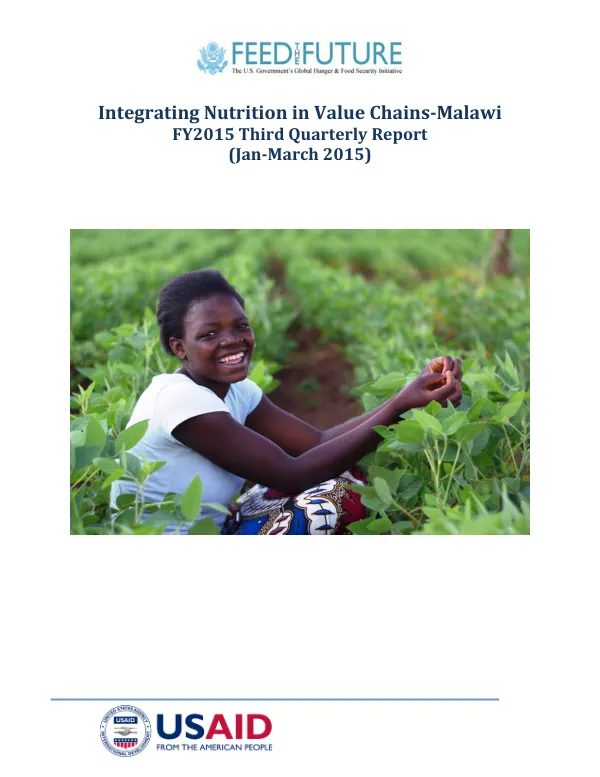
Final Quarterly FY 2012 Report: Malawi Integrating Nutrition in Value Chains (INVC)
Malawi Integrating Nutrition in Value Chains (INVC) is a project aimed at improving nutrition outcomes in Malawi through the integration of nutrition into value chains.
2012 · 36 pages
Sign in to readA free account is required to download.
Abstract
The project began in April 2012 and is funded by the United States Agency for International Development (USAID). The project's overall goal is to improve the nutritional status of Malawian households, particularly those in the target areas of Lilongwe and Mchinji districts. The project focuses on three main components: advancing value chain competitiveness, improving productivity, and improving community capacity to prevent under-nutrition. The first component aims to increase access to markets, value chain efficiency, and access to credit and finance. This is achieved through various sub-tasks, including conducting upgrading strategies, competitiveness analyses, and demand assessments, as well as supporting industry participants in market development and marketing. The second component focuses on improving productivity by increasing access to quality seed and other agro-inputs, new technology and management practices, and effective advisory extension services and information. This is achieved through sub-tasks such as increasing seed supply, strengthening and expanding seed/inputs distribution systems, and improving access to effective best bet technologies and management practices. The third component aims to improve community capacity to prevent under-nutrition by improving key nutrition-related behaviors within households, increasing access to diverse and quality foods among target populations, and enhancing consumption of a nutritious and sufficiently diversified diet. This is achieved through sub-tasks such as determining factors that influence nutrition and feeding practices, developing a behavior change communication (BCC) strategy, and facilitating implementation of the BCC strategy. During the period of April 25th to September 30th, 2012, the project made significant progress in all three components. In the first component, the project conducted upgrading strategies, competitiveness analyses, and demand assessments, and supported industry participants in market development and marketing. In the second component, the project increased seed supply, strengthened and expanded seed/inputs distribution systems, and improved access to effective best bet technologies and management practices. In the third component, the project determined factors that influence nutrition and feeding practices, developed a BCC strategy, and facilitated implementation of the BCC strategy. The project also made significant progress in terms of monitoring and reporting. The project established a monitoring and reporting system, strengthened grantee M&E systems, and set up a project baseline. The project also conducted a midterm evaluation, which revealed a 27% increase in household income among program participants compared to the control group. Overall, the Malawi INVC project has made significant progress in improving nutrition outcomes in Malawi through the integration of nutrition into value chains. The project's focus on advancing value chain competitiveness, improving productivity, and improving community capacity to prevent under-nutrition has led to significant improvements in household income, food security, and nutrition-related behaviors.