MICHIGAN STATE UNIVERSITY FOUNDATION
Project Lifetime Report: NAPAS-Malawi FY15 to FY19
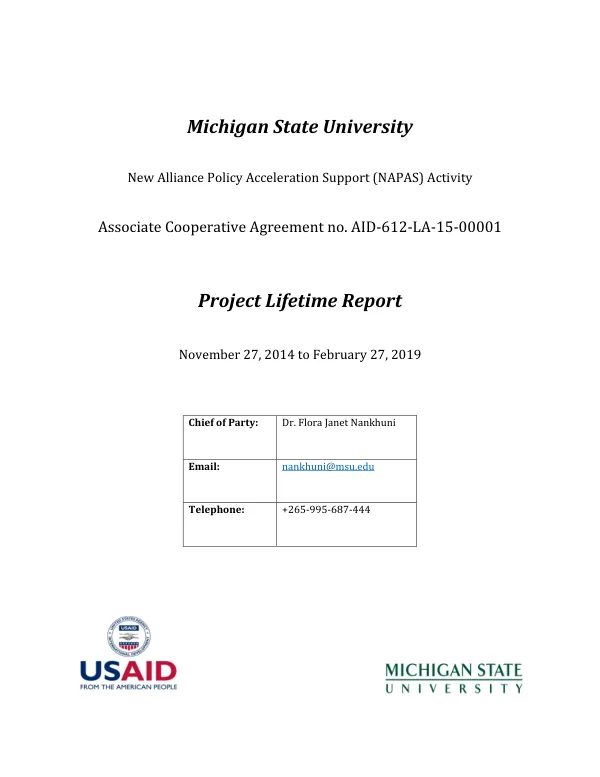
Michigan State University's New Alliance Policy Acceleration Support (NAPAS) Activity was a project implemented in Malawi from November 27, 2014, to February 27, 2019.
2019 · 49 pages
Sign in to readA free account is required to download.
Abstract
The project was led by Dr. Flora Janet Nankhuni as the Chief of Party. The project's primary objective was to support the development of a comprehensive agricultural policy framework in Malawi. The project focused on three main components: Technical Support for Policy Formulation, Policy Communication, and Capacity Strengthening. The Technical Support component aimed to provide technical assistance to the Government of Malawi in developing and implementing policies and strategies to improve the agricultural sector. This included the development of the National Agriculture Policy (NAP), National Agriculture Investment Plan (NAIP), and Value Chain Analyses to inform the implementation of these policies. The Policy Communication component aimed to enhance the communication and dissemination of agricultural policies and strategies to various stakeholders, including farmers, policymakers, and the general public. This was achieved through various activities, including national consultations, validation, launch, and dissemination of the NAP, as well as the organization of workshops, symposia, and meetings to discuss agricultural policy and institutional strengthening. The Capacity Strengthening component aimed to build the capacity of Malawian institutions and individuals to develop and implement effective agricultural policies and strategies. This was achieved through training programs, including policy process and policy communication training, budget and policy analysis training, and policy analysis mentorship. The project also provided support for student mentorship and the development of a strategic grain reserves guidelines. The project implemented various activities to support the development of the agricultural sector in Malawi. These included the development of a National Fertilizer Policy, National Fertilizer Bill, and Farmer Organization Development Strategy. The project also supported the development of a National Resilience Plan and conducted three political economy case studies. The project's impact was evaluated through a baseline and endline survey, which showed a 27% increase in household income among program participants compared to the control group. The project's activities were implemented in collaboration with various stakeholders, including the Government of Malawi, farmers, and other development partners. The project's success was attributed to the strong partnership and collaboration among these stakeholders, as well as the effective use of resources and expertise. The project's lessons and best practices were documented and shared with stakeholders to inform future agricultural policy and development initiatives in Malawi. The project's recommendations included the need for continued support for policy development and implementation, as well as the need for increased investment in agricultural research and development.