USAID DEC
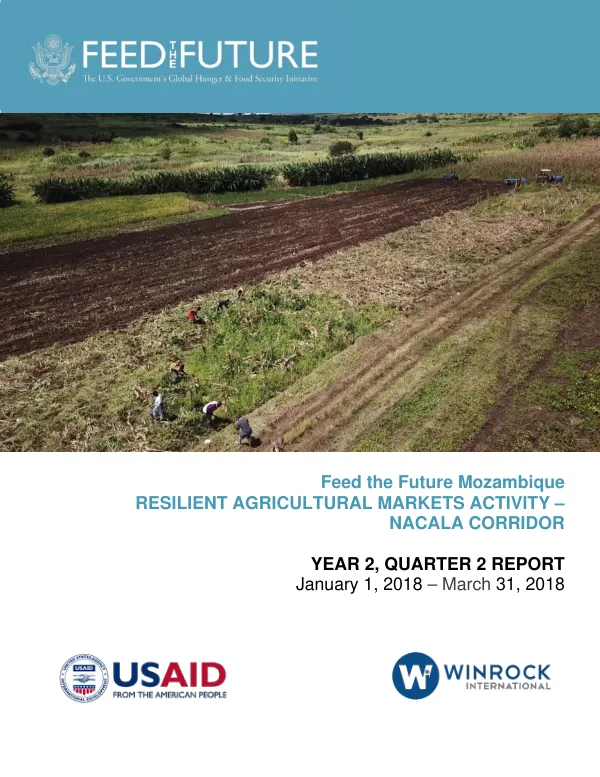
Feed the Future Mozambique Resilient Agricultural Markets Activity – Nacala Corridor Year 2 Annual Report
Sign inUSAID
Feed the Future Mozambique Resilient Agricultural Markets Activity – Nacala Corridor Year 2 Annual Report
The Feed the Future Mozambique Resilient Agricultural Markets Activity - Nacala Corridor (RAMA - Nacala Corridor) is a 27-month project that began on December 12, 2016, with a focus on building resilience among smallholder farmers in Mozambique's Nacala Corridor.
2018 · 54 pages
Sign in to readA free account is required to download.
Abstract
The project's geographic focus is the Nacala Corridor, and its objectives are to identify, evaluate, pilot, and scale impactful technologies that promote the resilience of smallholder farmers. The project emphasizes the development of critical thinking abilities among smallholder farmers to equip them to make smart decisions for their families in changing conditions. RAMA - Nacala Corridor also engages with women as decision-makers and drivers of production, and household nutrition. The project maximizes resources through partnerships with the private sector, the Government of Mozambique, and donor-funded programs, and supports the dissemination and commercialization of technologies and critical information through existing networks and value chain stakeholders. During the reporting period, October 1, 2017, to September 30, 2018, RAMA - Nacala Corridor prioritized six technologies and areas of innovation for intervention through strategic partnerships and development of communities of practice. These technologies include mechanized land preparation services, mechanized post-harvest legume processing technologies and services, fertilizer and plant fertility products, on-demand information solutions, water delivery service pilots and irrigation system design capabilities, and market intelligence products. The program used a strategic grant fund to incentivize promotion and adoption of technologies. RAMA - Nacala Corridor executed 14 fixed award agreements (FAAs) with key partners, mostly private sector, for-profit Mozambican small businesses, to co-invest in activities intended to meet specific technology access and adoption objectives and to gain relevant experience for replication and scale. In the first year, the project focused on mechanized land preparation services and fertilizer commercialization activities. Four partnerships were developed in these two areas of focus. Two partnerships, CPSA Angoche and DREAMERS Group, had the objectives to promote their services and educate potential smallholder farmer customers on the cost competitiveness of hired mechanization services, the benefits of mechanized over traditional practices, and the prerequisites of hiring services. Through these partnerships, 305 farmers (77 of whom were women) purchased the promotional package in 4 districts on a total of 709 hectares. RAMA - Nacala Corridor also worked with Hello Tractor to improve utilization of existing assets owned by private mechanization businesses in order to increase the number of customers and the area they can profitably serve. Hello Tractor installed their technology on 10 tractors owned by 9 mechanization service providers. While the installation occurred late in the mechanization season and not all nine businesses were actively selling services at that time, nearly 100 hectares of land had been prepared since installation. In late July, the RAMA - Nacala Corridor team reflected on the experience of the previous season and prepared a reinvestment strategy for the coming mechanized land preparation season. Four new FAAs were signed with mechanization service businesses, each with the objective of encouraging service providers to improve seasonal planning through potential demand mapping and use of differentiated pricing (promotional offers) to encourage earlier land preparation service purchase, prior to peak demand. A reinvestment with Hello Tractor will co-invest in further training and support for the first 9 pilot customers to ensure maximum product value in the coming season and for Hello Tractor to complete their first commercial sales in the country. The project's work with Hello Tractor has shown promising results, with nearly 100 hectares of land prepared since installation and over 2,800km traveled by 5 of the 10 tractors since the first of July. Hello Tractor has used the pilot period to adapt their customer support service approach, launch a virtual learning component to their technology offering, and plan for commercial sales in Mozambique within the coming period.