USAID DEC
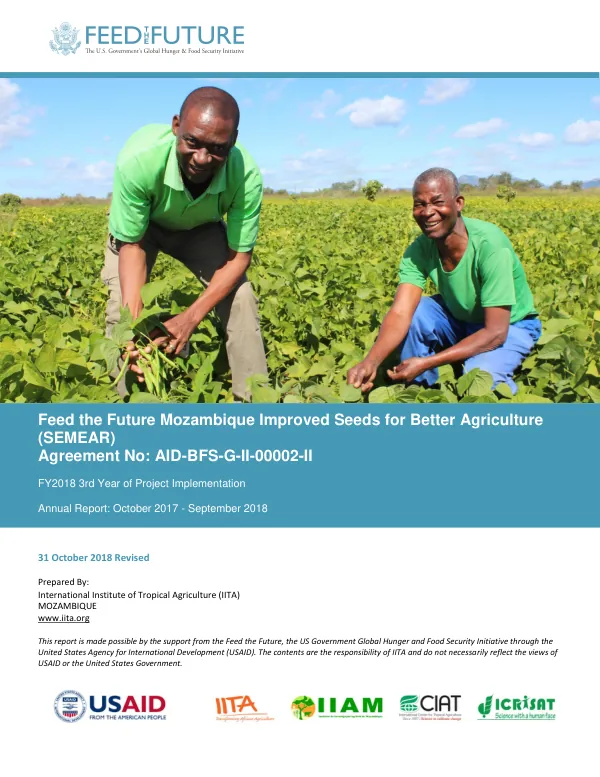
Annual Report: October 2017 - September 2018 for Feed the Future Mozambique Improved Seeds for Better Agriculture (SEMEAR)
Sign inINTERNATIONAL INSTITUTE OF TROPICAL AGRICULTURE
Annual Report: October 2017 - September 2018 for Feed the Future Mozambique Improved Seeds for Better Agriculture (SEMEAR)
The Feed the Future Mozambique Improved Seeds for Better Agriculture (SEMEAR) project is a five-year initiative aimed at increasing the production and supply of breeder, pre-basic, basic, and certified seeds of common bean, cowpea, groundnut, pigeon pea, sesame, and soybean in Mozambique.
2018 · 51 pages
Sign in to readA free account is required to download.
Abstract
The project's geographic focus spans four provinces: Nampula, Zambézia, Manica, and Tete. SEMEAR's objectives include scaling up and enhancing the adoption of improved varieties and best management practices in the Feed-the-Future Zone of Influence (FtF ZOI) using participatory approaches. During the fourth quarter of FY18 (July-September 2018), SEMEAR made significant progress in achieving its objectives. The project produced 171.3 tons of early generation seeds, consisting of 19.4 tons of breeder/pre-basic and 151.9 tons of basic seeds. This quantity is 2% higher than the target of 167.3 tons for FY18 and will enable the planting of 4,820 hectares in the upcoming season. SEMEAR also supported 165 individuals, 62 farmers' associations, and 10 seed companies and NGOs to produce certified seeds through the sale of 34 tons of basic seeds and training on seed production to strengthen capacities. The project's Component 2 focused on promoting and scaling up the adoption of best crop management practices in the FtF ZOI using participatory approaches. On-farm demonstrations were conducted, and training and scaling up adoption were implemented. Field days, exchange visits, and meetings were also organized to facilitate knowledge sharing and capacity building. Gender issues were addressed in SEMEAR's implementation, and the project ensured compliance with the Environmental Monitoring and Mitigation Plan (EMMP). SEMEAR collaborated with other donor projects, including the Resilient Agriculture and Marketing Activity (RAMA) and the Feed the Future Innovations for Agriculture Activity (FtF-InovA). The project also worked with the Seed Inspection Unit (SIU) to inspect and certify 210 hectares of certified seed fields. Seed producers whose fields and seeds were inspected and certified received certificates. The project's performance indicators showed significant improvements in seed production, adoption of improved varieties, and best management practices. However, major implementation issues were identified, including delays in seed distribution and sales, and challenges in acquiring inputs such as inoculants and fertilizers. The project's evaluation and assessment update highlighted the need for continued support and collaboration with other stakeholders to achieve its objectives. SEMEAR's success stories included the increased production and supply of breeder, pre-basic, basic, and certified seeds, as well as the adoption of improved varieties and best management practices by farmers. The project's financial information showed a total expenditure of $1.4 million during FY18, with a remaining balance of $2.8 million. The project's administrative update highlighted the need for continued support and collaboration with other stakeholders to achieve its objectives. Overall, SEMEAR's progress during FY18 demonstrated its commitment to improving the agricultural sector in Mozambique. The project's achievements in seed production, adoption of improved varieties, and best management practices highlighted its potential to contribute to the country's food security and economic development.
Related documents