USAID DEC
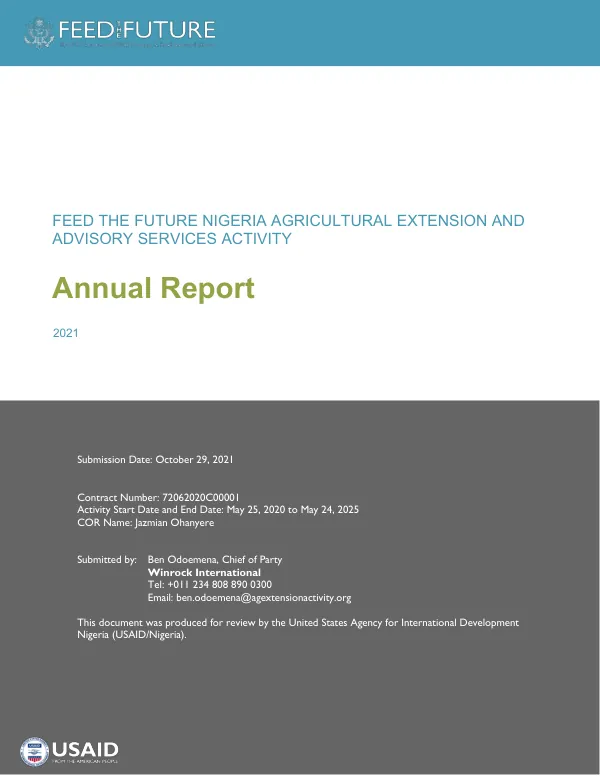
Feed the Future Nigeria Agricultural Extension and Advisory Services Activity Annual Report 2021
Sign inDIGITAL GREEN FOUNDATION
Feed the Future Nigeria Agricultural Extension and Advisory Services Activity Annual Report 2021
Feed the Future Nigeria Agricultural Extension and Advisory Services Activity is a five-year program implemented by Winrock International, with a start date of May 25, 2020, and an end date of May 24, 2025.
2021 · 83 pages
Sign in to readA free account is required to download.
Abstract
The program aims to provide access to agro-inputs and service delivery, as well as disseminate extension messaging to at least two million smallholder farmers in Benue, Cross River, Delta, Ebonyi, Kaduna, Kebbi, and Niger states. The program focuses on five value chains: aquaculture, cowpea, maize, rice, and soybean. The program's approach is centered on three cornerstones: achieving impact at scale, taking a 'farmer first' perspective to ensure on-farm results, and leveraging private sector investments. The program is implemented through partners with micro, small, and medium enterprises (MSMEs) and key market actors. The prime implementing partner is Winrock International, which is responsible for overall program implementation and compliance. The program has several objectives, including building the capacity of private extension service providers to deliver extension and advisory services to value chain stakeholders. This is achieved through the implementation of Component 1, which focuses on building the capacity of private extension service providers. The program also aims to strengthen linkages between agricultural research institutions, agro-allied companies, the public and private extension providers, and agricultural value chain stakeholders, which is achieved through Component 2. The program has made significant progress in its first year of implementation. The implementation mechanism has been established, and behavior change of smallholder farmers has been observed. The program has also established a plan for tracking outcome-level results. Cross-cutting activities, such as the launch of the Partnership and Investment Fund (PIF) and the Gender Equality and Social Inclusion (GESI) analysis and plan, have also been implemented. The program has also made progress in its implementation of Component 1, which focuses on building the capacity of private extension service providers. The program has trained over 2,500 farmers in sustainable agriculture techniques, and demonstration plots have shown yield improvements of 60% when applying the recommended practices. The program has also made progress in its implementation of Component 2, which focuses on strengthening linkages between agricultural research institutions, agro-allied companies, the public and private extension providers, and agricultural value chain stakeholders. The program has established partnerships with key stakeholders, including the Federal Ministry of Agriculture and Rural Development (FMARD) and the Partnership Initiatives in the Niger Delta (PIND). The program has also faced implementation challenges, including capacity development of staff and partners, and progress with farmer registration. However, the program has made significant progress in its first year of implementation, and it is expected to continue making progress in the coming years. The program's monitoring and evaluation (M&E) system has been established, and the program has made progress in its capacity development of staff and partners. The program has also made progress in its progress with farmer registration. The program's M&E system is designed to track outcome-level results, and it is expected to provide valuable insights into the program's impact and effectiveness. The program has also made progress in its integration of cross-cutting issues and USAID forward priorities. The program has established a plan for tracking outcome-level results, and it has made progress in its implementation of cross-cutting activities, such as the launch of the PIF and the GESI analysis and plan. The program has also made progress in its stakeholder participation and involvement. The program has established partnerships with key stakeholders, including the FMARD and the PIND. The program has also made progress in its management and administrative issues, including the establishment of a robust M&E system and the development of a plan for tracking outcome-level results. The program has also learned several lessons from its first year of implementation. The program has learned the importance of establishing a robust M&E system, and it has learned the importance of building the capacity of staff and partners. The program has also learned the importance of establishing partnerships with key stakeholders, including the FMARD and the PIND. The program has planned several activities for the next quarter, including the continuation of its implementation of Component 1 and Component 2. The program has also planned to continue its implementation of cross-cutting activities, such as the launch of the PIF and the GESI analysis and plan. The program has also planned to continue its monitoring and evaluation activities, including the tracking of outcome-level results.