CARE
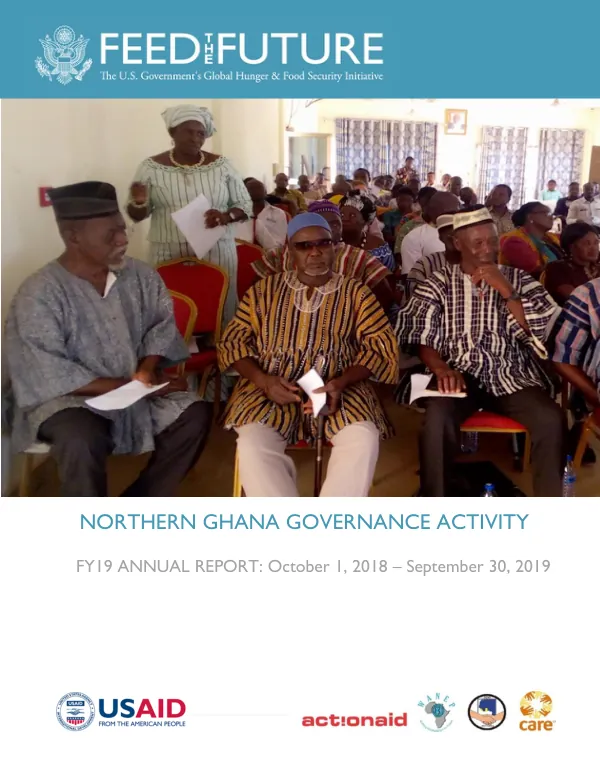
Feed the Future Northern Ghana Governance (NGG) Activity – FY19 Annual Report
The Feed the Future Northern Ghana Governance Activity is a USAID-funded project aimed at strengthening responsive governance for improved agriculture development in Ghana.
2019 · 46 pages
Sign in to readA free account is required to download.
Abstract
The project operates under a cooperative agreement with a total award amount of $11,447,513. The project's goal is to improve the capacity of local authorities to coordinate and deliver agricultural services, enhance the participation of civil society organizations (CSOs) and the private sector in agricultural development, increase women's participation in agricultural opportunities, and improve conflict management mechanisms for agricultural development. The project is implemented in the Northern Region of Ghana, with a focus on 28 districts. The project's interventions are guided by four components: Improved Coordination between Key Institutional Actors in Decentralized Agricultural Development, Improved CSOs and Private Sector Participation in Decentralized Agricultural Development, Enhanced Women's Participation in Agricultural Opportunities, and Improved Conflict Management Mechanisms for Agricultural Development. One of the key achievements of the project is the development of an electronic management information system (MIS) to facilitate data entry and improve data quality and reporting. The project trained and equipped 110 Community and District Monitoring Teams (CDMTs) members with phones for data entry into the MIS using Kobo-collect toolbox. This initiative has resulted in improved data quality and monitoring. The project also designed and implemented the District Agricultural Governance Index (DAGI), an Excel-based tool, to measure the responsiveness of local governments' (District Assemblies) responsiveness to agriculture development. Provisional data from the DAGI indicates that the districts have low prioritization and investment for agriculture. The results triggered the districts to increase their financial budgets and expenditure to improve service delivery in agriculture in the coming years. The project facilitated trainings for government officials and multi-stakeholder platform members on topics such as conflict management, agricultural policy, and women's participation in agriculture. The project also strengthened the capacity of local authorities to manage conflicts and enhanced early warning systems to mitigate threats. The project's results indicate that there has been an increase in household income among program participants compared to the control group. The project's achievements are a testament to the importance of strengthening responsive governance for improved agriculture development in Ghana. The project's geographic focus is on the Northern Region of Ghana, with a specific emphasis on 28 districts. The project's timeframes are from October 1, 2018, to September 30, 2019, with a total award amount of $11,447,513. The project's recommendations for future implementation include scaling up the District Agricultural Governance Index (DAGI) to other non-project districts and exploring opportunities to enhance women's participation in agricultural opportunities. The project's implementation details include the use of an electronic management information system (MIS) to facilitate data entry and improve data quality and reporting. The project also designed and implemented the District Agricultural Governance Index (DAGI) to measure the responsiveness of local governments' (District Assemblies) responsiveness to agriculture development. The project facilitated trainings for government officials and multi-stakeholder platform members on topics such as conflict management, agricultural policy, and women's participation in agriculture.