USAID DEC
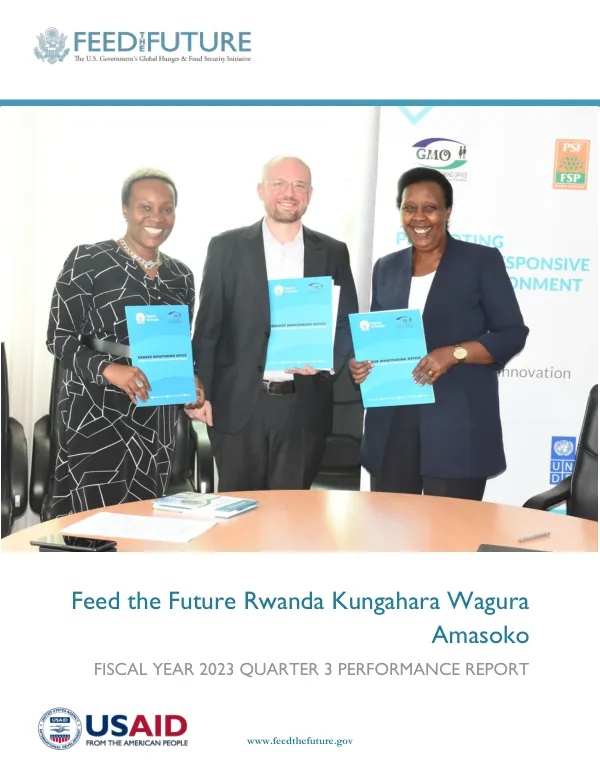
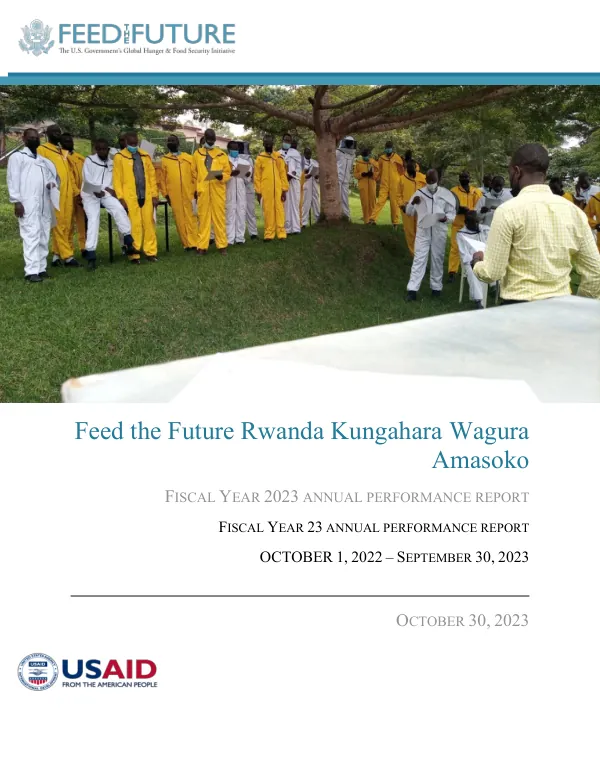
Feed the Future Rwanda Kungahara Wagura Amasoko Fiscal Year 2023 Annual Performance Report
Sign inRTI INTERNATIONAL
Feed the Future Rwanda Kungahara Wagura Amasoko Fiscal Year 2023 Annual Performance Report
The Kungahara Wagura Amasoko project, funded through Feed the Future, is a five-year USAID project aimed at boosting Rwanda's agricultural sector.
2023 · 133 pages
Sign in to readA free account is required to download.
Abstract
The project's primary objective is to increase the competitiveness of Rwanda's horticulture and coffee sectors, thereby enhancing the country's food security and economic growth. The project focuses on improving the quality and quantity of horticulture and coffee exports, as well as increasing the income of smallholder farmers. The project's implementation is divided into two main objectives. Objective 1 focuses on improving the competitiveness of Rwanda's horticulture and coffee sectors through the development of value chains, improvement of quality and quantity of exports, and enhancement of market access. Objective 2 aims to increase the income of smallholder farmers through the provision of training, capacity building, and access to finance. The project's monitoring, evaluation, and learning (MEL) framework is designed to track progress towards the project's objectives and identify areas for improvement. The framework includes indicators such as the number of smallholder farmers trained, the value of exports, and the income of smallholder farmers. The project also conducts regular assessments and evaluations to ensure that it is meeting its objectives and making a positive impact on the lives of smallholder farmers. One of the key challenges faced by the project is the limited access to finance for smallholder farmers. To address this challenge, the project has established partnerships with financial institutions to provide access to finance for smallholder farmers. The project has also established a database management system to track the progress of smallholder farmers and provide them with access to market information. The project has made significant progress in its first year of implementation. The number of smallholder farmers trained has increased, and the value of exports has also increased. The project has also established partnerships with key stakeholders, including the government of Rwanda, private sector companies, and civil society organizations. The project's success is dependent on the continued support of its stakeholders, including the government of Rwanda, private sector companies, and civil society organizations. The project will continue to work with its stakeholders to ensure that it is meeting its objectives and making a positive impact on the lives of smallholder farmers. The project's planned activities for the fourth quarter of FY 2023 include the continuation of training and capacity building for smallholder farmers, the establishment of partnerships with financial institutions to provide access to finance, and the continuation of monitoring and evaluation activities. The project will also conduct a midterm evaluation to assess its progress and identify areas for improvement. Overall, the Kungahara Wagura Amasoko project is making significant progress in its first year of implementation. The project's focus on improving the competitiveness of Rwanda's horticulture and coffee sectors, increasing the income of smallholder farmers, and providing access to finance is critical to the country's food security and economic growth.