USAID DEC
Contract 72069619C00001 Orora Wihaze FY2021 Quarter 3 Performance Report_USAID comments_tracked changes
Sign inCATHOLIC RELIEF SERVICES ORGANIZATION
Contract 72069619C00001 Orora Wihaze FY2021 Quarter 3 Performance Report_USAID comments_tracked changes
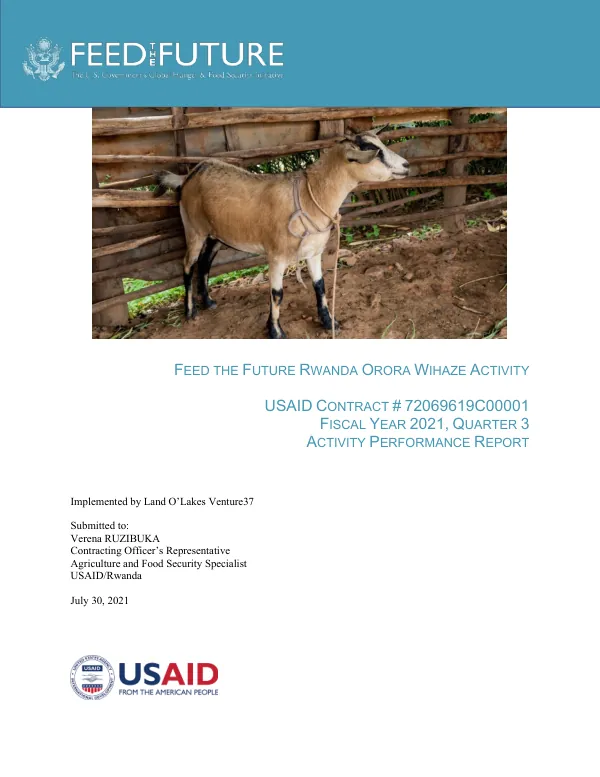
The Feed the Future Rwanda Orora Wihaze Activity is a USAID-funded program implemented by Land O'Lakes Venture37 in collaboration with Activity consortium partners.
2021 · 45 pages
Sign in to readA free account is required to download.
Abstract
The goal of the Activity is to sustainably increase the availability of, access to, and consumption of animal sourced foods (ASF) through the development of a profitable market. This goal is achieved by implementing two objectives through a Market Systems Development (MSD) approach: (1) Strengthen Private Sector Led ASF Value Chains and (2) Increase Demand for ASF Consumption for Women and Children. During the reporting quarter, the Activity achieved several milestones, including receiving USAID technical concurrence of two activity design documents (ADD), launching two new activities, signing collaboration agreements with five partner organizations, and completing the Social and Behavior Change (SBC) Strategy and Social and Behavior Change Communications (SBCC) Plan. The Activity team reviewed key Activity documents and tools and made important revisions to the ADD template and related tools in the design process with the goal to ease the process and reduce the amount of time spent developing activities. The MEL team worked to review Results Chains (RC) for all activities and updated the relevant activity monitoring plans (AMP) and associated data collection tools. MSA conducted a refresher training on MSD for the team to discuss and evaluate progress based on key pillars of scalability, sustainability, and inclusiveness of interventions in achieving market system change. The quarter closed with a Quarterly Portfolio Review (QPR) of interventions and specific actions to fast-track activity design and implementation. The Activity also hosted the USAID Economic Growth (EG) team for a status update, and the Contracting Officer's Representative (COR) visited an Activity site in Kayonza district. The Activity team reaffirmed the importance of a Request for Applications (RFA) targeting specific interventions that require additional partnerships and innovations. Key indicators recorded by the Activity by the end of Q3 include: 3,129 participants trained in Q3 with a cumulative of 3,655 trained participants during Year 2 against a target of 20,000 participants by the end of the year. The number of female participants in USG-assisted programs designed to increase access to productive economic resources was 58.2% during the reporting quarter, well above the life of project (LOP) target at 30%. The percentage of participants in USG-assisted programs designed to increase access to productive economic resources who are youth (15-29) was 17.2%, achieving an average YTD of 16.4% against a LOP target of 40%. The Activity team trained 3,129 participants in Q3, including individuals who participated in events organized to link Activity participants to relevant market actors such as financial institutions, agro-dealers, and transporters, amongst others, through targeted sessions at the district level. The Activity will continue to integrate women at every level to maintain a strong participation. The proportion of the youth participating in Orora Wihaze interventions is still low in part because youth engage less in livestock investment due to limited resources. The Activity has made significant progress in strengthening private sector-led ASF value chains and increasing demand for ASF consumption for women and children. The Activity has trained a significant number of participants, including women and youth, and has made important revisions to the ADD template and related tools in the design process. The Activity will continue to work towards achieving its goals and targets, including increasing the number of participants and improving the proportion of women and youth participating in Orora Wihaze interventions. The Activity has also made progress in implementing its objectives, including launching two new activities and signing collaboration agreements with five partner organizations. The Activity has completed the SBC Strategy and SBCC Plan, and has reviewed key Activity documents and tools. The Activity has also hosted the USAID EG team for a status update and has reaffirmed the importance of a Request for Applications (RFA) targeting specific interventions that require additional partnerships and innovations. The Activity's progress has been characterized by increased intensity of district-focused activities as COVID-19 travel restrictions were relaxed at the beginning of April, allowing for in-person meetings and trainings with stakeholders and market actors. Key Activity leaders made several visits to a selection of Activity sites to assess progress and further build relationships with implementing partners. The Activity has also made progress in implementing its Results Chains (RC) and has updated the relevant activity monitoring plans (AMP) and associated data collection tools.