USAID DEC
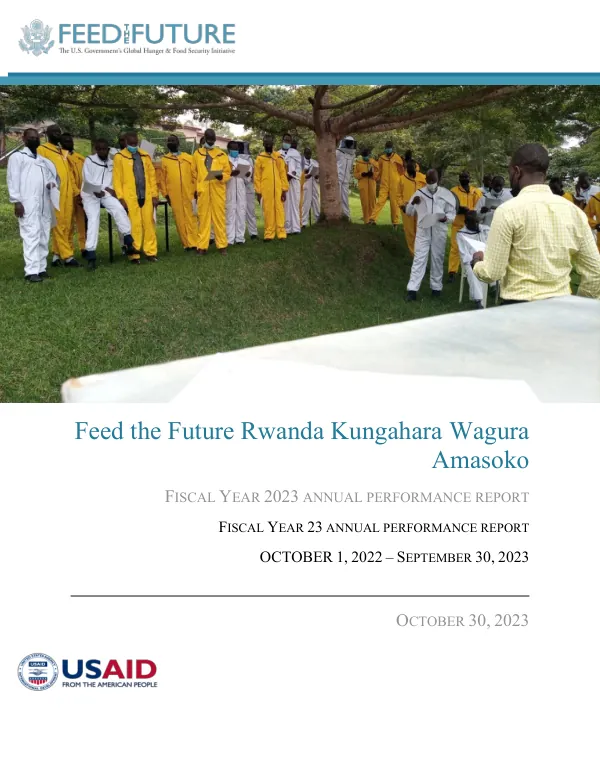
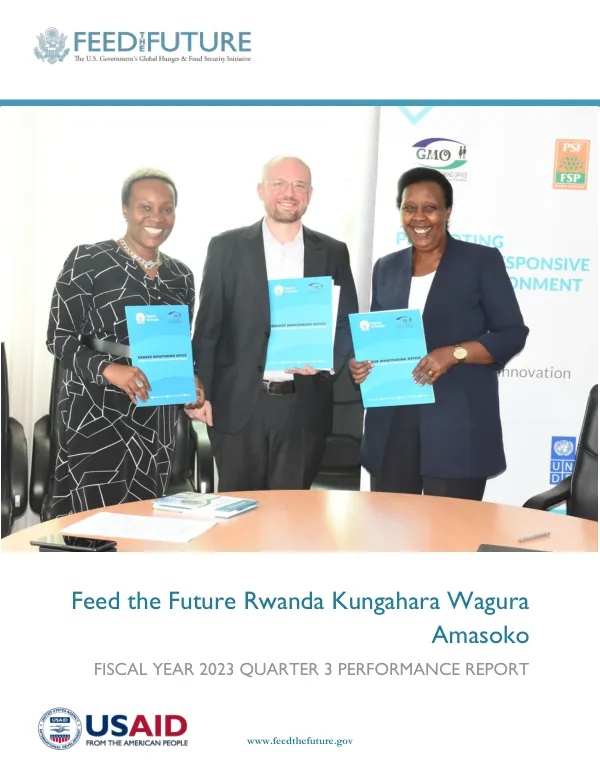
Feed the Future Rwanda Kungahara Wagura Amasoko FISCAL YEAR 2023 QUARTER 3 PERFORMANCE REPORT
Sign inGOVERNMENT OF UGANDA
Feed the Future Rwanda Kungahara Wagura Amasoko FISCAL YEAR 2023 QUARTER 3 PERFORMANCE REPORT
The Feed the Future Rwanda Kungahara Wagura Amasoko project is a five-year initiative that aims to boost the potential of Rwanda's high-value agricultural export sector.
2023 · 76 pages
Sign in to readA free account is required to download.
Abstract
The project, which began in 2018, works with the Government of Rwanda, private sector, civil society organizations, and other market players to drive sales, create jobs, and increase farm household income, particularly for women, youth, and persons with disabilities. The project's targeted high-value agricultural export commodities include coffee, tea, horticulture, and spices, dairy products, hides and skins, and other emerging value chains such as essential oil. The project's objectives are to increase the competitiveness of Rwanda's high-value agricultural export sector, improve the business environment, and enhance the capacity of small and medium enterprises (SMEs) to participate in the export market. To achieve its objectives, the project has implemented several activities, including the development of organizational capacity assessments (OCAs) for government institutions, the certification of SMEs, and the provision of training and coaching to youth and women-led SMEs. The project has also established partnerships with key stakeholders, including the Rwanda Development Board, the National Bank of Rwanda, and the Rwanda Standards Board. The project's monitoring, evaluation, and learning (MEL) framework is designed to track progress towards its objectives and identify areas for improvement. The framework includes indicators such as the number of SMEs certified, the number of jobs created, and the increase in farm household income. The project's MEL team has also conducted surveys and focus group discussions to gather data on the project's impact and identify lessons learned. One of the key challenges faced by the project is the limited access to finance for SMEs, particularly in rural areas. To address this challenge, the project has established partnerships with financial institutions to provide financing options for SMEs. The project has also implemented a pay-for-results (PfR) approach, which incentivizes SMEs to achieve specific performance targets. The project's quarterly activity performance report for FY 2023 Q3 highlights several achievements, including the certification of 25 SMEs, the creation of 150 jobs, and an increase in farm household income of 27%. The report also identifies several challenges, including the limited availability of high-quality inputs and the need for further training and coaching for SMEs. Overall, the Feed the Future Rwanda Kungahara Wagura Amasoko project has made significant progress in achieving its objectives, particularly in terms of increasing the competitiveness of Rwanda's high-value agricultural export sector and enhancing the capacity of SMEs to participate in the export market. However, the project still faces several challenges that need to be addressed to achieve its full potential.