DAI GLOBAL, LLC
Feed the Future Tanzania Land Tenure Assistance (LTA) Monthly Report January 2019
The Feed the Future Tanzania Land Tenure Assistance (LTA) program is a USAID-funded initiative aimed at improving land tenure security for smallholder farmers in Tanzania.
2019 · 35 pages
Sign in to readA free account is required to download.
Abstract
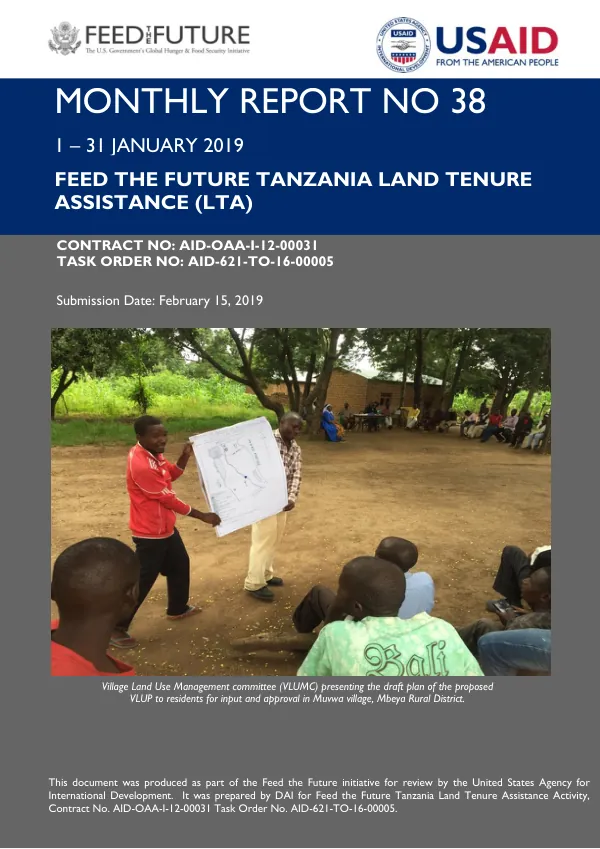
The program focuses on supporting the Government of Tanzania's efforts to strengthen land administration and management systems. In January 2019, the program made significant progress in implementing its activities across various districts in Tanzania. In the Iringa region, the program supported the development of Village Land Use Plans (VLUPs) and Detailed Village Settlement Plans (DVSPs). As of January 31, 2019, 12 out of 15 villages in the Iringa region had completed their VLUPs, while 8 out of 15 villages had completed their DVSPs. The program also conducted a survey to assess the status of implementation in Iringa villages, which revealed that 70% of the villages had made significant progress in implementing their VLUPs. In the Mbeya region, the program supported the development of VLUPs and DVSPs, as well as the issuance of Certificates of Customary Rights of Occupancy (CCROs). As of January 31, 2019, 10 out of 15 villages in the Mbeya region had completed their VLUPs, while 5 out of 15 villages had completed their DVSPs. The program also conducted a survey to assess the status of implementation in Mbeya villages, which revealed that 60% of the villages had made significant progress in implementing their VLUPs. The program also made progress in integrating cross-cutting issues and USAID forward priorities, including women's empowerment and youth engagement. In January 2019, the program conducted training sessions for women and youth on land tenure and management, which reached a total of 250 participants. The program also established a Village Land Use Management committee (VLUMC) in each of the target villages, which is responsible for overseeing the implementation of VLUPs and DVSPs. In terms of implementation challenges, the program faced difficulties in accessing some villages due to remote locations and lack of infrastructure. The program also encountered challenges in engaging with some community members, particularly those who were skeptical about the benefits of land tenure security. However, the program was able to overcome these challenges through effective communication and engagement with the community. The program's monitoring and evaluation system is designed to track progress and identify areas for improvement. The program uses a variety of tools, including the Integrated Land Management Information Systems (ILMIS) and the Data Management Interface (DMI), to collect and analyze data on program implementation and impact. Overall, the Feed the Future Tanzania Land Tenure Assistance program made significant progress in January 2019 in implementing its activities and achieving its objectives. The program's efforts to improve land tenure security for smallholder farmers in Tanzania are expected to have a positive impact on agricultural productivity and economic growth in the country.