USAID DEC
Feed the Future Tanzania MBOGA NA MATUNDA Market Stalls: A Game Changer in Local Markets
Sign inFEED THE FUTURE
Feed the Future Tanzania MBOGA NA MATUNDA Market Stalls: A Game Changer in Local Markets
The Feed the Future Tanzania MBOGA NA MATUNDA Market Stalls initiative has been instrumental in promoting the consumption of nutrient-rich crops in local communities.
2021 · 1 pages
Sign in to readA free account is required to download.
Abstract
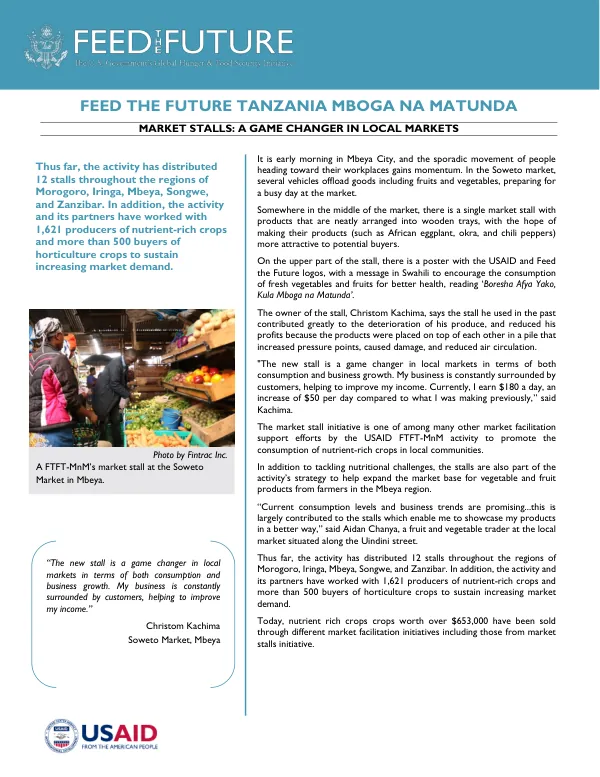
The activity has distributed 12 market stalls throughout the regions of Morogoro, Iringa, Mbeya, Songwe, and Zanzibar. These stalls have enabled farmers to showcase their products in a more attractive and appealing manner, thereby increasing market demand. The market stalls have been designed to address the challenges faced by farmers in the past, such as the deterioration of their produce due to poor storage and handling practices. The stalls feature wooden trays that allow for better air circulation and reduced pressure points, thereby minimizing damage to the produce. This has resulted in improved sales and increased income for farmers, with some reporting a daily income of up to $180. The initiative has also worked with 1,621 producers of nutrient-rich crops and more than 500 buyers of horticulture crops to sustain increasing market demand. The activity has partnered with local farmers to promote the consumption of fresh vegetables and fruits, which has led to improved health outcomes in the local communities. The USAID and Feed the Future logos are prominently displayed on the market stalls, along with messages in Swahili encouraging the consumption of nutrient-rich crops. The market stalls have been well-received by farmers and traders alike, with many reporting increased sales and improved business growth. Aidan Chanya, a fruit and vegetable trader, noted that the stalls have enabled him to showcase his products in a better way, leading to increased consumption levels and business trends. The initiative has also helped to expand the market base for vegetable and fruit products from farmers in the Mbeya region. To date, nutrient-rich crops worth over $653,000 have been sold through different market facilitation initiatives, including those from the market stalls initiative. The success of the initiative has been attributed to the effective design and implementation of the market stalls, which have addressed the challenges faced by farmers in the past. The initiative continues to promote the consumption of nutrient-rich crops in local communities, with a focus on improving health outcomes and increasing market demand.
Related documents