FINTRAC
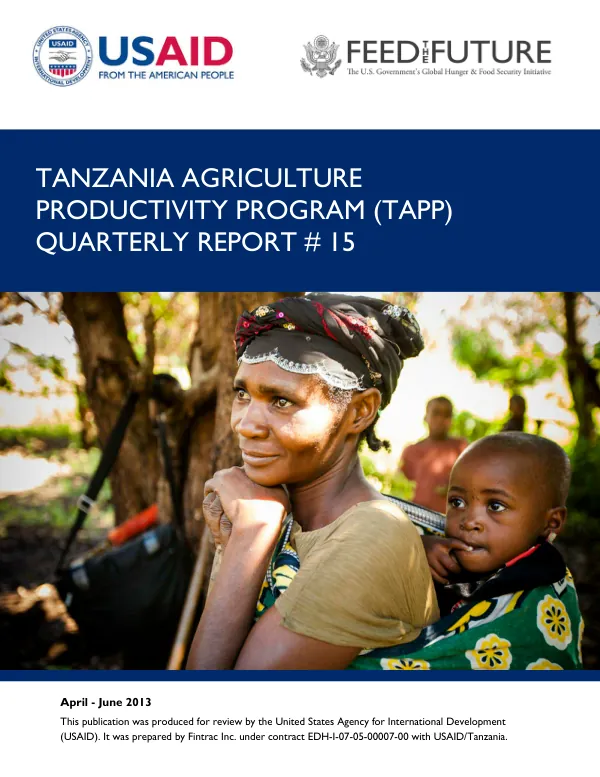
Tanzania Agriculture Productivity Program (TAPP) Quarterly Report #15
The Tanzania Agriculture Productivity Program (TAPP) is a USAID-funded initiative aimed at increasing smallholder incomes, improving nutrition, and expanding markets.
2013 · 21 pages
Sign in to readA free account is required to download.
Abstract
The program is part of the Feed the Future initiative and operates in Tanzania and the Isles of Zanzibar. In the third quarter of FY 2013, TAPP made significant progress towards its annual and overall program goals. TAPP expanded its farmer base during the reporting period, with a total of 4,121 new rural households joining the program across Tanzania and the Isles of Zanzibar. This brings the cumulative total of new households to 5,996 since the start of FY 2013, exceeding the annual target of 5,000 rural households by 19 percent. The program has expanded its outreach in all of its regions, with a faster expansion rate in the southern highlands and Morogoro. Training of farmers and rural households on production technologies, business skills, marketing, and nutrition is critical to achieving TAPP's higher-level goals. This quarter recorded the highest number of individuals trained during FY 2013, with a total of 4,739 unique trainees. The increase is due to more awareness of the USAID-TAPP project and the tangible success of client farmers within communities, resulting in higher numbers of neighboring farmers attending the trainings. As of the close of the third quarter, a total of 8,738 individuals received training from TAPP on agricultural sector productivity, health, nutrition, and business management. TAPP has been working with the private sector on designing lower-cost drip irrigation systems to make the technology more affordable for farmers. Modifications have been made to water pumps, filtering systems, air valves, and drip tape, resulting in a 50 percent price reduction for an acre of drip system. In addition, 120 farmer groups are growing their crops on just over 100 acres of drip systems. In the area of market and trade development, TAPP marketing specialists continued to develop relationships with reputable buyers from the main local markets in Tanzania. They also trained farmers on market-led production, providing market feedback in terms of seasonality, volume, frequency of delivery, quality expectations, and establishing the right market links. A wide range of market contacts have been established and valuable feedback has been provided to TAPP agronomists on the most promising opportunities for farmers. TAPP improved access to domestic markets by assisting farmers in making direct links to buyers. During the reporting quarter, 68 farmer groups were linked to commercial buyers from local markets, including Ilula, Tunduma, Dar es Salaam, Iringa, Mbeya, Zanzibar, and Njombe markets. Initial sales to these buyers totaled over $55,000. After initial introductions were made and business transactions were completed between buyers and sellers, TAPP allowed farmers and buyers to continue their negotiations. A trip to the Middle East was carried out to assess export potential for sweet potato, onion, carrot, avocado, pineapple, and mango. It was found that enormous potential exists for Tanzania to export to the Middle East. Select contacts established during the trip have been shared with Tanzanian companies who are following up with these buyers for potential new business opportunities. In the area of crosscutting themes, 623 orphans and vulnerable children (OVCs) were provided with core care services, and 498 new vulnerable households were assisted by the project, both directly and through partners. Business development specialists trained over 50 farmer groups on entrepreneurship, basic recordkeeping, costing, and sales records. These skills have proven to be useful for farmers, as they are able to determine crop profitability by accurately tracking costs and sales. TAPP has established seven public-private partnerships (PPPs) with organizations such as PACT, GreenRain, and Africado to support the development of outgrower schemes for the production and commercialization of high-value crops. These partnerships will link thousands of smallholder farmers with reliable markets for high-value crops. Partnerships with Kibo Trading, ZAIDI, and EcoAgriConsult will increase the availability of high-quality inputs and new technologies in rural areas of Tanzania with high potential for agricultural development. USAID-TAPP's partnership with Global Service Corps will improve the availability of nutritious foods in thousands of poor households in Northern Tanzania, as well as raise awareness of health and nutrition issues through trainings. A second call for proposals was requested during the period, and over 160 applicants responded. After review by the grants committee, seven additional PPPs are currently being prepared for approval. Implementation of these partnerships is expected to commence before the end of FY 2013.
Related documents
![Measurement Approaches for Effective Coverage Estimation [MR31]](https://covers.devme.ai/gen/138167.webp)