FINTRAC
Feed the Future Tanzania Mboga na Matunda Monthly Update: September 2021
The Feed the Future Tanzania Mboga na Matunda (FTFT-MnM) activity is a five and a half-year initiative funded by the United States Agency for International Development (USAID).
2021 · 2 pages
Sign in to readA free account is required to download.
Abstract
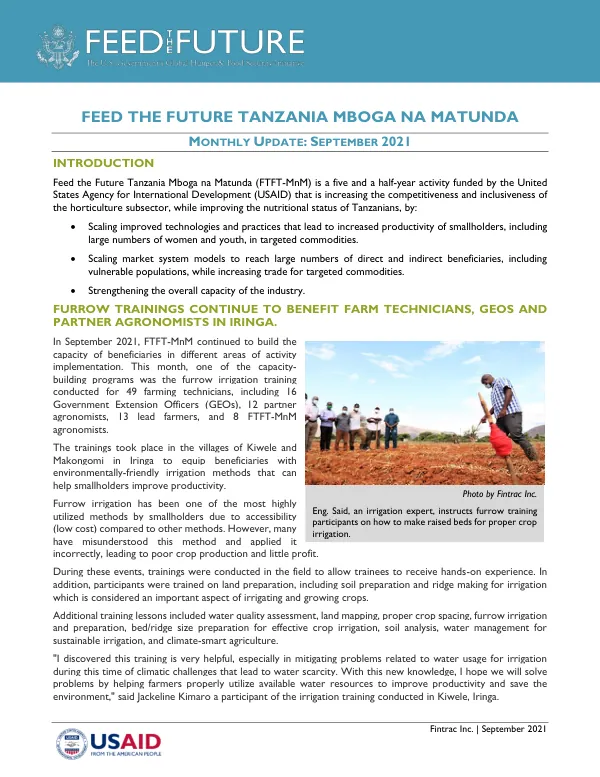
The program aims to increase the competitiveness and inclusiveness of the horticulture subsector in Tanzania, while improving the nutritional status of Tanzanians. Key objectives include scaling improved technologies and practices to increase smallholder productivity, scaling market system models to reach vulnerable populations, and strengthening the overall capacity of the industry. Capacity-building programs are a crucial component of FTFT-MnM. In September 2021, the program conducted furrow irrigation training for 49 farming technicians, including 16 Government Extension Officers (GEOs), 12 partner agronomists, 13 lead farmers, and 8 FTFT-MnM agronomists. The training took place in the villages of Kiwele and Makongomi in Iringa, equipping beneficiaries with environmentally-friendly irrigation methods to improve productivity. Furrow irrigation is a highly utilized method by smallholders due to its accessibility and low cost, but many have misunderstood its application, leading to poor crop production and little profit. The training included hands-on experience in the field, as well as lessons on land preparation, water quality assessment, land mapping, proper crop spacing, furrow irrigation and preparation, bed/ridge size preparation for effective crop irrigation, soil analysis, water management for sustainable irrigation, and climate-smart agriculture. Participants reported that the training was helpful in mitigating problems related to water usage for irrigation, particularly during times of climatic challenges that lead to water scarcity. In addition to the furrow irrigation training, FTFT-MnM conducted field exchange visits in Pemba-Zanzibar, bringing together seven buyers, five aggregators, and seven GEOs to harmonize the planting calendar with smallholders. The exchange visit aimed to encourage diversification of horticultural crops production, as many farmers previously focused on a single crop, such as tomato, leading to a shortage of other fruits and vegetables on the island. Participants exchanged knowledge on production, harvesting, and transportation of crops, as well as postharvest handling procedures, quality and standards of fresh horticultural produce, packaging operations, food safety, transportation, and disease management. Since its inception in 2017, the USAID Feed the Future Mboga na Matunda activity has empowered more than 770,000 different stakeholders in the horticulture value chain, helping them increase productivity. The program's comprehensive capacity-building programs aim to help smallholders increase food productivity and security, ultimately improving the nutritional status of Tanzanians.