USAID DEC
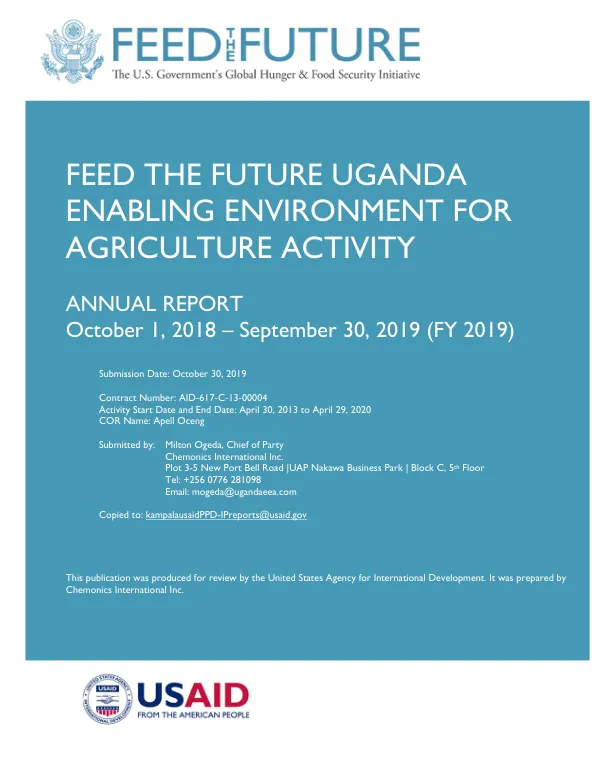
Feed the Future Uganda Enabling Environment for Agriculture Activity Annual Report FY19
Sign inCHEMONICS
Feed the Future Uganda Enabling Environment for Agriculture Activity Annual Report FY19
The Feed the Future Uganda Enabling Environment for Agriculture Activity began in April 2013 with the goal of improving the enabling environment for agriculture in Uganda.
2019 · 61 pages
Sign in to readA free account is required to download.
Abstract
The activity is led by Chemonics International Inc. and is funded by the United States Agency for International Development (USAID). The activity's primary objective is to enhance the capacity of the Government of Uganda to develop and implement policies, regulations, and institutional frameworks that support agricultural development. The activity focuses on three main areas: policy and regulatory reform, institutional capacity building, and stakeholder engagement. The policy and regulatory reform component aims to strengthen the policy and regulatory framework for agriculture, while the institutional capacity building component focuses on building the capacity of key institutions, such as the Ministry of Agriculture, Animal Industry and Fisheries (MAAIF) and the Uganda Coffee Development Authority (UCDA). The stakeholder engagement component involves working with various stakeholders, including farmers, private sector organizations, and civil society organizations, to ensure that their needs and concerns are taken into account in the policy and regulatory reform process. The activity operates at both the national and district levels, with a focus on 38 Feed the Future districts and the Global Food Security Strategy (GFSS) Uganda Zones of Influence (ZOI). The activity's geographic coverage is countrywide, with a focus on national-level policies and regulatory instruments. The activity's reporting period is from October 1, 2018 to September 30, 2019, and this report provides an overview of the activity's progress and achievements during this period. The report highlights the activity's key accomplishments, including the development of a new national agricultural policy, the strengthening of the capacity of MAAIF and UCDA, and the establishment of a stakeholder engagement platform. The activity has made significant progress in achieving its objectives, with notable achievements in policy and regulatory reform, institutional capacity building, and stakeholder engagement. The activity has also made significant contributions to the Country Development Cooperation Strategy (CDCS) Results Framework, with notable progress in the areas of policy and regulatory reform, institutional capacity building, and stakeholder engagement. The activity's leadership development component has also made significant progress, with the development of a leadership development plan and the implementation of training programs for key staff. The activity's environmental compliance component has also made significant progress, with the development of an environmental compliance plan and the implementation of measures to minimize the activity's environmental impact. The activity's award-specific reporting requirements have been met, and the activity's management and administrative issues have been addressed. The activity's planned activities for the next year, including upcoming events, are also outlined in the report. The activity has a strong partnership with the Government of Uganda, with key counterpart organizations including MAAIF, UCDA, and the Ministry of Water and Environment (MWE). The activity has also established partnerships with private sector organizations, civil society organizations, and other stakeholders to ensure that their needs and concerns are taken into account in the policy and regulatory reform process. The activity's financial management is also robust, with a strong financial management system in place to ensure that the activity's financial resources are managed effectively and efficiently. The activity's management and administrative issues have been addressed, and the activity's planned activities for the next year, including upcoming events, are also outlined in the report. Overall, the Feed the Future Uganda Enabling Environment for Agriculture Activity has made significant progress in achieving its objectives, with notable achievements in policy and regulatory reform, institutional capacity building, and stakeholder engagement. The activity has also made significant contributions to the CDCS Results Framework, and its leadership development, environmental compliance, and financial management components have also made significant progress.