USAID DEC
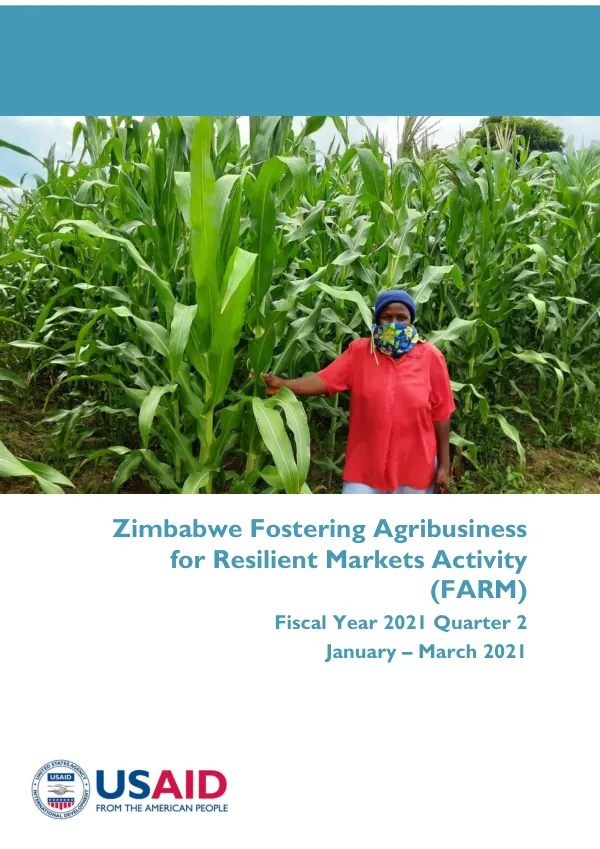
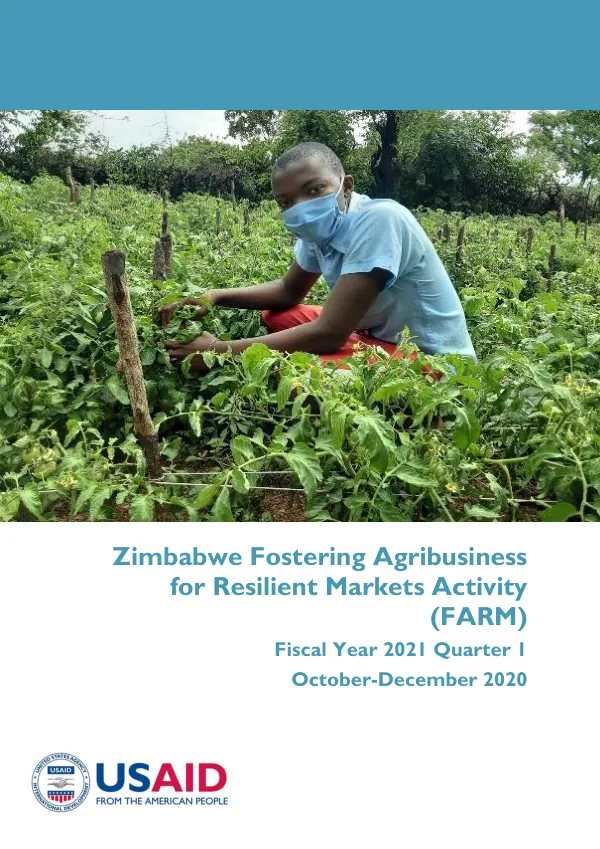
Feed the Future Zimbabwe Fostering Agribusiness for Resilient Markets Activity (FARM)
Sign inANOTHER OPTION, LLC
Feed the Future Zimbabwe Fostering Agribusiness for Resilient Markets Activity (FARM)
The Feed the Future Zimbabwe Fostering Agribusiness for Resilient Markets (FARM) Activity aims to reduce rural poverty and increase food security and resilience among 20,000 smallholder farmers in Natural Regions III, IV, and V of Manicaland and Masvingo provinces.
2021 · 50 pages
Sign in to readA free account is required to download.
Abstract
The Activity seeks to achieve this goal through climate-smart market-driven production, productivity, and value-chain development that increase smallholder farmers' food security, incomes, nutritional status, and resilience. FARM will focus on increasing incomes, agricultural production and productivity, business and finance activities, improving nutrition and hygiene status, and social behavior change. The Activity will also engage with beneficiary households to improve their hygiene and nutrition practices. Direct technical assistance from FARM will address humanitarian and food security needs to increase smallholder farmers' incomes and generate income for other community members through employment in the agricultural sector. The Activity has identified potential partners, including commercial companies, other USAID programs, and nongovernmental organizations (NGOs). Partnerships with financial organizations, private sector traders, processors, input suppliers, and technical service providers are a key part of FARM's approach to commercialization of smallholder farmers. During the review period, FARM continued to identify potential partners and collaborated with some of them in providing training and technical assistance and purchasing produce from smallholder farmers. A baseline survey was conducted among 413 households in the communities of Buhera, Mutare, Chimanimani, Chipinge, Chiredzi, Zaka, Bikita, Masvingo, Chivi, and Mwenezi districts where FARM plans to work. The survey results informed target geographic areas, indicator targets, and technical areas for intervention. FARM has the resources to leverage investments in feasible and viable value chains that have high participation of small and medium entrepreneurs, including smallholder farmers. Field interventions started in the two districts of Chipinge and Chiredzi, piggybacking on the MOUs of Fintrac and NAZ. The 2020/2021 agricultural season started off well in most parts of Chipinge and Chiredzi districts, with some areas receiving the first rains in October 2020 and receiving effective rains by early December 2020. Cumulative rainfall for the quarter under review for Chipinge and Chiredzi districts were 300 millimeters and 143 millimeters, respectively. The rains received allowed farmers to commence cropping activities on dryland sites. Cattle condition was very poor until mid-November 2020 due to inadequate drinking water and grazing from the rangelands. The continuous rains since November 2020 have improved the availability and quality of grazing from the rangelands and drinking water, impacting positively on cattle condition. By the end of the review period, cattle condition had improved from about 1.5 to 2 in mid-November 2020 to average body condition scores between 2.5 to 3. The Activity provided technical assistance for on-farm tick control using knapsack sprayers and encouraged farmers to procure PERSUAP compliant acaricides to safeguard their livestock. Outbreak of Theileriosis was reported in both Chipinge and Chiredzi districts due to high tick infestations encouraged by the hot and wet conditions and limited dipping services from the government-run dipping facilities. During the review period, the Activity achieved several specific objectives, including working with 348 farmers, 49 percent women and 13 percent youth, in Chipinge and Chiredzi districts. Farmers received training and technical assistance on Good Agricultural Practices (GAPs), Good Animal Husbandry Practices (GAHPs), crop production, and establishment of crop demonstration plots. Sixty-five farmer-managed crop and livestock demonstration sites were set up to augment the technical training, show good GAPs and GAHPs, and facilitate farmer-to-farmer learning, technology adoption, and enhance linkages with the private sector input suppliers and output buyers. The Activity facilitated 35 smallholder cattle owners (46 percent women) to access $10,488 (an average of $300 per smallholder cattle owner) in loans to purchase veterinary drugs, pen-fattening, and supplementary stock feed. The beef farmers pen-fed 71 cattle for 45 days and realized $39,000 in gross sales through Montana Carswell Meats abattoir.
Related documents