NORC AT THE UNIVERSITY OF CHICAGO
Fellows Deploy Scientific Skills to Support USAID Strategies and Policies
The Research Technical Assistance Center (RTAC) is a collaborative effort between RTAC and NORC at the University of Chicago, supported by the United States Agency for International Development (USAID) under contract no.
2024 · 2 pages
Sign in to readA free account is required to download.
Abstract
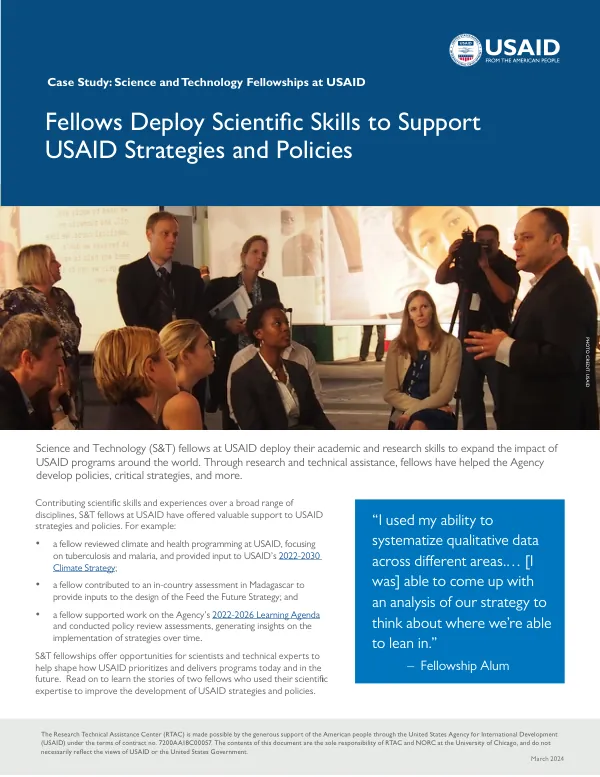
7200AA18C00057. RTAC's Science and Technology (S&T) fellows deploy their scientific skills to expand the impact of USAID's strategies and policies worldwide. S&T fellows contribute their expertise in various fields, including climate and health programming, to inform USAID's strategies and policies. For instance, a fellow analyzed climate and health programming at USAID, focusing on climate and health programming, and provided inputs to USAID's 2022-2030 Climate Strategy. Another fellow contributed to an in-country assessment in Madagascar, providing inputs to the Feed the Future Strategy. The S&T fellowship program offers opportunities for scientists and technical experts to help USAID prioritize and deliver programs today and in the future. The program has supported the development of USAID's first Policy on Promoting the Rights of Indigenous Peoples, as well as the creation of the Agency's Learning Agenda. Lauren Baker, a political ecologist, was a fellow at USAID's Office of Policy from 2016-2018. Baker supported the creation of USAID's first Policy on Promoting the Rights of Indigenous Peoples, leveraging her expertise in climate change policy and inclusive development. She also traveled throughout Latin America, providing technical advice and assistance to USAID's in-country policy teams. Cleo Chou, an ecologist, was a fellow from 2018-2020 in USAID's Office of Global Climate Change. Chou supported USAID's Natural Climate Solutions program, which partners with governments to conserve and restore forests and other ecosystems. Chou helped design activities in various regions, including Papua New Guinea and Papua New Guinea, and led an analysis to strategically prioritize USAID's natural climate solutions program. The S&T fellowship program has enabled fellows to develop policies, build capacity, and support changing economic systems and Indigenous Peoples and local communities. The program continues to push for scaling up solutions to global challenges, such as climate change and biodiversity loss.
Related documents