USAID
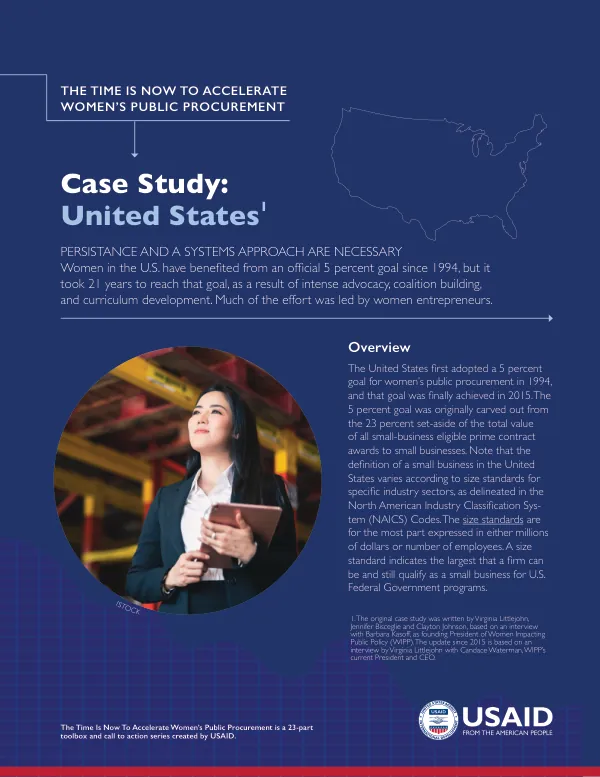
The Time is Now to Accelerate Women's Public Procurement: Case Study: United States
The United States first adopted a 5 percent goal for women's public procurement in 1994, with the goal of awarding 5 percent of federal contracts to small businesses owned by women.
2021 · 15 pages
Sign in to readA free account is required to download.
Abstract
This goal was achieved in 2015, after 21 years of intense advocacy, coalition building, and curriculum development led by women entrepreneurs. The original case study was written by Virginia Littlejohn, Jennifer Bisceglie, and Clayton Johnson, based on an interview with Barbara Kasoff, the founding President of Women Impacting Public Policy (WIPP). The update since 2015 is based on an interview by Virginia Littlejohn with Candace Waterman, WIPP's current President and CEO. To participate in and be certified for the Women-Owned Small Business (WOSB) program, a firm must be a small business, be at least 51 percent owned and controlled by women who are U.S. citizens, and have women manage day-to-day operations and make long-term decisions. There is also a category of Economically Disadvantaged Women-Owned Small Business (EDWOSB) that meets the above requirements and also meets requirements concerning income, personal assets, and net worth. Current efforts in the United States focus on creating a strategic new partnership, enhanced curriculum development, especially linking corporate and public procurement, virtualization of training due to the COVID-19 pandemic, opening up more industry sectors to WOSBs, continued advocacy and coalition building, changes in the certification process, and updates on achieving the 5 percent goal, which was documented through fiscal year 2019. The United States is unique in that almost all progress on women's public procurement has been spearheaded by the private sector. The United States has a dynamic women's entrepreneurial sector, which has grown more rapidly than the overall economy over the past 20 years. However, gains within the federal procurement space have not reflected that growth. This case study draws on the experience of Women Impacting Public Policy (WIPP), a non-partisan advocacy group that was a key actor in enabling the United States to reach the 5 percent threshold for awarding procurement contracts to small businesses owned by women. The case study analyzes how policymakers sought to overcome the obstacles to gender equality in federal procurement and reviews the changes achieved. The drivers of success in achieving the 5 percent goal were an effective bipartisan advocacy strategy, awareness-raising among women on entrepreneurship issues and coalition-building, capacity-building and curriculum development to facilitate women's success in procurement processes, technical and operational issues, certification, and sectoral research and analysis that resulted in evidence-based policymaking. The government established a "set-aside" program, which allowed for opportunities to be set aside exclusively for small businesses, including WOSBs. This program became the foundation for the U.S. Federal Government establishing the goal of federal agencies awarding 5 percent of their contracts to WOSBs. Bipartisan advocacy and policymaker education played a crucial role in achieving the 5 percent goal. WIPP's approach emphasized the economic rationale, supporting its arguments with research and hard data. Potential policy influencers became convinced that the use of WOSB contractors presented an untapped opportunity for economic growth. They also believed that their constituents would tangibly benefit from higher gross domestic product (GDP) and employment growth. WIPP's leaders participated actively in the Democratic and Republican conventions in 2008, working to educate the party platforms and presidential candidates on the procurement opportunity for women.