CHEMONICS
FEWS NET 7_EWT_FY23Q1_Quarterly Report
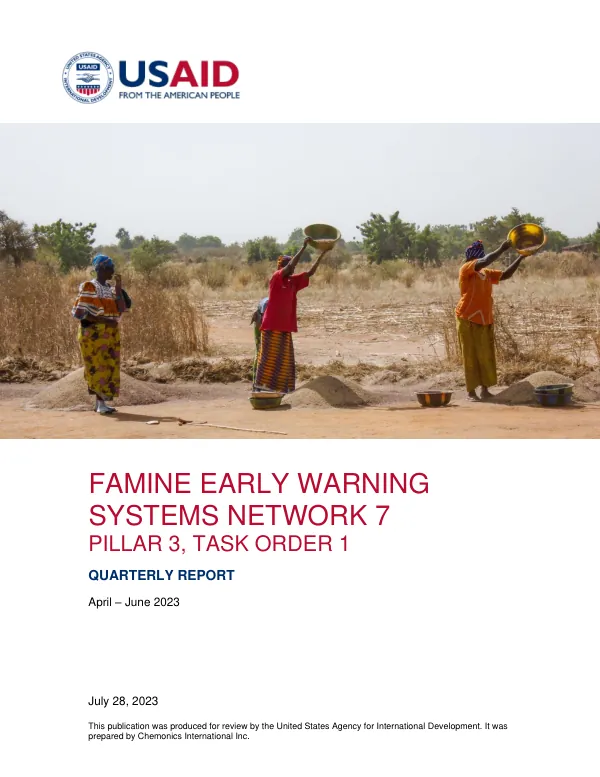
The Famine Early Warning Systems Network 7 (FEWS NET 7) Pillar 3, Task Order 1 (TO 1) activities for the April 1, 2023, to June 30, 2023, reporting period focused on developing and updating Household Economy Analysis (HEA) livelihood zone baseline profiles, as well as associated analysis tools, such as the Livelihoods Impact Analysis Spreadsheet (LIAS) and the Decision-Makers Dashboard.
2023 · 13 pages
Sign in to readA free account is required to download.
Abstract
The technical team, led by Chemonics International Inc., collaborated with international, regional, and national partners to collect information on household livelihoods. The primary objective of this task order is to develop and update HEA livelihood zone baseline profiles, as well as the associated analysis tools. The technical team will also leverage existing in-country technical capacity in HEA data collection and analysis, capitalizing on local contextual and geographic expertise. Pillar 3 TO 1's activities will operate within the existing national food security analysis infrastructure and promote interagency data exchanges, collaborative analysis, and technical capacity strengthening across the task order's selected geographies. FEWS NET 7 comprises four pillars, which work together to produce a timely, relevant, and evidence-based analysis of the causes, severity, and consequences of food insecurity to inform international, national, and local decision-making. Pillar 1, the Early Warning Team (EWT), provides timely, accurate, and transparent early warning of current and future acute food insecurity worldwide. Pillar 2, the FEWS NET Learning and Data Hub, ensures that FEWS NET data and analysis are captured, documented, and made widely accessible for users through the FEWS NET website and other delivery channels. Pillar 3, Analysis of the dynamics of food, nutrition, and livelihood security, deepens understanding of the causes of persistent or recurrent food insecurity, malnutrition, and vulnerability so appropriate responses can be developed. This pillar uses and expands on FEWS NET's rich understanding of livelihoods, markets, agroclimatology, nutrition, and other socioeconomic phenomena to help identify solutions to sustainably enhance food, nutrition, and livelihood security and build resilience. During the reporting period, the technical team continued implementation in Nigeria and Mali and met a number of key project milestones. The team submitted a revised base year work plan, which outlined the activities to be implemented during the reporting period. The team also conducted a regional orientation workshop in Maiduguri, Nigeria, which facilitated collaboration and coordination among stakeholders. The technical team also switched base year countries, which required adjustments to the work plan and implementation strategy. Security concerns also posed a challenge, and the team had to adapt to changing circumstances. Despite these challenges, the team made progress in implementing the base year activities and met key project milestones. The technical team will continue to work on developing and updating HEA livelihood zone baseline profiles, as well as associated analysis tools, during the next reporting period. The team will also continue to leverage existing in-country technical capacity in HEA data collection and analysis and promote interagency data exchanges, collaborative analysis, and technical capacity strengthening across the task order's selected geographies. The technical team will also continue to work on Pillar 3's objectives, including deepening understanding of the causes of persistent or recurrent food insecurity, malnutrition, and vulnerability. The team will use and expand on FEWS NET's rich understanding of livelihoods, markets, agroclimatology, nutrition, and other socioeconomic phenomena to help identify solutions to sustainably enhance food, nutrition, and livelihood security and build resilience. The technical team will also continue to collaborate with international, regional, and national partners to collect information on household livelihoods and develop and update HEA livelihood zone baseline profiles, as well as associated analysis tools. The team will also continue to promote interagency data exchanges, collaborative analysis, and technical capacity strengthening across the task order's selected geographies. The technical team will also continue to work on Pillar 4, Technology and innovation support, which ensures that innovations in data collection and analysis related to FEWS NET's core mission are available and utilized across all implementing partners. The team will continue to explore new methods for delivering FEWS NET data, tools, information, knowledge, and learning to other FEWS NET partners and users beyond the project's food insecurity stakeholder audiences. The technical team will also continue to work on the Decision-Makers Dashboard, which provides a user-friendly interface for accessing and analyzing FEWS NET data and analysis. The team will continue to develop and update the dashboard to ensure that it meets the needs of users and provides timely, relevant, and evidence-based information to inform international, national, and local decision-making. The technical team will also continue to work on the Livelihoods Impact Analysis Spreadsheet (LIAS), which provides a tool for analyzing the impact of different livelihood strategies on food security and nutrition outcomes. The team will continue to develop and update the LIAS to ensure that it meets the needs of users and provides timely, relevant, and evidence-based information to inform international, national, and local decision