UNIVERSITY OF MARYLAND
Field Summaries 2015
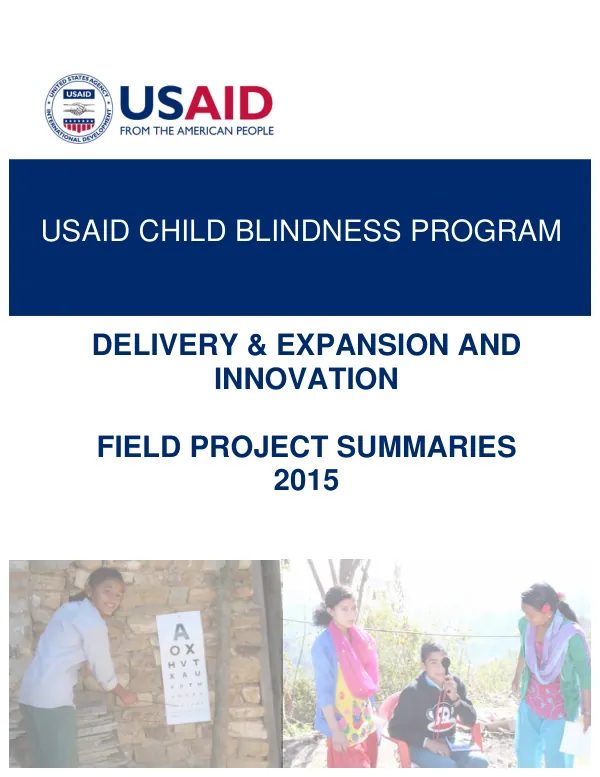
The Child Blindness Program (CBP) is a collaborative effort to address child blindness in various regions around the world.
2015 · 5 pages
Sign in to readA free account is required to download.
Abstract
In northern Tanzania, the Kilimanjaro Centre for Community Ophthalmology (KCCO) is working with schools to identify children in need of eye care services. The program focuses on training and strengthening the capacity of 250 teachers in public schools to properly refer children with severe vision problems to regional hospitals. An estimated 1,500 children will be screened for eye care conditions, and 270 will receive additional services. Physicians for Peace (PFP) is partnering with its local counterparts, PFP-Philippines, to boost organizational capacity and strengthen the foundation of its vision care program. Efforts include conducting a baseline assessment of capability to identify areas of improvement, such as motivating volunteer optometrists in outlying rural areas. This will inform action plans to lead to better care and expanded eye care services. In India, the Aravind Eye Hospital (AEH) is working to determine if preschool children can efficiently and effectively be screened for poor vision. The project will engage members of the community to develop a referral network to screen 40,000 children in three districts. The project will use relatively new vision screening technology that allows children to be screened quickly and without discomfort. Services for the children referred from screenings will be made available, and a campaign will be started to improve awareness of eye problems in children among general physicians, preschool teachers, pediatricians, and the community at large. World Gospel Mission (WGM) is expanding coverage of quality eye care services throughout the Nyanza and S. Rift Valley provinces of Kenya. WGM's collaboration with CBP and USAID's American Schools and Hospitals Abroad (ASHA) is building and equipping a new hospital. CBP's role is providing essential ophthalmologic tools and supplies, including exam chairs, floor units, lamps, and ophthalmoscopes. These resources will double the capacity of the services the current hospital can provide, significantly increasing availability of eye care services for children and other vulnerable populations in Kenya. The Kilimanjaro Centre for Community Ophthalmology (KCCO) is conducting research that directly contributes to CBP's goals to increase knowledge sharing and the use of best practices. Specifically, KCCO is examining the efficacy of community health workers and volunteers to identify children with severe vision loss or blindness and refer them to receive appropriate care. KCCO will also examine the latest research regarding the use of school teachers to screen, identify, and refer children in need of eye care services. Further, research will explore different strategies to achieve the best follow-up possible after eye surgery. Aravind Eye Hospital (AEH) is focusing its efforts on diagnosing and increasing the treatment of Retinopathy of Prematurity (ROP), a disease in premature babies that could lead to blindness. AEH will be implementing a telescreening program called ROPE-SOS throughout Special Neonatal Care. The main goal of this program is to perform ROP screening in 10 underserved and rural areas. Initially, AEH will train technicians to use a retinal camera, and the retinal images will be transmitted real-time through broadband internet to a remote ROP expert. Babies identified with this blinding disease will be immediately referred to the base hospital, or if the child is too sick to travel, prompt onsite laser treatment will be delivered by the ROP expert with a portable laser tool. CBP is collaborating with the College of Ophthalmology of Eastern, Central, and Southern Africa (COECSA) to address child blindness in northern Tanzania through the capacitation of Assistant Medical Officers (AMO) and sub-specialty training for ophthalmologists. In support of the Child Blindness Prevention Program in Tanzania, COECSA will train AMOs in pediatric eye care for the early identification of eye patients and proper follow-up care. They will work closely with the Kilimanjaro Christian Medical College as needed for definitive diagnosis, treatment, and/or surgery. Orbis International is strengthening treatment and prevention of child blindness in Northwest Ethiopia. To do this, the organization will be training and educating 96 teachers, parents, and volunteers to screen 23,000 children and identify those in need of vision care. They will also be equipping facilities with appropriate supplies to increase treatment, and conducting a large-scale multimedia education campaign with eye care messages targeted to 40,000 community members. Elim Eye Hospital in Nigeria is working in partnership with the University of Calabar Teaching Hospital and Mercy Hospital to increase their capacity to deliver quality pediatric eye surgeries, including cataract. A total of 2,500 children will be examined and cared for, and 260 children will benefit from high-quality cataract surgery and refractive services. The project will increase the capacity of the pediatric surgical team by enhancing the facilities and improving community outreach. This includes training of a pediatric ophthalmologist provided by Emory University, new equipment and supplies, and better transport between the outlying Mercy Hospital and the
Related documents