UNIVERSITY OF HAWAII AT MANOA
Filipino 2040: Environmental Resources, Shocks, and National Well-Being
Environmental Resources, Shocks, and National Well-Being in the Philippines by 2040 The Philippines aims to achieve a high level of well-being by 2040, with Filipinos envisioning a simple and comfortable life in vibrant and resilient communities.
2016 · 2 pages
Sign in to readA free account is required to download.
Abstract
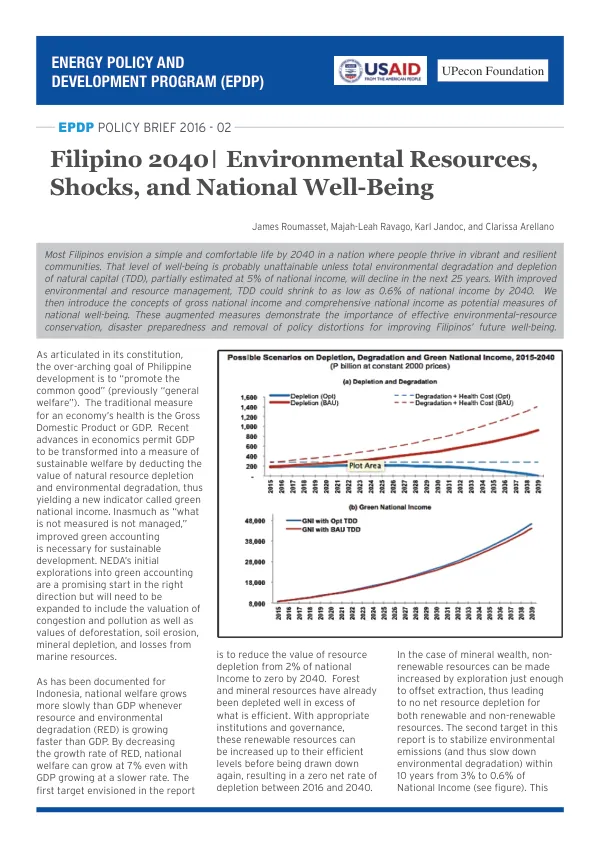
However, this goal is unlikely to be attained unless total environmental degradation and depletion of natural capital (TDD) decline significantly over the next 25 years. With improved environmental and resource management, TDD could decrease from 5% of national income to as low as 0.6% by 2040. The study introduces the concepts of gross national income and comprehensive national income as potential measures of national well-being. These measures demonstrate the importance of environmental-resource conservation, disaster preparedness, and the removal of policy distortions for enhancing Filipinos' future well-being. The report emphasizes the need for improved accounting for environmental degradation and resource depletion, as well as the valuation of congestion and losses from marine resources. The study proposes two targets for the Philippines: to reduce the value of resource depletion from 2% of national income to zero by 2040, and to stabilize environmental emissions within 10 years from 3% to 0.6% of national income. These targets can be achieved through a package of market-based control instruments, such as emission taxes or cap-and-trade arrangements. Additionally, integrated management of natural disaster risks, including climate change, can increase national welfare at a greater rate than GDP's growth rate. The study also introduces the concept of comprehensive national income (CNI), which is a more comprehensive measure of national welfare that incorporates event probabilities. CNI is a forward-looking measure that does not suffer from downward revisions due to adverse events. This allows for the evaluation of the effectiveness of various measures in reducing the probabilities of welfare losses. Policy issues related to the promotion of the common good include the efficient management of natural and environmental resources, as well as integrated management of disaster risks. The study emphasizes that trying to manage environmental and resource systems with separate objectives can detract from national welfare. GDP can be extended to a green national income, which more completely measures national welfare. The study proposes several policy recommendations to achieve the targets of reducing resource depletion and stabilizing environmental emissions. These include growing renewable resource stocks, increasing exploration for minerals, and halting the growth of emissions through market-based control instruments. Additionally, policy reforms are needed to promote efficient exploration and progressive royalty assessment to finance capital formation. The study also highlights the importance of integrated management of natural disaster risks, including climate change, to enhance national welfare. This approach requires an integrated approach that incorporates the interdependence of protection, early warning, rapid response, and the enhancement of individual and community coping mechanisms.