ABT ASSOCIATES
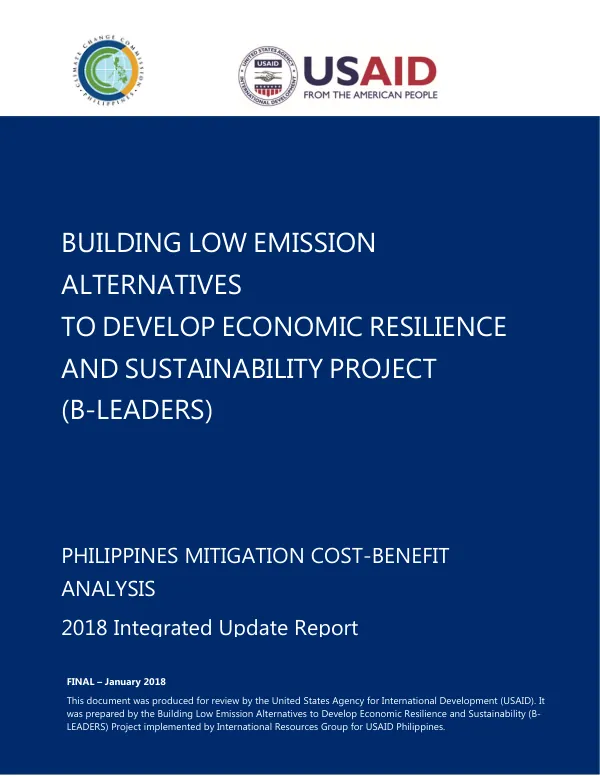
Philippines Mitigation Cost Benefit Analysis 2018 Integrated Update Report
The 2018 Integrated Update Report for the Philippines Mitigation Cost-Benefit Analysis was prepared by the Building Low Emission Alternatives to Develop Economic Resilience and Sustainability (B-LEADERS) Project, implemented by International Resources Group for the United States Agency for International Development (USAID) Philippines.
2018 · 36 pages
Sign in to readA free account is required to download.
Abstract
The report provides an integrated update of the mitigation cost-benefit analysis for the Philippines, focusing on the energy, transport, waste, forestry, and industry sectors. The report begins with an executive summary, which highlights the key findings and recommendations of the analysis. The 2010 base year greenhouse gas (GHG) emissions and removals are presented, along with the baseline projection for 2010 to 2050. The report also includes a mitigation cost-benefit and co-benefit analysis, which assesses the costs and benefits of various mitigation options in the Philippines. The energy sector is a significant contributor to GHG emissions in the Philippines, and the report highlights the importance of transitioning to renewable energy sources. The transport sector is also a major contributor to emissions, and the report recommends the adoption of electric vehicles and the implementation of fuel-efficient technologies. The waste sector is another key area of focus, with the report highlighting the need for improved waste management practices and the adoption of circular economy principles. The forestry sector is also critical, with the report emphasizing the importance of sustainable forest management and the protection of forests from deforestation and degradation. The industry sector is a significant contributor to emissions, and the report recommends the adoption of energy-efficient technologies and the implementation of best practices in industrial processes. The report also highlights the importance of addressing the impacts of climate change on human health and the economy. The report presents a marginal abatement cost curve, which illustrates the costs and benefits of various mitigation options in the Philippines. The curve shows that the most cost-effective options are those that focus on energy efficiency and the adoption of renewable energy sources. The report also includes a detailed analysis of the costs and benefits of various mitigation options, including the adoption of electric vehicles, the implementation of fuel-efficient technologies, and the adoption of circular economy principles. The report concludes that the Philippines has a significant opportunity to reduce its GHG emissions and transition to a low-carbon economy, while also achieving economic and social benefits. The report was prepared in accordance with the guidelines of the United Nations Framework Convention on Climate Change (UNFCCC) and the Intergovernmental Panel on Climate Change (IPCC). The analysis was conducted using a range of data sources, including national statistics, international databases, and expert consultations. The report provides a comprehensive analysis of the mitigation cost-benefit options for the Philippines, and it highlights the importance of addressing the impacts of climate change on human health and the economy. The report concludes that the Philippines has a significant opportunity to reduce its GHG emissions and transition to a low-carbon economy, while also achieving economic and social benefits. The report includes a detailed analysis of the costs and benefits of various mitigation options, including the adoption of electric vehicles, the implementation of fuel-efficient technologies, and the adoption of circular economy principles. The report also highlights the importance of addressing the impacts of climate change on human health and the economy. The report was prepared by a team of experts from the B-LEADERS Project, in collaboration with national and international partners. The report provides a comprehensive analysis of the mitigation cost-benefit options for the Philippines, and it highlights the importance of addressing the impacts of climate change on human health and the economy. The report was prepared in accordance with the guidelines of the UNFCCC and the IPCC, and it includes a detailed analysis of the costs and benefits of various mitigation options. The report concludes that the Philippines has a significant opportunity to reduce its GHG emissions and transition to a low-carbon economy, while also achieving economic and social benefits. The report concludes that the Philippines has a significant opportunity to reduce its GHG emissions and transition to a low-carbon economy, while also achieving economic and social benefits. The report provides a detailed analysis of the costs and benefits of various mitigation options, and it highlights