USAID DEC
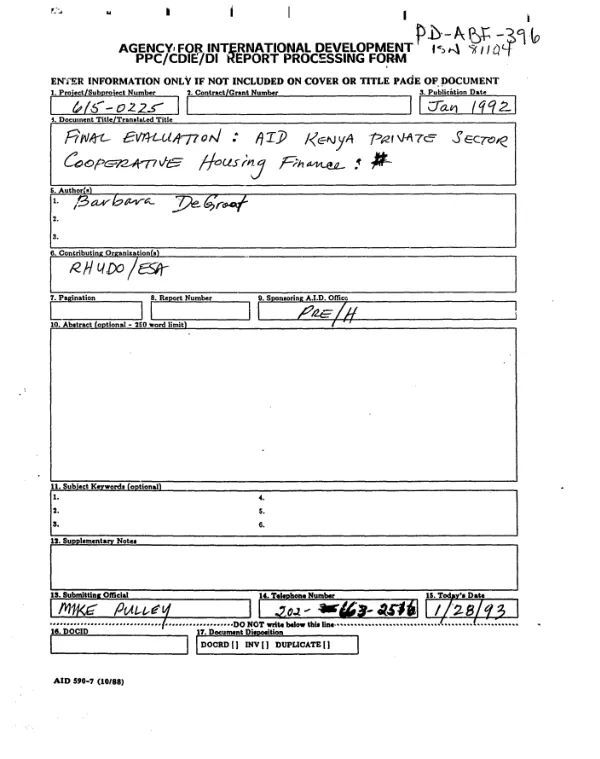
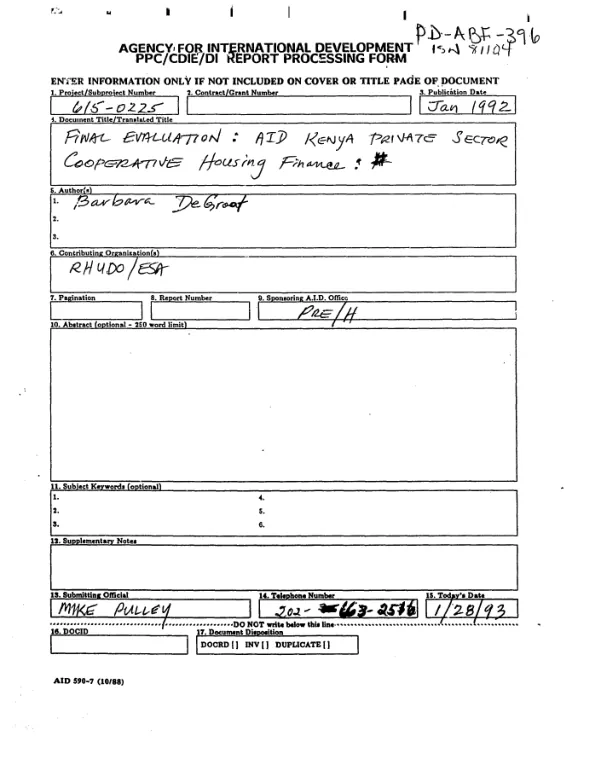
Final evaluation : AID/Kenya private sector cooperative housing finance project, 615-0225
Sign inUSAID. BUR. FOR AFRICA. REGIONAL HOUSING AND URBAN DEVELOPMENT OFC. FOR EAST AND SOUTHERN AFRICA
Final evaluation : AID/Kenya private sector cooperative housing finance project, 615-0225
Final external evaluation of a project (12/83-8/91) to strengthen Kenya's National Cooperative Housing Union (NACHU) and Kenyan finance institutions participating in an A.I.D.
DeGroot, Barbara · 1991
Sign in to readA free account is required to download.
Abstract
Housing Guaranty program (HG07) aimed at the private sector. The project required 7 rather than the intended 4 years to implement, but delays were generally attributable to A.I.D.'s decision to slow the pace of project implementation pending the conclusion of negotiations for the related HG program -- which, as it happened, was never implemented and was ultimately deauthorized. Nonetheless, the project largely addressed its original objectives, as follows. (1) Project TA, training, and commodity support directly contributed to a strengthening of NACHU as a private technical services organization for the Kenyan housing cooperative system. (2) NACHU was assisted in planning ten cooperative housing projects to benefit 2,962 low-income households. (3) Assistance to NACHU in the actual contracting and implementation of housing projects was not provided due to the failure of the HG loan to materialize. However, NACHU has since gone on to contract five housing projects benefiting 474 households with construction financing from other sources, thus approximating production targets defined for the HG program. (4) As a result of the project, significant resources were mobilized for mortgage lending to low-income households. Project TA directly led to the establishment of a new, locally funded program for issuance of group mortgages to low-income communities through the private sector Kenya Cooperative Bank, with $1.96 million in initial funding. Cooperative housing projects planned and implemented through NACHU will be among the first beneficiaries of this program. The project had a less direct impact on the mortgage lending practices of more traditionally defined Kenyan housing finance institutions. Several lessons were learned. (1) This project was handicapped by the failure of the design to distinguish carefully between its expected achievements and those of the related HG. (2) The need vs. the demand for TA services must be carefully assessed. Despite the social need for expanded mortgage lending to low-income households, the housing finance institutions targeted for TA were unwilling to accept this TA to modify their mortgage lending practices in the absence of capital financing assistance planned under the HG. (3) In "software" projects involving TA and training, precise benchmarks are required to channel progress toward project objectives. Lacking such, RHUDO/ESA had little to guide it beyond the rather broad objectives of strengthening NACHU and increasing mortgage lending to low-income households. (4) RHUDO/ESA lost the opportunity to learn from the project's training component by apparently failing to collect feedback from trainees. (5) More use of institutional contractors may be appropriate for RHUDO/ESA in this day of diminishing resources and staff. The hidden costs of the labor-intensive contracting approach used on this project appear to have been significant. (Author abstract, modified)