USAID
Final Evaluation Report AID-FFP-G-16-00128 WV Swaziland Jan 8
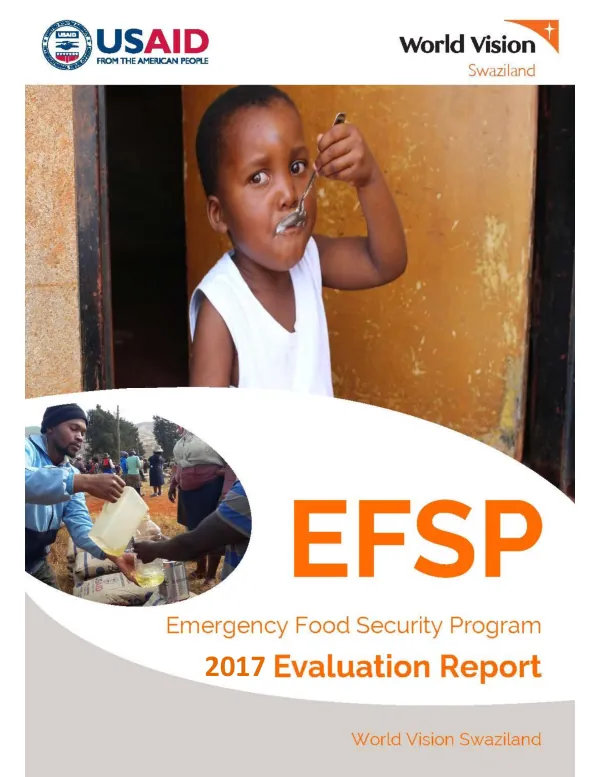
The Emergency Food Security Program (EFSP) is a USAID-funded emergency food program implemented by World Vision Swaziland.
2018 · 46 pages
Sign in to readA free account is required to download.
Abstract
The program addresses hunger and malnutrition caused by the El Niño-induced drought that struck Southern Africa in 2015/2016. The project aimed to provide immediate food assistance to 57,988 drought-affected beneficiaries, comprising 11,598 households, over a ten-month period. The program had three objectives: 1) Increase access to food for vulnerable households, 2) Increase resilience to future shocks, and 3) Reduce Moderate Acute Malnutrition in Children under Five (CU5) and Pregnant and Lactating Women (PLWs). The program adopted the Food for Assets (FFA) approach, committing to creating quality sustainable community assets that would build or enhance community resilience to future shocks. Conditional food via FFA targeted 10,439 households, while Unconditional food targeted 1,159 households deemed vulnerable due to being child or elderly headed. In addition, supplementary feeding targeted 8,311 children under five years (CU5) and 110 pregnant and lactating women (PLW) showing signs of Moderate Acute Malnutrition (MAM). The survey was conducted in July 2017 for a period of 5 days in the six constituencies (referred to as "Tinkhundla") where WVS implemented the Emergency Food Security Programme. The Evaluation survey explored the use of Mixed Methods Approaches (MMA) with an Explanatory Strategy, entailing the exploration of Quantitative and Qualitative inquiries on the survey study units. Qualitative reasoning and explanatory analyses were performed for triangulations on observed quantities. Secondary sources were explored to augment, ascertain, or nullify the observed results obtained from MMA. The survey tools developed included the Household Survey tool, Focus Group discussion tool, and Asset Mapping tool/Asset. These tools were developed as guided by the questions for measurement and relevance to the target population, as led by the Program Design. The survey aimed to assess the impact of the EFSP on the target population, exploring the effectiveness of the program in achieving its objectives. The survey results showed significant improvements in household dietary diversity, household hunger scale, and food consumption score. The Coping Strategy Index (CSI) also showed a decrease in the number of households using coping strategies, indicating improved food security. The survey results further showed that the EFSP had a positive impact on the target population, with significant improvements in household income, food security, and nutrition. The program's Food for Assets (FFA) approach was found to be effective in creating quality sustainable community assets, which built or enhanced community resilience to future shocks. The unconditional food assistance was found to be effective in targeting vulnerable households, while the supplementary feeding program showed significant improvements in the nutrition of children under five years and pregnant and lactating women. The survey results also highlighted the importance of community participation and ownership in the program's success. The program's use of Mixed Methods Approaches (MMA) was found to be effective in providing a comprehensive understanding of the program's impact. The survey results further emphasized the need for continued support and funding to ensure the sustainability of the program's impact. The EFSP's success was attributed to the program's effective implementation, strong community participation, and the use of evidence-based approaches. The program's impact was found to be significant, with improvements in household dietary diversity, household hunger scale, food consumption score, and coping strategy index. The program's use of Food for Assets (FFA) approach and unconditional food assistance was found to be effective in targeting vulnerable households and improving food security. The supplementary feeding program showed significant improvements in the nutrition of children under five years and pregnant and lactating women.
Related documents