USAID
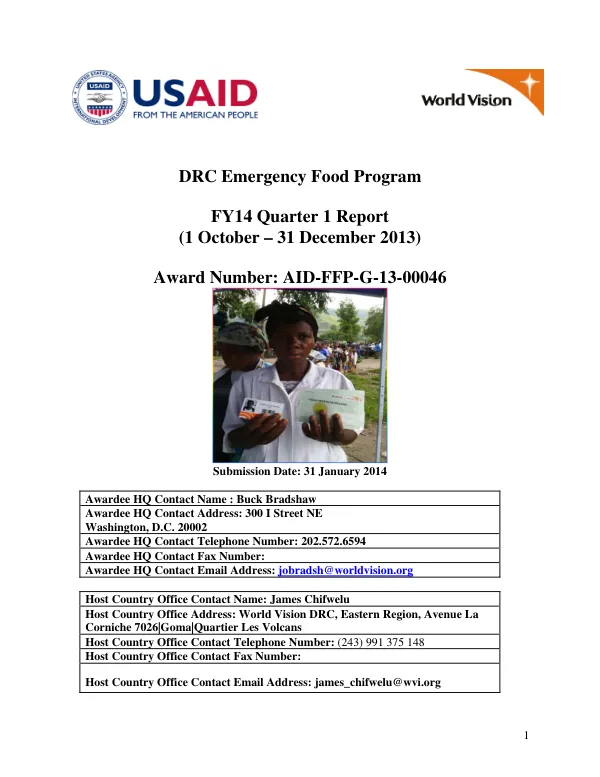
DRC Emergency Food Security Program (EFSP) FY14 Quarter 1 Report
The DRC Emergency Food Security Program (EFSP) aims to improve the food security of 3,150 vulnerable households in the Kalehe territory of South Kivu.
2014 · 7 pages
Sign in to readA free account is required to download.
Abstract
The program supports these households through the provision of monthly food vouchers worth $90, meeting 100% of immediate household food needs. In addition, the program provides agricultural inputs and training to support livelihood recovery and increased resilience in the longer term. Implementation of the program began in October 2013, with World Vision finalizing start-up activities, including conducting a baseline survey, community sensitization, beneficiary identification and registration, market surveys, vendor assessment, and contracting. The distribution of vouchers to beneficiaries and payment for vouchers redeemed was also completed during this period. All staff recruitment was completed except for the Program Officer. The project registered 2,991 beneficiaries, representing 95% of the targeted beneficiary household number. The registered beneficiaries included households of internally displaced persons (IDPs), host families, and returnees. However, the project did not reach the targeted number of 3,150 households due to lower-than-expected numbers of IDPs, host families, and returnees in the 10 villages where the project is being implemented. Voucher distribution was a key activity during the quarter, with 8,658 vouchers distributed to 2,886 households. Each household received 3 vouchers worth $90, denominated as $30 for each voucher. The total number of beneficiaries reached during the quarter was 17,316, consisting of children under two years, children between 3-5 years, children 6-12 years, children 13-18 years, and adults 19 years and over. Vendor participation was also a critical component of the program, with 169 vendors surveyed and selected to participate in the voucher program. Of these, 116 vendors signed contracts with the project for the first round of distribution conducted in December. The vendors were trained on the voucher redemption process, and a total of 8,658 vouchers were exchanged for commodities at the vendor shops. The most frequently purchased commodities were maize flour, cassava flour, beans, and vegetable oil. The program also aimed to provide early recovery opportunities for most vulnerable households, with a focus on equipping beneficiaries to grow crops. However, this activity was not achieved during the quarter due to delays in the startup. World Vision proposes to undertake this activity during the January/February 2014 planting season. Key indicators for the program include reduced prevalence of households with moderate or severe hunger, mean number of food groups consumed by households (dietary diversity score), and percentage of vulnerable households eating three meals per day. The program also aims to increase the average proportion of ration consumed, sold, and shared by target household members.