USAID
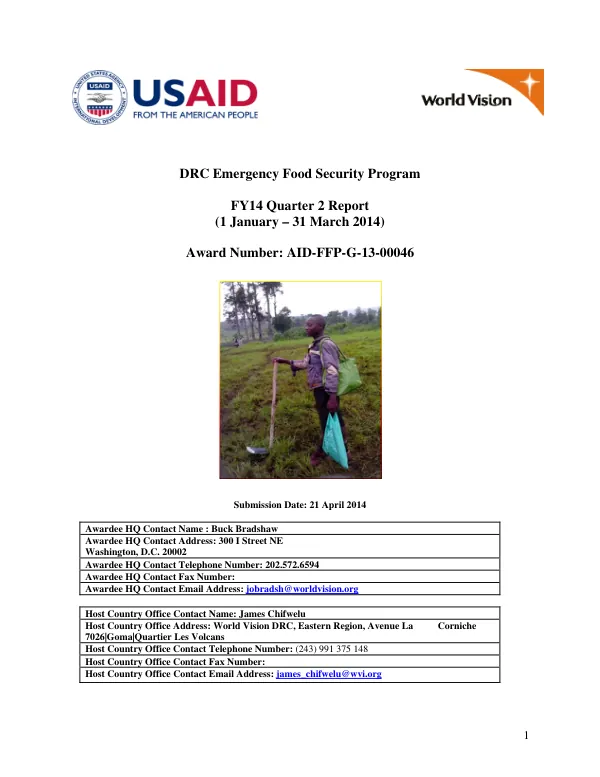
DRC Emergency Food Security Program FY14 Quarter 2 Report
The DRC Emergency Food Security Program aims to improve the food security of 3,150 vulnerable households in the Kalehe territory of South Kivu.
2014 · 8 pages
Sign in to readA free account is required to download.
Abstract
The program provides monthly food vouchers worth $90, meeting 100% of immediate household food needs, as well as agricultural inputs and training to support livelihood recovery and increased resiliency. The direct beneficiaries represent 7% of the population of approximately 46,666 households along the Kalehe Littoral Axis. Implementation of the program began in January 2014, with four of the six planned voucher distributions completed by the end of the quarter. Agricultural seeds and tools were distributed for the second planting season, and beneficiaries received training on land preparation, seed conservation, and planting techniques. Project staff and community committees were also trained on Sexual and Gender-Based Violence (SGBV) messaging. The project reached 3,151 beneficiaries this quarter, with an additional 160 beneficiaries added due to errors in processing household questionnaires. The registered beneficiaries now represent 100% of the targeted beneficiary household number. Community sensitization on gender issues and equality was conducted through 8 training sessions on SGBV sensitization, with 34 community SGBV champions trained to promote SGBV issues in their communities. Voucher distribution continued during the quarter, with 3,097 beneficiaries exchanging their vouchers at project partner shops. A total of 9,076 vouchers were distributed, equivalent to $816,840 in total value for the 3 months. The products bought with vouchers included cassava flour, maize flour, legumes, vegetable oil, and salt. The total number of beneficiaries reached during the quarter was 14,377, with a breakdown by age and gender as follows: under 5 years (860 males, 929 females), 5-11 years (2024 males, 1988 females), 12-17 years (1027 males, 1004 females), 18-55 years (2912 males, 2950 females), and over 55 years (311 males, 372 females). The vendors, who were initially without bank accounts and business registration, now have 100% of them with bank accounts and some form of business registration. The vendors underwent two formal training sessions on basic bookkeeping, resulting in improved vendor invoices submitted, which facilitated faster payment. During the quarter, the beneficiaries continued to redeem vouchers at the vendor shops, with the vendors having enough stocks to fulfill the beneficiary requirements. A total of 9,076 vouchers were exchanged for commodities, and $794,996 USD was transferred to the vendor accounts. The project also provided agricultural extension services to 3,099 households, covering agricultural calendar and soil preparation, seeds preparation, planting techniques, and crop maintenance. The seeds distributed were tested for germination, with only seeds with a germination rate of 70% and above accepted. The results of the seed germination test showed that 5 out of 7 suppliers had seeds with a germination rate of 70% and above, while 2 suppliers had seeds with a germination rate below 70%. The accepted seeds included haricot, soja, and amarante, while the rejected seeds included maize and soja.