CHECCHI AND COMPANY, CONSULTING, INC.
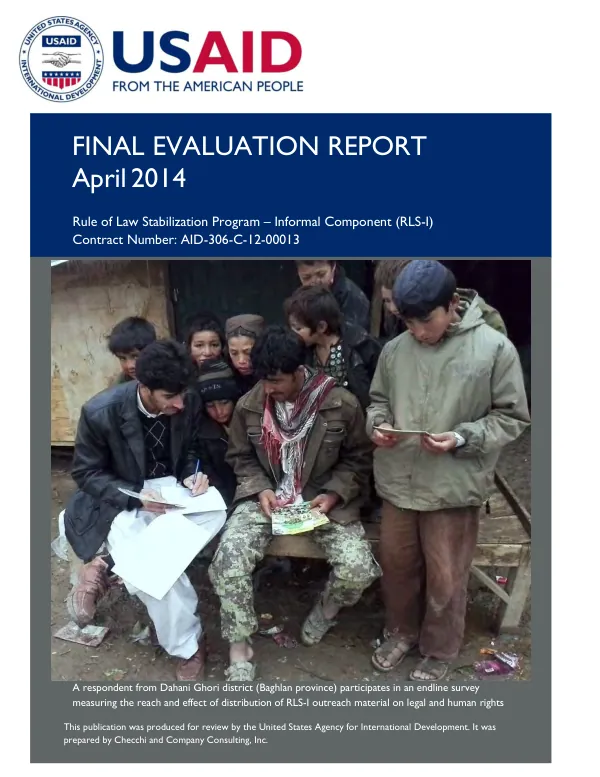
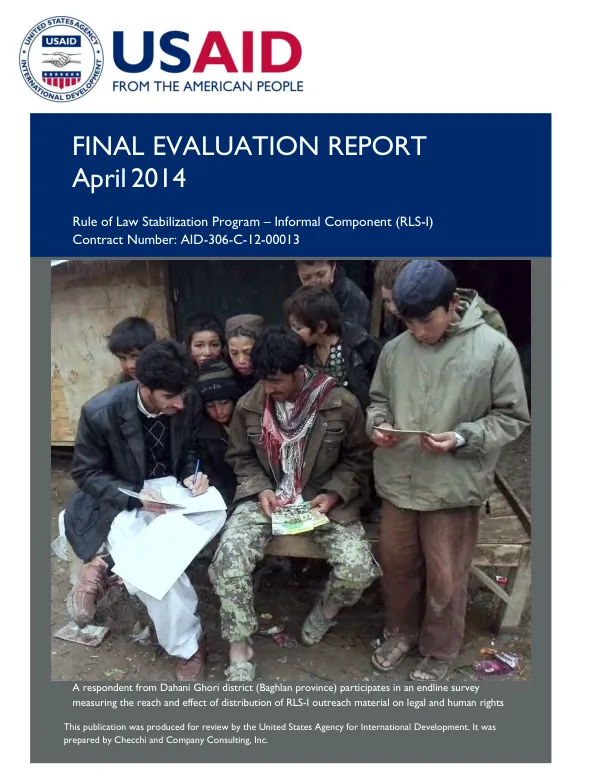
Final Evaluation Report: Rule of Law Stabilization Program – Informal Component
The Rule of Law Stabilization Program – Informal Component (RLS-I) was implemented in Afghanistan to promote the rule of law and stabilize the country's informal justice system.
2014 · 67 pages
Sign in to readA free account is required to download.
Abstract
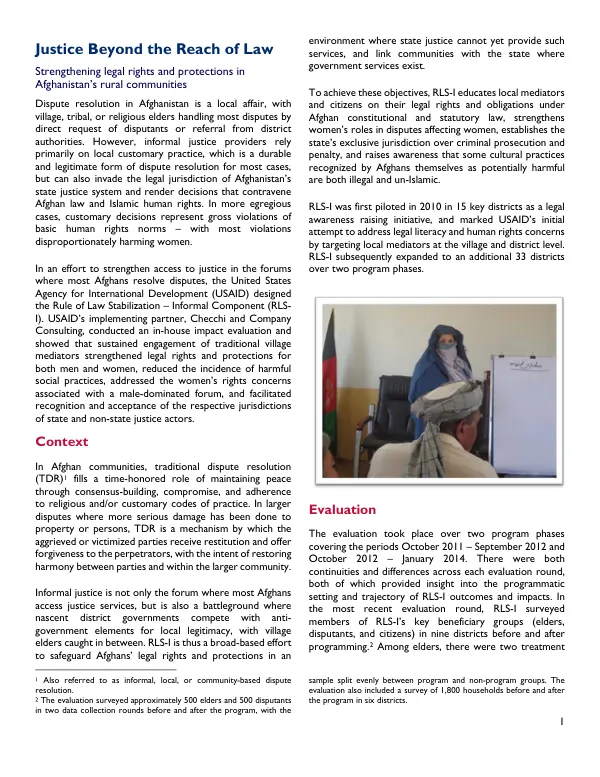
The program was conducted in 16 districts across the country, with a focus on improving the capacity of elders to resolve disputes through mediation and promoting the use of Islamic law. The program was funded by the United States Agency for International Development (USAID) and was implemented by Checchi and Company Consulting, Inc. The program's development problem was the lack of a functioning informal justice system in Afghanistan, which led to a high number of disputes and a lack of access to justice for many citizens. The program aimed to address this problem by improving the capacity of elders to resolve disputes through mediation and promoting the use of Islamic law. The program's methodology involved the selection of 16 districts across the country, where elders were trained in mediation and Islamic law. The program also involved the establishment of a network of mediators, known as "RLS-I elders," who were trained to resolve disputes through mediation. The program's design was based on a randomized controlled trial (RCT) design, with 8 districts serving as treatment groups and 8 districts serving as control groups. The program's sample selection involved the selection of 16 districts across the country, with a focus on districts that had a high level of conflict and a lack of access to justice. The districts were selected using a stratified random sampling method, with a focus on ensuring that the sample was representative of the country as a whole. The program's findings indicated that the RLS-I program was effective in improving the capacity of elders to resolve disputes through mediation and promoting the use of Islamic law. The program's evaluation also found that the RLS-I program had a positive impact on the perceptions of disputants, with a significant increase in the number of disputants who perceived the RLS-I elders as impartial and knowledgeable about Islamic law. The program's findings also indicated that the RLS-I program had a positive impact on the use of Islamic law in dispute resolution, with a significant increase in the number of disputes that were resolved using Islamic law. The program's evaluation also found that the RLS-I program had a positive impact on the role of women in dispute resolution, with a significant increase in the number of women who were involved in dispute resolution and a significant decrease in the number of disputes that were resolved in favor of men. The program's conclusions and recommendations emphasized the importance of continued support for the RLS-I program and the need for further research on the program's impact. The program's evaluation also highlighted the need for further research on the role of Islamic law in dispute resolution and the impact of the RLS-I program on the perceptions of disputants. The program's annexes provide additional information on the program's methodology, sample selection, and findings. The annexes also provide information on the program's impact measures, disputant perception, and elder knowledge, as well as the program's outreach and activities. The program's tables provide additional information on the program's methodology, sample selection, and findings, as well as the program's impact measures, disputant perception, and elder knowledge, and the program's outreach and activities. The tables also provide information on the program's activities attended and RLS-I graduation by district, as well as the number of RLS-I elders meeting workshop attendance levels. The program's glossary provides definitions of key terms used in the program, including "RLS-I," "mediation," and "Islamic law." The glossary also provides information on the program's methodology and sample selection, as well as the program's findings and conclusions.