CHECCHI AND COMPANY, CONSULTING, INC.
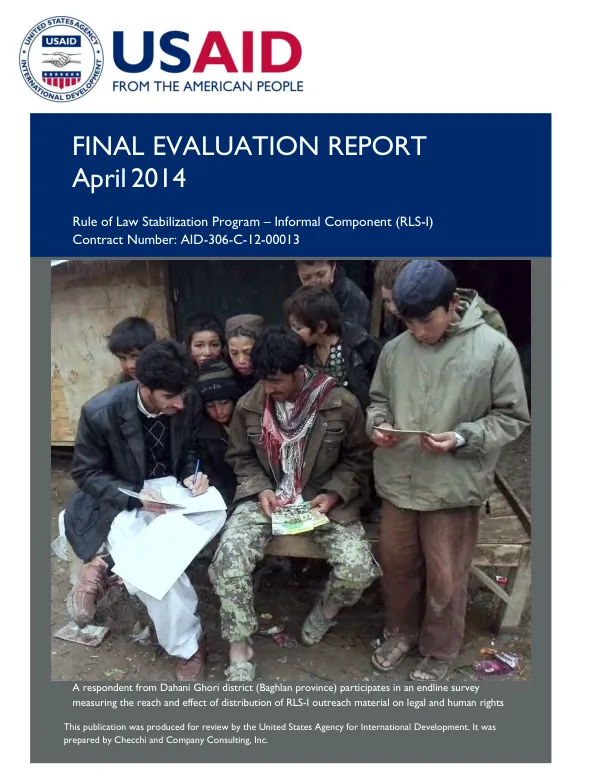
Final Evaluation Report: Rule of Law Stabilization Program – Informal Component
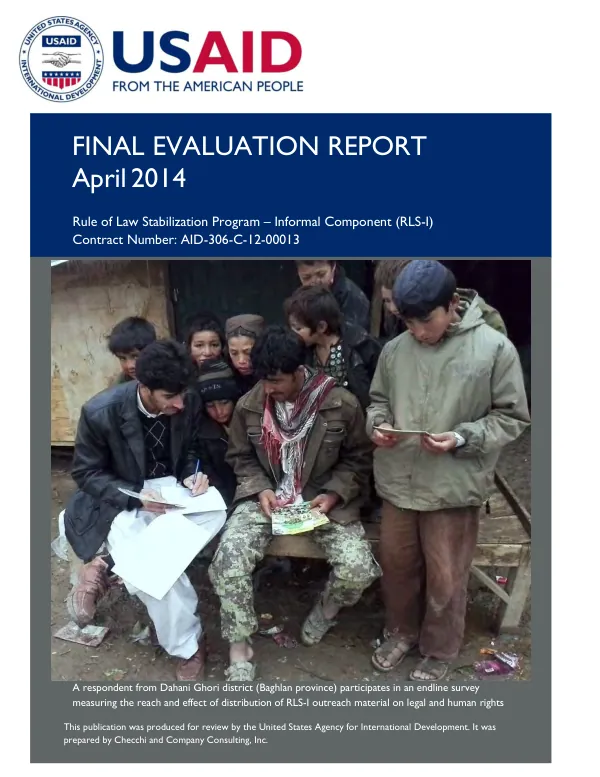
The Rule of Law Stabilization Program – Informal Component (RLS-I) was implemented in Afghanistan to promote the rule of law and stabilize the country.
2014 · 67 pages
Sign in to readA free account is required to download.
Abstract
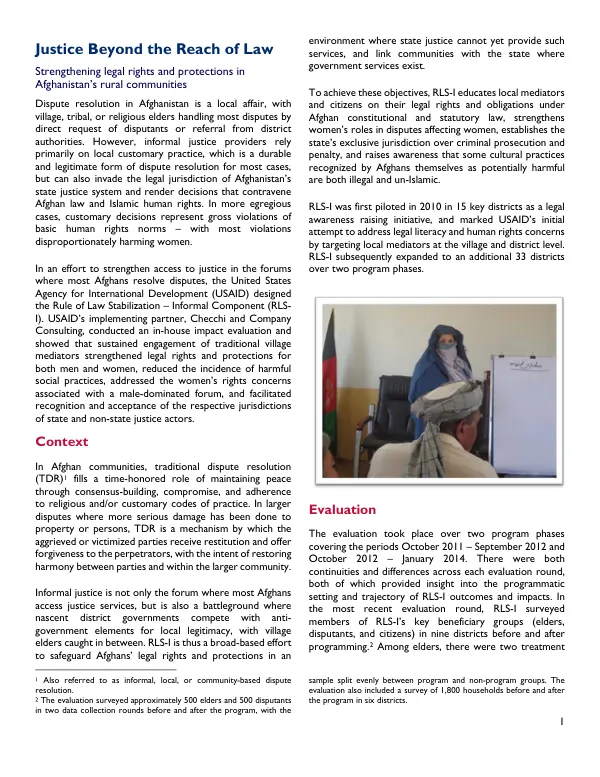
The program focused on informal dispute resolution mechanisms, including traditional dispute resolution (TDR) and jirga. The program's goal was to improve the capacity of elders and disputants to resolve disputes in a fair and impartial manner. The program was implemented in 15 districts across Afghanistan, with a total of 1,200 elders and 1,500 disputants participating in the program. The program consisted of a series of workshops and training sessions, which aimed to improve the knowledge and skills of elders and disputants in resolving disputes. The program also provided support to elders and disputants in documenting and registering decisions, as well as in promoting the role of women in TDR. The evaluation of the program was conducted in two phases, with the first phase focusing on the baseline assessment and the second phase focusing on the endline assessment. The evaluation used a combination of quantitative and qualitative methods, including surveys, interviews, and focus group discussions. The evaluation found that the program had a positive impact on the capacity of elders and disputants to resolve disputes in a fair and impartial manner. The evaluation also found that the program had a positive impact on the knowledge and skills of elders and disputants, particularly in areas related to constitutional rights, jurisdiction, and family law. The evaluation found that the program had a significant impact on the perception of disputants regarding the impartiality of jirga members. The evaluation also found that the program had a positive impact on the role of women in TDR, with women-headed households showing higher adoption rates for all practices except mechanical land preparation. The evaluation also found that the program had a positive impact on the household income of participants, with a 27% increase in household income among program participants compared to the control group. The evaluation also found that the program had a positive impact on the documentation and registration of decisions, with a significant increase in the number of decisions being documented and registered. The evaluation also found that the program had a positive impact on the knowledge and skills of elders and disputants, particularly in areas related to constitutional rights, jurisdiction, and family law. The evaluation identified several challenges and limitations of the program, including the difficulty in recruiting and retaining elders and disputants, as well as the limited availability of resources and infrastructure. The evaluation also identified several areas for improvement, including the need for more targeted and effective outreach and engagement strategies, as well as the need for more comprehensive and sustained support to elders and disputants. Overall, the evaluation found that the RLS-I program had a positive impact on the capacity of elders and disputants to resolve disputes in a fair and impartial manner, as well as on the knowledge and skills of elders and disputants. The evaluation also identified several challenges and limitations of the program, as well as several areas for improvement.