GEORGE WASHINGTON UNIVERSITY CIBER
Final HC-HIV meeting report – 15 April 2013
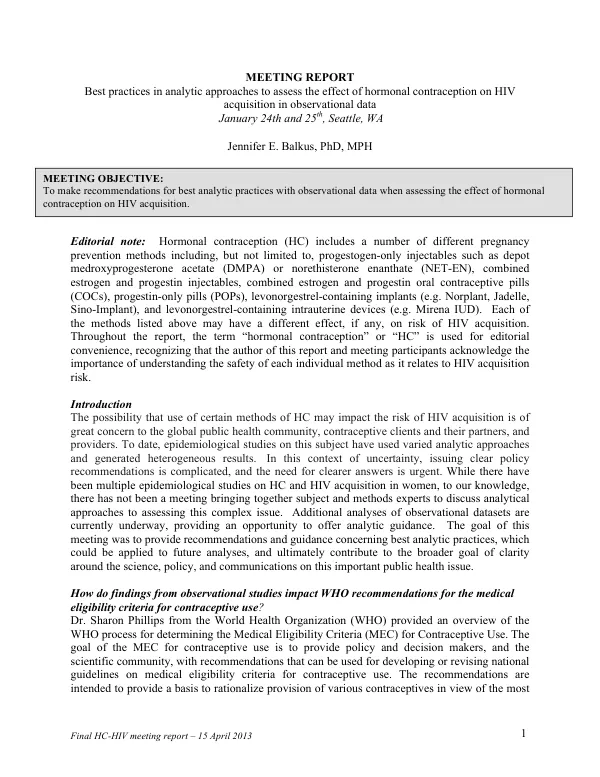
The meeting report from the Final HC-HIV meeting, held on January 24th and 25th, 2013, in Seattle, Washington, focused on best practices in analytic approaches to assess the effect of hormonal contraception on HIV acquisition in observational data.
2013 · 25 pages
Sign in to readA free account is required to download.
Abstract
The meeting aimed to provide recommendations and guidance concerning best analytic practices, which could be applied to future analyses, and ultimately contribute to the broader goal of clarity around the science, policy, and communications on this important public health issue. The World Health Organization (WHO) uses the Medical Eligibility Criteria (MEC) for Contraceptive Use to provide policy and decision makers, and the scientific community, with recommendations that can be used for developing or revising national guidelines on medical eligibility criteria for contraceptive use. The MEC classification system, presented in Table 1, categorizes conditions into four classes, with Class 1 indicating no restriction for the use of the contraceptive method and Class 4 indicating an unacceptable health risk if the contraceptive method is used. The overall body of evidence for both injectable contraception and oral contraceptive pills and HIV acquisition was rated "low" due to serious limitations and serious inconsistency between studies. However, the WHO review of the evidence for the MEC will take place in 2014, and it is possible that more consistent results would emerge, allowing for clearer interpretation of the data and enhancing the strength of the overall evidence base. Modeling studies assessing the competing risks of HIV and unintended pregnancy and maternal morbidity/mortality in various epidemiological contexts were also presented. The studies reported that discontinuation of injectable HC, without replacement with another method, or with replacement with combined oral contraceptive pills, would avert new cases of HIV but would lead to increased maternal mortality and decreased life expectancy. However, reducing injectable use globally could result in an increase in births and maternal mortality, and a net public health benefit to removing injectables is unlikely, except in countries with large HIV epidemics, such as South Africa. Observational studies assessing the effect of HC on HIV acquisition were also reviewed, with 24 studies from 22 different study populations included in the review. The studies showed temporal trends in the design of studies to assess this issue, with earlier studies published in the 1990's analyzing data from prospective cohort or nested case-control studies. These studies were small and contained minimal disaggregation of specific hormonal contraceptive methods. Starting around the 2000's, studies began to include more detailed information on specific hormonal contraceptive methods and study populations. The evidence from observational studies regarding the risk of HIV acquisition among women using hormonal contraceptive methods is heterogeneous, with varying study populations, study design features, and analytic methods. The heterogeneity in the evidence affects the validity of effect estimates, and more consistent results would be needed to inform policy and decision-making. The meeting aimed to provide recommendations and guidance concerning best analytic practices to address this issue and ultimately contribute to the broader goal of clarity around the science, policy, and communications on this important public health issue.
Related documents
Documents in this collection
 2021
2021USAID DEC
HIV SELF-TESTING OPERATIONAL GUIDE FOR THE PLANNING, IMPLEMENTATION, MONITORING AND REPORTING OF HIV SELF-TESTING MEETING TARGETS AND MAINTAINING EPIDEMIC CONTROL (EPIC) PROJECT
Open record 2019
2019USAID DEC
Global Tobacco Control: U.S. Efforts Have Primarily Focused on Research and Surveillance
Open record