USAID DEC
Higher Education Solutions Network (HESN) 2.0 Programs Annual Performance Report Narrative
Sign inCATHOLIC RELIEF SERVICES ORGANIZATION
Higher Education Solutions Network (HESN) 2.0 Programs Annual Performance Report Narrative
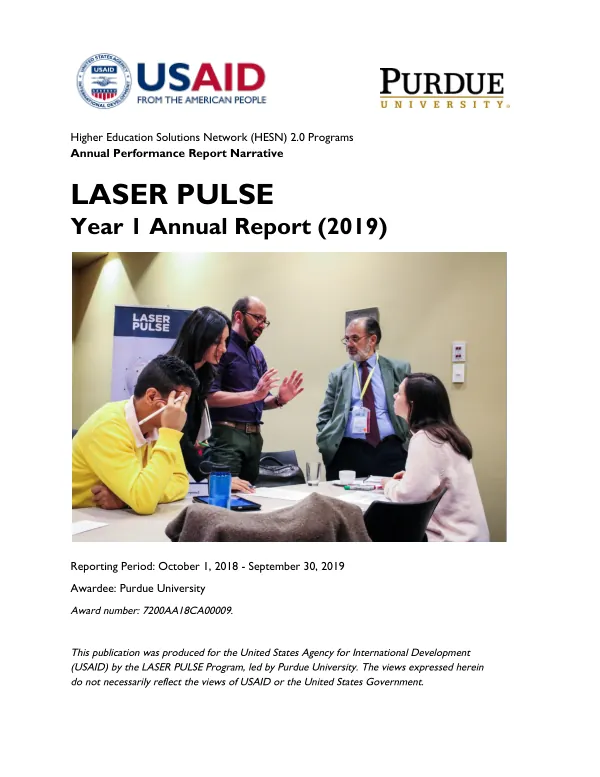
The Higher Education Solutions Network (HESN) 2.0 Programs Annual Performance Report Narrative for LASER PULSE Year 1 Annual Report (2019) highlights the consortium's efforts to support research-driven, practical solutions to critical development challenges in low- and middle-income countries (LMICs).
2019 · 24 pages
Sign in to readA free account is required to download.
Abstract
The LASER PULSE consortium, led by Purdue University, comprises Catholic Relief Services, Indiana University, Makerere University, and the University of Notre Dame. The consortium's strategy focuses on three pillars: Research Capacity Building, Research Translation, and Sustainable Networks. Research Capacity Building aims to support the research enterprise overall, while Research Translation supports research applied to development solutions. Sustainable Networks support South-South, North-South, and researcher-practitioner collaborations in research for development. During the reporting period, October 1, 2018, to September 30, 2019, LASER PULSE achieved several milestones. The first Research for Development (R4D) conference was held in Kampala, Uganda, from May 6-8, 2019, with around 130 participants attending. The conference provided a platform for researchers and practitioners to share knowledge and collaborate on development-focused research. The LASER RFA was completed, and online certificate trainings were conducted for research teams. The Comprehensive Issue Analysis process was used to generate input towards the refinement of the sector focus for the RFA. The online Matchmaking site was launched for LASER network researchers and practitioners, with 1,329 registered members, including 1,257 researchers and 55 development professionals. The HEI Network was activated, and informational documents on processes were finalized. Researchers were identified to invite to the network through outreach and buy-ins, and many new researchers joined the network through invitation to the R4D Conference in Uganda. A Qualtrics survey serves as the registration platform for both HEI researchers and development practitioners to join the LASER PULSE Network. The HEI researcher capacity assessment was carried out, which showed that Higher Education Institutions in Africa have capacity gaps in all capabilities related to the development research ecosystem. The assessment identified key capacity gaps that need to be addressed to increase development research outputs and impacts from low-income country universities. The Corporate Advisory Board was postponed until Year Two due to force majeure delays in holding the R4D Conferences. However, a private sector convening was held in Uganda, and a keynote speaker from HP Enterprises engaged with LASER on development issues. The possibility of a CAB for Year Three was re-examined, with strategies to meet the needs of corporate partners. The issue and stakeholder analysis specific to the R4D region was developed for East Africa and Colombia. The process involved reviewing key documents and input from sectoral experts to identify priority sectors and success factor trees. The trees represent the factors that need to be in place for success in a given sectoral system, and a protocol and materials were developed to enable participants to understand how to navigate the trees during the success factor gap identification sessions at the conference. The LASER PULSE consortium's efforts aim to support the discovery and uptake of research-sourced, evidence-based solutions to development challenges. The consortium's strategy focuses on building research capacity, translating research into practical solutions, and fostering sustainable networks. The achievements during the reporting period demonstrate the consortium's commitment to addressing critical development challenges in LMICs.