USAID DEC
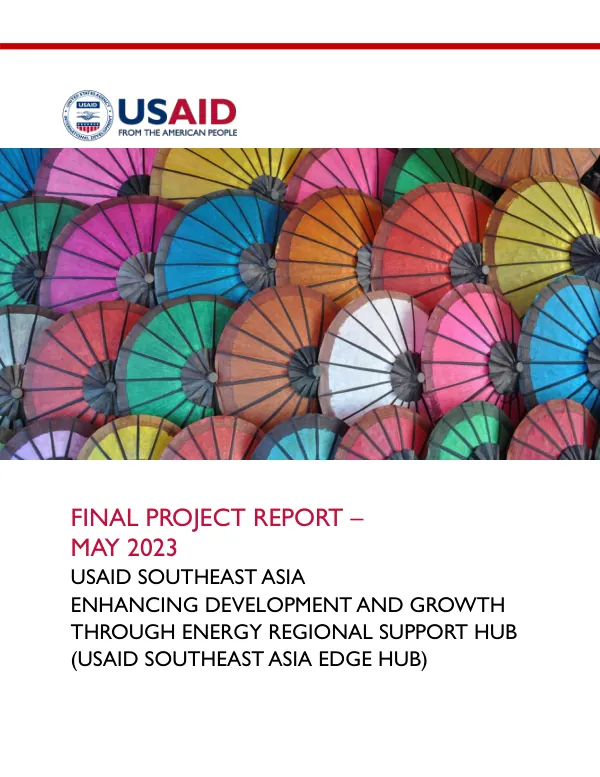
FINAL PROJECT REPORT – Enhancing Development and Growth Through Energy Regional Support Hub (USAID SOUTHEAST ASIA EDGE HUB)
Sign inTETRA TECH
FINAL PROJECT REPORT – Enhancing Development and Growth Through Energy Regional Support Hub (USAID SOUTHEAST ASIA EDGE HUB)
The Southeast Asia EDGE Hub, a regional support hub, was established to enhance development and growth through energy programming in the region.
2023 · 69 pages
Sign in to readA free account is required to download.
Abstract
The hub's primary objective is to improve the capacity of USAID staff and implementing partners to design, implement, monitor, and evaluate high-quality, impactful energy programming. The hub's work is guided by a results framework that outlines key indicators and expected outcomes. The hub's technical services are focused on supporting energy programming in five countries: Burma, Laos, Philippines, Thailand, and Timor-Leste. In Burma, the hub provided technical assistance to the Ministry of Electricity and Energy to improve the country's energy sector. In Laos, the hub supported the development of a national energy policy and provided training to Lao energy officials. In the Philippines, the hub worked with the Department of Energy to improve the country's energy efficiency and renewable energy sectors. In Thailand, the hub supported the development of a national energy plan and provided training to Thai energy officials. In Timor-Leste, the hub provided technical assistance to the Ministry of Energy and Water to improve the country's energy sector. The hub also conducted a Clean EDGE Asia Power Sector Learning Series, which brought together energy officials and stakeholders from across the region to share knowledge and best practices in energy programming. The series included webinars, workshops, and other events that focused on topics such as energy efficiency, renewable energy, and energy policy. The hub also developed a range of technical resources and tools to support energy programming in the region, including an online energy training resource guide and a database of energy-related indicators and metrics. The hub's monitoring, evaluation, and learning (MEL) activities are focused on tracking progress toward the hub's key indicators and outcomes. The hub uses a range of MEL tools and methods, including surveys, focus groups, and data analysis. The hub also conducts regular reviews and assessments of its programs and activities to identify areas for improvement and to ensure that the hub is meeting its objectives. The hub's external stakeholder outreach activities are focused on engaging with a range of external stakeholders, including government officials, private sector companies, and civil society organizations. The hub uses a range of outreach tools and methods, including social media, email newsletters, and in-person events. The hub also works closely with USAID's regional development mission to ensure that the hub's activities are aligned with USAID's overall development objectives in the region. The hub's internal stakeholder outreach activities are focused on engaging with USAID staff and implementing partners. The hub uses a range of outreach tools and methods, including regular meetings, email updates, and in-person events. The hub also works closely with USAID's regional development mission to ensure that the hub's activities are aligned with USAID's overall development objectives in the region. The hub's private sector engagement activities are focused on working with private sector companies to support energy programming in the region. The hub uses a range of engagement tools and methods, including partnerships, joint projects, and advisory services. The hub also works closely with USAID's regional development mission to ensure that the hub's activities are aligned with USAID's overall development objectives in the region. The hub's gender activities are focused on ensuring that energy programming in the region is inclusive and equitable for women and girls. The hub uses a range of gender tools and methods, including gender analysis, gender-sensitive programming, and gender training. The hub also works closely with USAID's regional development mission to ensure that the hub's activities are aligned with USAID's overall development objectives in the region. The hub's administration activities are focused on ensuring that the hub's operations are efficient and effective. The hub uses a range of administration tools and methods, including financial management, human resources management, and logistics management. The hub also works closely with USAID's regional development mission to ensure that the hub's activities are aligned with USAID's overall development objectives in the region. The hub's operations activities are focused on ensuring that the hub's programs and activities are implemented effectively and efficiently. The hub uses a range of operations tools and methods, including project management, monitoring and evaluation, and reporting. The hub also works closely with USAID's regional development mission to ensure that the hub's activities are aligned with USAID's overall development objectives in the region. The hub's local partnerships activities are focused on working with local organizations and stakeholders to support energy programming in the region. The hub uses a range of partnership tools and methods, including partnerships, joint projects, and advisory services. The hub also works closely with USAID's regional development mission to ensure that the hub's activities are aligned with USAID's overall development objectives in the region. The hub's lessons learned activities are focused on identifying best practices and lessons learned from the hub's programs and activities. The hub uses a range of lessons learned tools and methods, including surveys, focus groups, and data analysis. The hub also works closely with USAID's regional development mission to ensure that the hub's activities are aligned with USAID's overall development objectives in the region. The hub's fiscal report provides an
Related documents