USAID DEC
Final Report: ECOUT Program
The Emergency Food Security Program (EFSP) in Niger, funded by USAID/Food for Peace, was implemented by Mercy Corps Niger from April 11, 2014, to February 29, 2016.
2016 · 21 pages
Sign in to readA free account is required to download.
Abstract
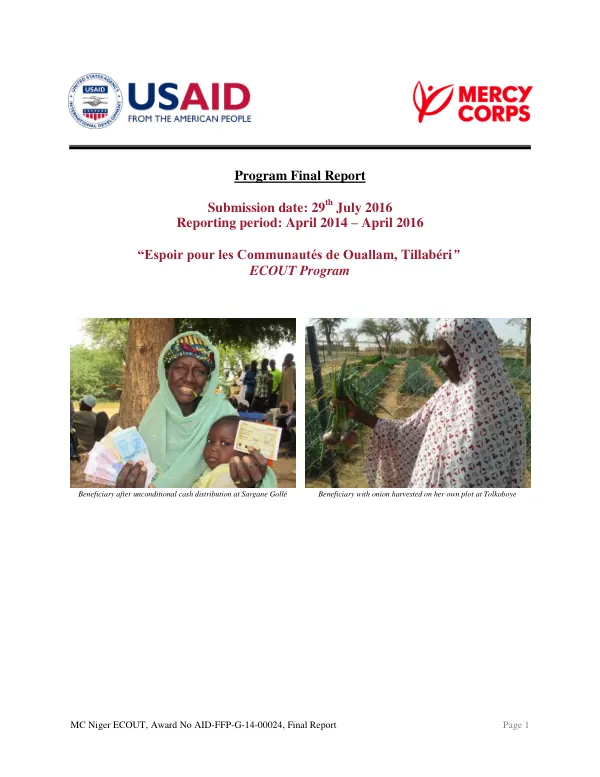
The program, titled ECOUT, aimed to meet the immediate needs of communities affected by recurrent food crises and build their resilience capacities to future stresses and shocks. The program targeted 55,944 of the most vulnerable individuals (7,992 households) from 56 villages in the communes of Ouallam and Dingazi in the department of Ouallam. The program's first outcome focused on reducing the nutrient gap among agro-pastoralist populations affected by food insecurity. To achieve this, the program distributed nutritious food during the lean seasons through a voucher system under Food For Work activities. A total of US$ 738,689 worth of food was distributed, corresponding to 1,249 metric tons of millet, 150 metric tons of cowpea, and 24,579 liters of vegetable oil. Additionally, unconditional and conditional cash transfers were made to beneficiaries, totaling US$ 3,133,125. These distributions enabled households to fill their food needs during the lean seasons, resulting in a significant reduction in hunger and the need for coping strategies. The program's second outcome focused on increasing the capacity and resources of agro-pastoralist populations to support resilience. To achieve this, the program implemented various activities, including the rehabilitation of 2,388 hectares of pasture and agricultural lands, the construction of 13 storage facilities, and the preparation of women's gardening field schools. The program also distributed 223.5 metric tons of improved seeds of rain-fed crops and 274 kg of improved seeds of vegetable crops. Furthermore, the program implemented warrantage in Ouallam, starting with piloting in 5 villages and scaling up to 11 villages, resulting in an increase in the number of beneficiaries and the amount of loans distributed. The program's impact was significant, with 89% of surveyed households reporting acceptable food security compared to 51% at the baseline. The percentage of households facing acute food insecurity decreased from 23% to 3% at the end of the program. Additionally, the consumption of goats' milk increased from 21% to 61% among beneficiaries. The program also contributed to the improvement of agricultural practices, with approximately 60% of beneficiaries using at least two sustainable agriculture practices compared to 38% in the baseline. Finally, the program's community-based early warning systems (CBEWS) implementation resulted in strong evidence of changes made, with 90% of households stating that their villages were covered by the CBEWS and 62% of these households aware of their roles and responsibilities compared to 15% from the baseline. The Ouallam department of Tillabéri region was one of the hardest hit by the 2013 drought and floods, with 59% of the population affected. The program's activities were designed to address the immediate needs of the affected population and build their resilience capacities to future stresses and shocks. The program's impact was significant, with a reduction in hunger and the need for coping strategies, an increase in food security, and an improvement in agricultural practices.