COOPERATIVE FOR ASSISTANCE AND RELIEF EVERYWHERE INTERNATIONAL
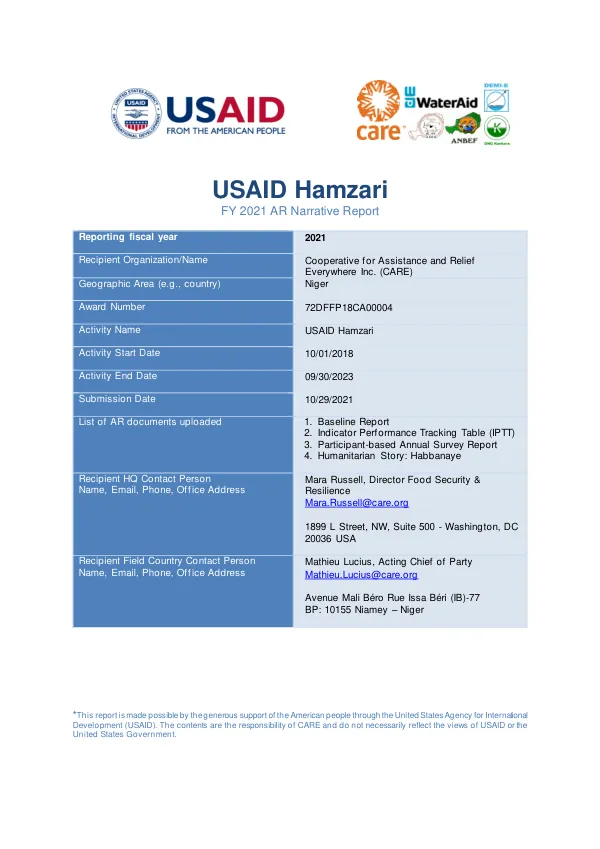
USAID Hamzari FY 2021 AR Narrative Report
USAID Hamzari is a development initiative in Niger that aims to enhance the resilience of 96,000 unique participants across three vulnerable communes in the Maradi region.
2021 · 23 pages
Sign in to readA free account is required to download.
Abstract
The project is fully gender-integrated and focuses on improving food and nutrition security while strengthening the capacity of people, households, and communities to respond to and cope with various shocks and stressors. During FY21, USAID Hamzari worked with 26,370 unique direct households, with a total of 94,757 unique direct participants, including 55,242 women, who benefited from project activities. The project implemented a consistent package of activities that leverage and build upon existing community structures as drivers of interventions and to strengthen sustainability and exit strategies. USAID Hamzari provided outreach support to existing platforms for vulnerable groups, including Mata Masu Dubara (MMD) groups, functional cereal banks, and youth associations. The project combined capacity building, initial investment stimulation, training, and an increase in social capital to provide adequate responses to the needs of vulnerable groups, including increasing the availability and access to food and water, improved hygiene and sanitation, increased livestock capital and cereal stocks, and access to improved technologies. During FY21, USAID Hamzari demonstrated significant progress in building team capacity to manage and respond to complex social and cultural issues by exposing all staff to discussions on social analysis and action (SAA) as well as gender diversity and equity programming. The project reinforced and strengthened team attention and started making concrete plans to foster these critical and crosscutting approaches in field activities. However, the project's operational context remains precarious and prone to several risks, including insecurity on the Nigerian border and the presence of refugees and internally displaced persons (IDPs) in the intervention area. The project's Theory of Change is based on the results achieved in FY21, which indicates that Hamzari is on track to achieve the different outcomes addressing the underlying causes of food insecurity and malnutrition in the program target areas. Under Purpose 1, the implementation of Mata Masu Dubara (MMDs) groups and their accountability to address several issues that affect communities has increased. The capacity to mobilize resources (cash and in kind) to support community initiatives has significantly increased between FY20 and FY21. For example, cereal banks set up through MMD groups have enabled approximately 3,239 vulnerable households to access food during the period of stress (lean season). USAID Hamzari is strengthening the absorptive and adaptive capacity of communities to shocks and stressors by systematizing the sharing of climatic information and advice for risk reduction in collaboration with TerresEauVie (USAID funded project implemented by Winrock) and through the "Cadre Régional de Coordination et de Concertation (CRCC) de Maradi". This has allowed Hamzari and Winrock to create an unprecedented space for exchange between rural development technicians who are the focal points of the technical services and responsible for providing technical assistance to communities. The project's operational context remains precarious due to the insecurity on the Nigerian border and the presence of refugees and IDPs in the intervention area. The progress of Covid-19 remained very marginal, but the border restrictions and the closure of Nigerian borders for a long time have had perverse effects on the local economy, leading to a rise in the price of several basic necessities, including cereals during the lean season. USAID Hamzari will have to consider the present development context and the necessary dialogue with humanitarian actors aimed at reinforcing synergy and impact when implementing the sustainability plan and exit strategy.